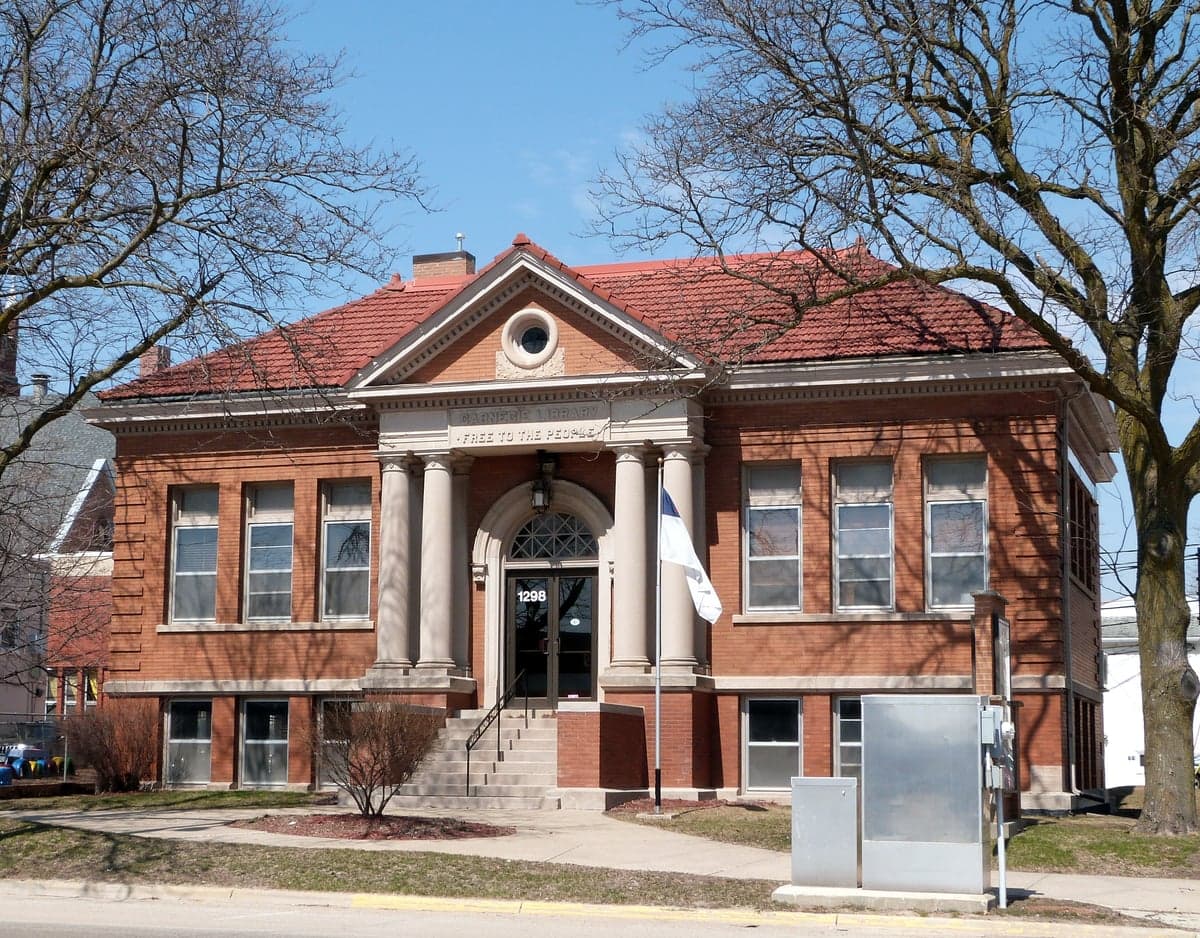
Photo: Wikipedia
Demographics of Marion, IA
Affluence Level in Marion, IA
A middle-class area roughly in line with national averages across income, home values, education, and employment.
People of Marion, IA
The people of Marion, Iowa, today form a predominantly white, family-oriented community of 41,690 residents, characterized by a notably low foreign-born population of just 1.5% and a college attainment rate of 39.2%. The city’s identity is rooted in its historic small-town core and expanding suburban neighborhoods, attracting families and professionals seeking proximity to Cedar Rapids without urban density. Distinctive markers include a strong sense of local pride centered on Uptown Marion, a high rate of homeownership, and a demographic profile that remains less diverse than the national average, with 88.6% of residents identifying as white alone.
How the city was settled and grew
Marion was founded in 1839 as the county seat of Linn County, drawing its earliest settlers—primarily Yankee migrants from New England and upstate New York—via the Military Road and later the railroad. These original families, many of whom were farmers and merchants, built the city’s first homes in what is now the Uptown Marion Historic District, a compact grid of brick and frame houses centered on 7th Avenue. A second wave arrived in the late 19th century, composed of German and Irish immigrants who worked in the area’s growing milling and agricultural industries. These groups settled in the Bowman Woods area and along the railroad corridor near 10th Street, establishing Catholic and Lutheran parishes that remain active today. By 1900, Marion’s population had reached roughly 2,500, and the city’s character as a quiet, church-going, civic-minded community was firmly set.
Modern era (post-1965)
The post-1965 period brought suburban expansion rather than international migration. The 1965 Hart-Cellar Act had minimal impact on Marion; the city’s foreign-born share remains at 1.5%, far below the national average. Instead, domestic in-migration from other parts of Iowa and the Midwest drove growth, particularly after the 1980s farm crisis pushed rural families toward urban employment. New subdivisions such as Indian Creek Crossing and Lovell Crossing absorbed these domestic migrants, who were overwhelmingly white and middle-class. The city’s Hispanic population, now 3.2%, began growing in the 1990s, concentrated in the West Marion area near Highway 151, largely employed in construction and service industries. The Black population (2.7%) and East/Southeast Asian community (1.0%) are small but present, with Asian families notably clustered near the Oakbrook neighborhood, drawn by newer housing stock and access to the Linn-Mar Community School District. The Indian-subcontinent population (0.8%) is a recent, professional cohort, many working in healthcare and technology in Cedar Rapids, and tends to settle in the Stone Bridge subdivision. Overall, Marion’s modern growth has been driven by domestic white families seeking good schools and lower taxes, not by international immigration.
The future
Marion’s population is projected to continue growing steadily, reaching an estimated 45,000–48,000 by 2040, driven by annexation of surrounding farmland and new housing developments. The city is not homogenizing into a single bloc but is instead tribalizing into distinct enclaves: established families remain in Uptown and Bowman Woods, while newer subdivisions like Stone Bridge attract younger professionals and a modestly more diverse mix. The Hispanic and East/Southeast Asian communities are growing slowly but steadily, with no signs of rapid acceleration; the foreign-born share is likely to remain below 3% for the next decade. The Indian-subcontinent population, while small, is the fastest-growing minority group, drawn by tech and medical jobs in the Cedar Rapids metro. The city is not experiencing the ethnic enclave formation seen in larger metros; instead, these groups are assimilating into predominantly white neighborhoods. The biggest demographic shift will be aging: the 65+ cohort is expected to rise from roughly 18% to 25% by 2040, as the large baby-boom generation ages in place.
Marion is becoming a more affluent, older, and slightly more diverse version of its current self—still overwhelmingly white and family-oriented, but with a growing professional class and a small but visible minority presence. For someone moving in now, the city offers stable property values, strong schools, and a low-crime environment, but little ethnic or cultural diversity outside the white mainstream. The next 20 years will likely see continued suburban expansion, a modest uptick in Asian and Hispanic residents, and a gradual shift toward a more age-diverse population, but no fundamental change to Marion’s core character as a safe, conservative-leaning Midwestern suburb.

* Values derived from national, state, county, city and local statistics and may differ in a specific area. Last updated: 2026-04-30T03:18:36.000Z
Narrative content on this page is AI-generated and may contain mistakes. Verify any details that matter before acting on them.
ReloMaps may earn a commission from affiliate links at no extra cost to you.

