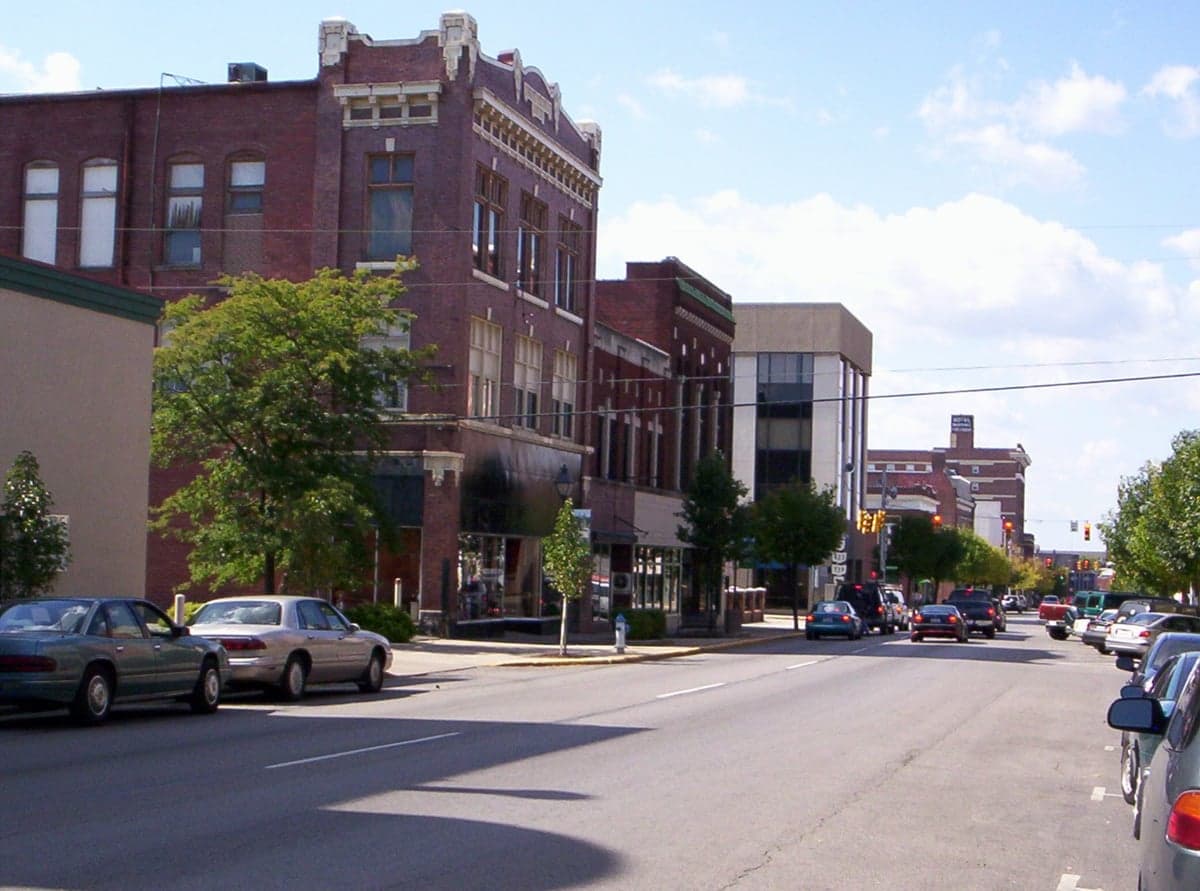
Photo: Wikipedia
Demographics of Marion, OH
Affluence Level in Marion, OH
A low-income area with significant economic hardship. Household wealth and educational attainment are well below national averages.
People of Marion, OH
The people of Marion, Ohio today form a predominantly white, working-class community of 35,771 residents, marked by a strong manufacturing heritage and a notably low foreign-born population of just 0.8%. The city’s character is shaped by its legacy as a union-era industrial hub, with a population that is 79.4% white, 8.8% Black, and 4.6% Hispanic, and a college attainment rate of only 10.1%—well below national averages. Distinctive identity markers include a deep-rooted sense of local pride tied to the Harding Memorial and the Marion Star, alongside a demographic stability that has seen little recent immigration-driven change.
How the city was settled and grew
Marion was originally settled in the early 1820s by pioneers of English and German descent, drawn by the fertile farmland along the Olentangy River and the promise of the newly surveyed U.S. land grants. The city’s real growth began after the Civil War, when the arrival of the railroad and the discovery of natural gas in the 1880s sparked an industrial boom. The Marion Steam Shovel Company (later Marion Power Shovel) became the city’s economic engine, attracting waves of European immigrants—primarily German, Irish, and Polish—who built the working-class neighborhoods of East Park and Southland. These areas, characterized by modest frame houses and proximity to the factories, remain the historic heart of Marion’s white ethnic communities. By the early 20th century, the city also saw a small but established Black population, concentrated in the Fairpark neighborhood near the rail yards, drawn by industrial jobs during the Great Migration.
Modern era (post-1965)
Following the 1965 Hart-Cellar Act, Marion experienced minimal international immigration—its foreign-born share today is a mere 0.8%, far below the national average. Instead, the post-1965 era was defined by domestic in-migration from rural Ohio and Appalachia, as white families moved into neighborhoods like Oakland and West Center seeking factory work at the Whirlpool plant and other manufacturers. The Black population, which grew to 8.8% by 2020, remained largely concentrated in the Fairpark and East Park areas, reflecting persistent residential patterns. The Hispanic population (4.6%) is a more recent addition, with families settling in the Southland district, often working in agriculture-related industries or service jobs. The East/Southeast Asian share (0.3%) and Indian subcontinent share (0.1%) are negligible, with no distinct ethnic enclaves forming. Suburbanization after 1970 drew some middle-class white families to outlying townships, but Marion’s core neighborhoods retained their working-class, racially defined boundaries.
The future
Marion’s population is projected to remain stable or decline slightly, with no major influx from immigration or domestic migration expected. The city is not homogenizing into a single identity; rather, it is tribalizing along existing racial and economic lines, with Fairpark and East Park remaining predominantly Black and white working-class, respectively. The Hispanic community in Southland is slowly growing but remains a small share. The foreign-born population is unlikely to rise significantly given the lack of refugee resettlement programs or major employers attracting skilled immigrants. The next 10–20 years will likely see an aging white population, with younger residents leaving for college and not returning, while the Black and Hispanic shares may inch upward through higher birth rates. The city’s low college attainment rate (10.1%) suggests limited attraction for knowledge-economy workers, reinforcing its blue-collar character.
Marion is becoming a more racially diverse but still overwhelmingly white, low-immigration, working-class city—a place where neighborhood identities remain tied to historic settlement patterns. For someone moving in now, this means a community with strong local roots, limited ethnic variety, and a demographic trajectory that favors stability over transformation. The practical reality is a city where your neighbors are likely to be multi-generational Ohioans, and where the cultural and economic landscape is shaped more by the past than by new arrivals.

* Values derived from national, state, county, city and local statistics and may differ in a specific area. Last updated: 2026-04-21T18:52:28.000Z
Narrative content on this page is AI-generated and may contain mistakes. Verify any details that matter before acting on them.
ReloMaps may earn a commission from affiliate links at no extra cost to you.

