
Photo: Wikipedia
Political ClimatePolitical Climate in Marion, OH
District shown is the primary district for this city’s centroid. Cities may span multiple districts.
Local Political AnalysisPolitical Analysis of Marion, OH
Marion, Ohio, has long been a solidly conservative community, and the numbers back that up with a Cook PVI of R+18, meaning the area votes about 18 points more Republican than the national average. That’s not just a statistic—it’s a reflection of the values you’ll find in the grocery store, at the high school football game, and around the dinner table. The political lean here is deeply rooted in a belief in personal responsibility, limited government, and a healthy skepticism of federal overreach. While the surrounding counties like Delaware and Union have seen some demographic shifts and a slight drift toward suburban moderation, Marion County has held its ground, with most local elections going to candidates who prioritize fiscal restraint and individual liberties over expanding government programs.
How it compares
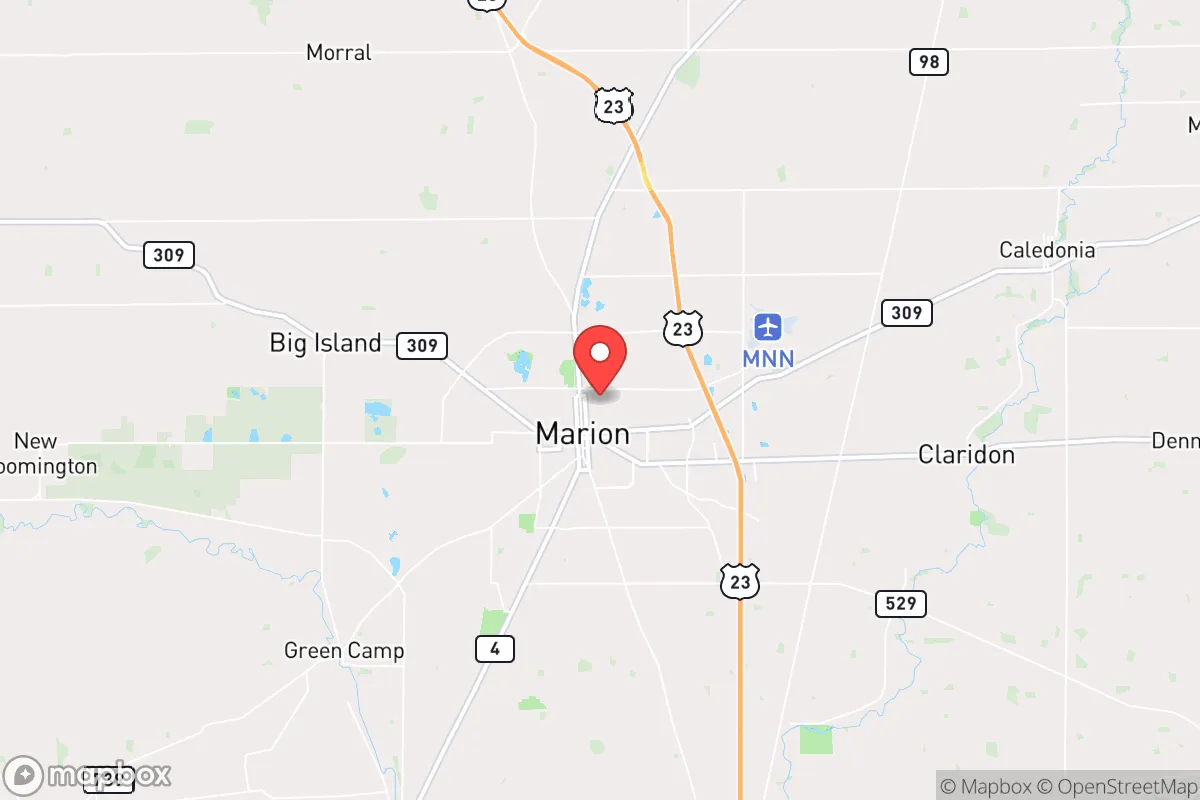
If you drive 30 minutes south to Delaware, you’ll notice a different vibe—more transplants from Columbus, more yard signs for moderate Democrats, and a general acceptance of progressive social policies. Marion, by contrast, feels like a time capsule of traditional Midwestern conservatism. Neighboring towns like Caledonia and Morral are even more rural and tend to vote even further right, while Marion itself is the county’s population center and still leans heavily Republican. The contrast is stark: in 2024, Marion County voted for the Republican presidential candidate by a margin that dwarfed the statewide average, while Delaware County, though still red, showed more purple streaks. For someone who values limited government, Marion’s consistency is reassuring—it’s a place where you don’t feel like your voice is drowned out by coastal-style politics.
What this means for residents
For folks living here, the political climate translates directly into daily life. You won’t see the kind of government overreach that’s become common in blue states—no mask mandates that drag on for years, no heavy-handed business closures, and no local officials trying to dictate what you can or can’t do with your property. The county commission and city council have generally resisted the urge to adopt progressive policies like sanctuary city status or defunding the police, which is a big deal for residents who value public safety and local control. That said, there’s always a concern about creeping influence from the state level, especially as Columbus pushes for more regional planning and environmental regulations that could trickle down. Long-term residents remember when Marion was even more hands-off, and there’s a quiet worry that the next generation might be more open to the kind of government expansion that erodes personal freedoms.
One cultural distinction worth noting is the strong presence of faith-based organizations and veteran groups, which anchor the community’s conservative ethos. You’ll find that local schools still emphasize traditional values, and there’s a general resistance to the kind of curriculum changes that have sparked debates elsewhere. The political climate here isn’t just about voting—it’s about a way of life that prioritizes self-reliance and community over bureaucracy. If you’re looking for a place where your rights are respected and the government stays out of your business, Marion is a solid bet. But keep an eye on the long-term trends: as younger families move in from more liberal areas, the political landscape could shift, and that’s something worth watching for anyone who values the conservative foundation that’s made this area what it is.

State Political ClimatePolitical Climate in Ohio
State Political AnalysisPolitical Environment in the State
Ohio has long been the quintessential bellwether state, but over the past decade its political center of gravity has shifted noticeably rightward, even as its national electoral importance has waned. The state now leans solidly Republican at the state level, with a GOP trifecta controlling the governorship, state House, and state Senate, and a 2024 presidential margin that saw Donald Trump win by over 11 points. This wasn't always the case—Ohio voted for Barack Obama twice and was a true swing state as recently as 2012—but a combination of deindustrialization, suburban realignment, and a steady outflow of urban Democratic voters has cemented a conservative coalition that dominates from the Ohio River to Lake Erie.
Urban vs. rural divide
The political map of Ohio is a stark study in contrasts. The state's three major metros—Cleveland, Columbus, and Cincinnati—are Democratic strongholds, but they are increasingly isolated islands of blue in a sea of red. Cuyahoga County (Cleveland) and Franklin County (Columbus) together account for nearly all of the state's Democratic vote share, while Hamilton County (Cincinnati) has become a competitive suburban battleground. Outside these urban cores, the story is overwhelmingly Republican. The sprawling exurbs of Delaware County (north of Columbus) and Warren County (north of Cincinnati) are among the most reliably GOP counties in the nation, with margins exceeding 60% in recent cycles. Meanwhile, the rural Appalachian counties in the southeast—places like Muskingum County and Belmont County—have flipped from blue-dog Democratic to deep red over the last two decades, driven by cultural conservatism and frustration with national Democratic policies on energy and trade. The result is a state where Republicans can lose the popular vote in a close presidential race but still hold supermajorities in the legislature thanks to aggressive gerrymandering.
Policy environment
Ohio's policy environment is broadly favorable to conservatives, though not without its frustrations. The state has a flat income tax rate of 3.5% (down from a top rate of nearly 5% a decade ago), and the GOP legislature has been steadily phasing out the state's business tax on gross receipts. Property taxes are a mixed bag—they're assessed at the county level and can be high in districts with good schools, but there is no state-level property tax. On education, Ohio has one of the most robust school choice programs in the Midwest, including a universal voucher system (the EdChoice program) that allows families to use state funding for private or religious schools. This has been a major win for parental rights and has driven enrollment growth in suburban and rural private schools. Healthcare policy is more mixed: the state expanded Medicaid under the Affordable Care Act in 2014, a decision that remains controversial among conservatives, but there has been no push for a state-level public option. Election laws have tightened in recent years, with voter ID requirements and stricter absentee ballot rules passed in 2023, though the state still allows no-excuse early voting. On the whole, Ohio's policy environment is one of incremental conservative reform, with a focus on tax reduction and school choice, but it has not yet embraced the kind of sweeping deregulation seen in states like Florida or Texas.
Trajectory & freedom
Ohio's trajectory on personal freedom is a mixed bag, and this is where the state's conservative credentials get complicated. On the positive side, Ohio has become a national leader in Second Amendment rights. In 2022, the state passed constitutional carry (permitless carry), allowing any law-abiding adult to carry a concealed firearm without a license or training. This was a major victory for gun rights advocates. On parental rights, the state passed the "Parents' Bill of Rights" in 2023, which requires schools to notify parents of any changes to a student's health or well-being and prohibits instruction on sexual orientation or gender identity in grades K-3. This law has been a flashpoint but is broadly popular with conservative families. However, there are concerning trends. In 2023, the state legislature passed a transgender youth ban (blocking puberty blockers and surgeries for minors), which was a win for social conservatives, but the same session saw a six-week abortion ban that was later overturned by a voter referendum in November 2023. That referendum—Issue 1—enshrined abortion rights in the state constitution, a major defeat for the pro-life movement and a sign that direct democracy can override the legislature. On medical freedom, Ohio has not passed any broad vaccine mandates, but it also hasn't passed any broad medical freedom protections like those seen in Idaho or Montana. The state's regulatory environment is improving—occupational licensing reforms have been modest—but it still lags behind the most free states in the South and West.
Civil unrest & political movements
Ohio has seen its share of political turbulence. The most visible flashpoint in recent years was the 2020 protests in Columbus and Cincinnati following the murder of George Floyd, which included property damage and clashes with police. These events accelerated the suburban realignment, with many moderate voters in places like West Chester and Mason (both in Warren County) moving decisively toward the GOP. On the right, the Ohio Freedom Alliance and local chapters of Moms for Liberty have been active in school board races and library board elections, particularly in the Cincinnati and Columbus suburbs. Immigration politics are less heated than in border states, but there have been localized controversies over refugee resettlement in Columbus's Somali community and the arrival of Haitian migrants in Springfield (Clark County), which has strained local services and fueled conservative backlash. Election integrity remains a live issue: the 2020 election saw no major fraud in Ohio, but the legislature has passed multiple bills to tighten voting procedures, and there is ongoing litigation over the state's voter roll maintenance practices. Overall, the political climate is one of active grassroots engagement on both sides, but the right has the institutional upper hand.
Projection
Looking ahead five to ten years, Ohio is likely to become more Republican at the state level but more competitive in presidential races due to demographic shifts. The in-migration pattern is a double-edged sword: retirees and remote workers are moving into the state's lower-cost rural and exurban areas, which tends to reinforce the GOP base, but the urban cores of Columbus and Cincinnati are growing faster than the rest of the state, driven by young professionals and immigrants. Columbus, in particular, is a Democratic growth engine that could eventually flip the state back to purple if trends continue. However, the state's gerrymandered legislative maps will likely keep the GOP in power for the foreseeable future. The biggest wildcard is the state's abortion politics: the 2023 Issue 1 victory for abortion rights has energized progressive voters, but it has also galvanized the pro-life movement to push for a new constitutional amendment to restrict the procedure. Expect continued ballot fights on this issue. For a conservative moving to Ohio, the bottom line is that the state offers a solid policy environment for families—good schools, low taxes, and strong Second Amendment protections—but it is not a libertarian paradise. The state government is active in regulating social issues, and the urban-rural divide means that your experience will vary dramatically depending on whether you settle in Dublin (a wealthy Columbus suburb that is trending purple) or Medina (a reliably red exurb of Cleveland).
For a new resident, the practical takeaway is this: Ohio is a state where conservative values are reflected in state law, but you'll need to be strategic about where you live. The suburbs of Cincinnati and Columbus offer the best balance of good schools, low crime, and Republican-friendly politics, while the rural counties offer the most freedom from government overreach. Avoid the urban cores unless you're comfortable with progressive governance and higher taxes. The state is trending in the right direction on taxes and school choice, but the fight over abortion and medical freedom is far from over. If you're looking for a place where your vote counts and your values are respected, Ohio is a solid bet—just don't expect it to be Texas or Florida anytime soon.
* Values derived from national, state, county, city and local statistics and may differ in a specific area. Last updated: 2026-04-21T18:52:28.000Z
Narrative content on this page is AI-generated and may contain mistakes. Verify any details that matter before acting on them.
ReloMaps may earn a commission from affiliate links at no extra cost to you.

