Photo: Wikipedia
Demographics of Marshalltown, IA
Affluence Level in Marshalltown, IA
A middle-class area roughly in line with national averages across income, home values, education, and employment.
People of Marshalltown, IA
Marshalltown, Iowa, is a city of 27,491 residents defined by its working-class roots and a striking demographic transformation over the past three decades. The population is now 56.0% White, 33.1% Hispanic, 5.0% East/Southeast Asian, and 2.0% Black, with a foreign-born share of 12.1% that is nearly triple the state average. This is a community where a historic Anglo-Germanic manufacturing base has been reshaped by sustained immigration from Latin America and Southeast Asia, creating a city that is both culturally diverse and economically grounded in meatpacking and industrial labor. Only 19.7% of adults hold a college degree, reflecting a blue-collar identity that remains central to daily life.
How the city was settled and grew
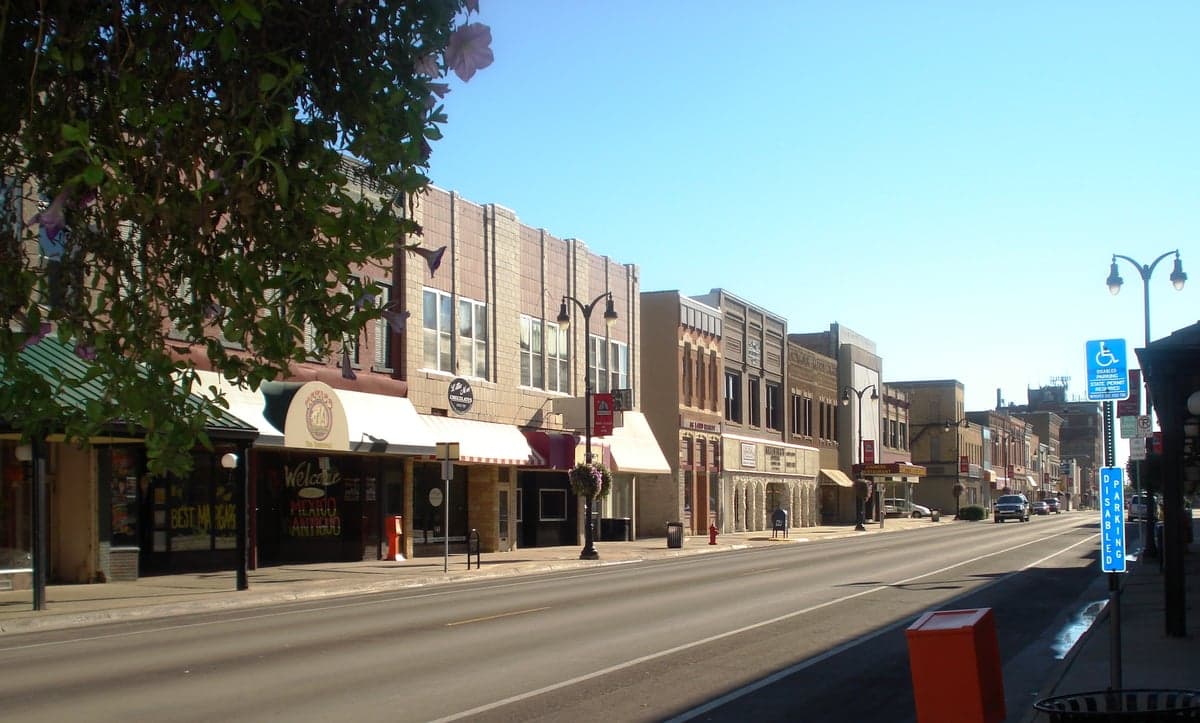
Marshalltown was founded in the 1850s as a railroad and agricultural hub on the Iowa River, drawing its earliest settlers from New England and the Mid-Atlantic states. The arrival of the Chicago and North Western Railway in the 1860s spurred growth, and by the late 19th century, German and Irish immigrants formed the backbone of the workforce in the city's brickyards, foundries, and grain mills. The historic Central Business District around Main Street and the North End neighborhood, with its Victorian-era homes, were built by these early Anglo and German families. A smaller wave of Danish and Swedish immigrants settled in the South Side near the railroad tracks, establishing Lutheran churches and mutual aid societies that persisted through the mid-20th century. By 1950, Marshalltown was overwhelmingly White and native-born, with a population of about 19,000.
Modern era (post-1965)
The Immigration and Nationality Act of 1965 opened the door for new arrivals, but Marshalltown's modern demographic shift began in earnest in the 1980s and 1990s, driven by the expansion of the Swift & Company (now JBS USA) pork processing plant on the city's eastern edge. The plant's demand for labor attracted a large wave of Mexican and Central American immigrants, who settled primarily in the East Side and South 6th Street corridor, areas that now contain the highest concentration of Hispanic-owned businesses and Spanish-language signage. A second significant wave came from Southeast Asia after the Vietnam War: Hmong and Lao refugees arrived in the 1980s, followed by a smaller number of Burmese and Karen families in the 2000s. These East/Southeast Asian communities concentrated in the West End and around 13th Street, near the Marshalltown Community School District's elementary schools. The White population, which was over 90% in 1980, has declined in absolute numbers as older residents have aged out or moved to suburban areas like Albion and State Center, while the Hispanic share has risen from under 5% in 1990 to 33.1% today. The Black population remains small at 2.0%, and the Indian subcontinent population is negligible at 0.1%.
The future
Marshalltown's population is trending toward a Hispanic majority, likely within the next 10–15 years, as the White cohort continues to age and the Hispanic cohort is younger and has higher birth rates. The East/Southeast Asian population, at 5.0%, appears stable but not rapidly growing, as refugee resettlement has slowed and second-generation families often move to larger cities like Des Moines for broader economic opportunities. The city is not homogenizing into a single culture; rather, it is tribalizing into distinct enclaves, with the East Side and South 6th Street corridor remaining heavily Hispanic, the West End retaining a Hmong and Lao presence, and the North End and Central Business District staying predominantly White and older. The foreign-born share of 12.1% is likely to plateau or decline slightly as immigration enforcement tightens and the meatpacking industry automates, but the Hispanic share will continue to rise through natural increase. For a newcomer, this means a city where Spanish is increasingly heard in public spaces, where the school district is majority-minority, and where the civic identity is still being negotiated between a fading Anglo past and a rising Latino future.
Marshalltown is becoming a majority-minority, working-class city anchored by a single industry, with a demographic trajectory that mirrors other Midwestern meatpacking towns like Storm Lake and Denison. For a conservative-leaning individual or family moving in, the practical reality is a community where traditional institutions—churches, the county fair, the VFW—still operate, but where daily life increasingly involves cross-cultural interaction, especially in schools and retail. The city's future depends on whether these distinct ethnic enclaves can integrate economically and socially, or whether they remain parallel communities. The next decade will tell.

* Values derived from national, state, county, city and local statistics and may differ in a specific area. Last updated: 2026-04-30T01:22:21.000Z
Narrative content on this page is AI-generated and may contain mistakes. Verify any details that matter before acting on them.
ReloMaps may earn a commission from affiliate links at no extra cost to you.

