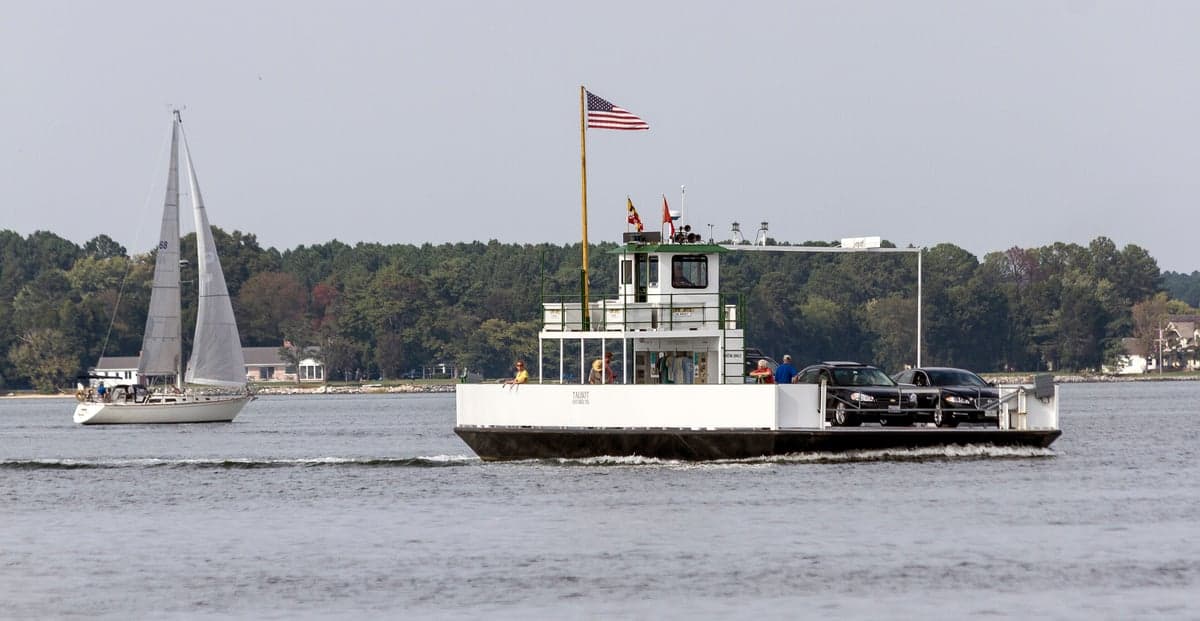
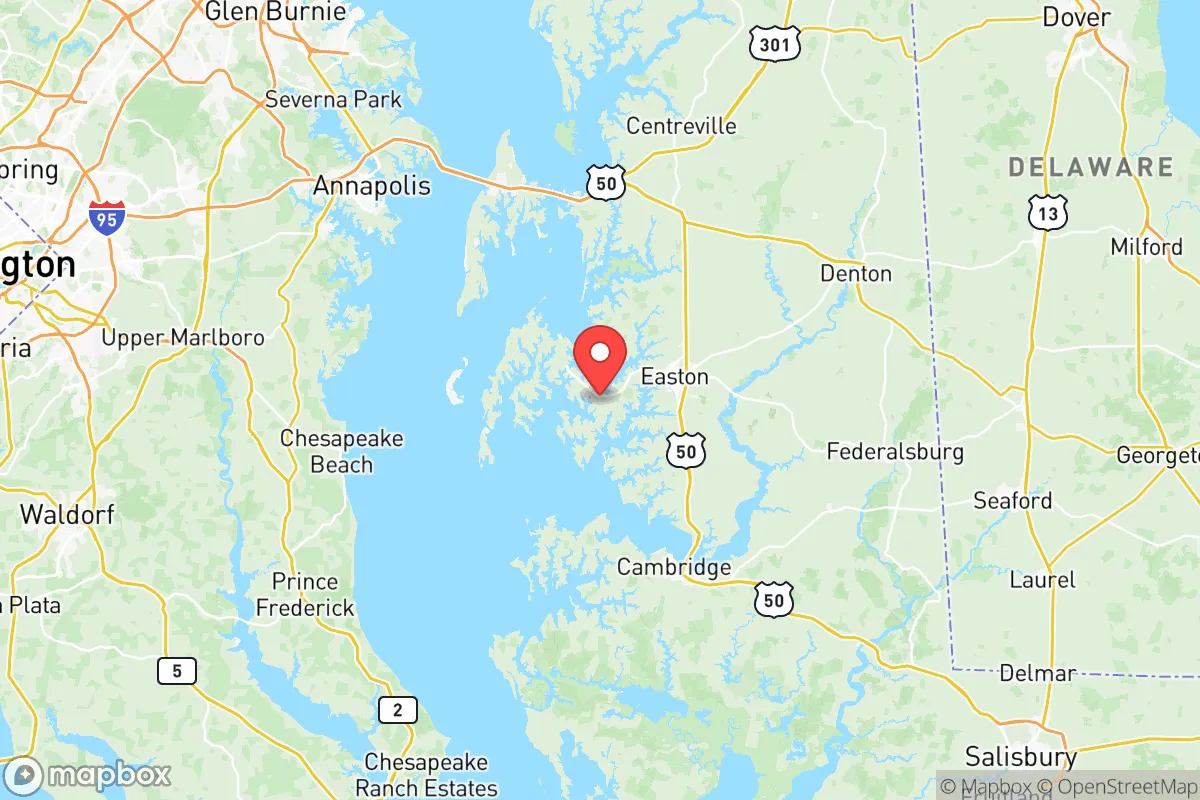
Photo: Wikipedia
Personal Sovereignty in Talbot County
Viable for self-reliance. Generally workable, though some barriers may limit total independence.
What does Personal Sovereignty tell us?
Personal Sovereignty measures your capacity for self-reliance and independence with minimal government friction. Higher scores mean fewer barriers between you and the way you want to live... but it assumes you have the space you need and good neighbors.
What does this tell us?
Personal Sovereignty measures your capacity for self-reliance and independence with minimal government friction. Higher scores mean fewer barriers between you and the way you want to live... but it assumes you have the space you need and good neighbors.
State Policy
Energy independence: Importer (8% of energy produced in-state)
Personal Liberty
Homesteading

Personal Liberty Analysis
Talbot County, Maryland, offers a notably higher degree of personal sovereignty than much of the Washington D.C. and Baltimore orbit, but it operates within the constraints of a state with a strong regulatory tradition. For the freedom-minded individual or family, the county provides a meaningful buffer from the most intrusive state-level policies, particularly in its rural and small-town communities like Easton, St. Michaels, and Oxford, where local governance tends to be more hands-off than in the state capital. However, the autonomy environment is best described as a "pragmatic independence" — residents enjoy significant personal liberty in daily life, but must navigate Maryland's broader tax and regulatory framework, which is not as light-touch as in states like Texas or Florida.
Tax burden and regulatory posture in Talbot County
Maryland's state-level tax burden is among the highest in the nation, and Talbot County residents feel this directly. The state income tax ranges from 2% to 5.75%, and the county adds its own local income tax of 2.4% (the county rate as of 2026), bringing the combined top marginal rate to approximately 8.15%. Property taxes are moderate for the region: the county rate is roughly $0.63 per $100 of assessed value, with additional town taxes in Easton (around $0.28) and St. Michaels (around $0.22), making the effective rate in those towns about $0.85-$0.91 per $100. The regulatory posture is mixed: Talbot County has a relatively permissive approach to land use in its unincorporated areas, but the Maryland Department of the Environment and Critical Area Commission impose strict rules on development within 1,000 feet of tidal waters, which covers much of the county's most desirable waterfront property. For a relocation reader, the key takeaway is that while the tax burden is real, the regulatory environment for non-waterfront properties in towns like Trappe and Cordova is significantly lighter than in more urbanized Maryland counties.
Self-defense and gun law specifics in Talbot County
Maryland is a "may-issue" state for concealed carry permits, but the 2022 Supreme Court decision in New York State Rifle & Pistol Association v. Bruen forced the state to adopt a "shall-issue" standard. As of 2026, Talbot County residents can obtain a concealed carry permit through the Maryland State Police, but the process remains more burdensome than in constitutional carry states: applicants must complete a 16-hour training course, submit fingerprints, and pay a fee of roughly $75 for the initial application plus $50 for fingerprinting. The county itself is relatively gun-friendly — the Talbot County Sheriff's Office has historically been supportive of Second Amendment rights, and there are no local ordinances restricting firearms beyond state law. Open carry is legal but rarely practiced, and the state's ban on "assault weapons" (defined by a 2013 law) applies uniformly across the county. For practical self-defense, residents in Easton and St. Michaels can legally carry in most public places, but must avoid sensitive locations like schools, government buildings, and establishments that serve alcohol. The overall environment is one of lawful compliance with state mandates, but without the additional local hostility found in more urban Maryland jurisdictions.
Self-reliance and homesteading viability in Talbot County
Talbot County offers genuine opportunities for self-reliant living, particularly in its rural eastern and southern reaches. Zoning in unincorporated areas allows for agricultural and residential uses on parcels as small as 1 acre in some districts, though the county's Agricultural Preservation Program has kept many large tracts intact. In towns like Cordova and Trappe, residents can find 2-5 acre lots suitable for substantial gardens, small livestock, and even hobby farms, with the county's Right-to-Farm law protecting agricultural operations from nuisance complaints. Off-grid feasibility is limited by Maryland's building codes, which require connection to the electrical grid for new construction in most areas, though solar panels with net metering are permitted and increasingly common. Rainwater collection is legal for non-potable uses, but well and septic systems must meet state health department standards, which can be costly. The county's soil quality is excellent for gardening, and the growing season runs from April to October, making food self-sufficiency a realistic goal for committed homesteaders. However, residents in the historic districts of Easton and St. Michaels face stricter historic preservation rules that can limit modifications to older homes, so those seeking maximum self-reliance should focus on the unincorporated areas.
Personal liberties in Talbot County: parental rights, medical autonomy, speech, and property
Parental rights in Talbot County are generally respected, with the local school system (Talbot County Public Schools) maintaining a policy of parental notification for health services and curriculum opt-outs, though Maryland state law mandates comprehensive sex education and LGBTQ-inclusive policies that some conservative families find objectionable. Medical autonomy is constrained by state-level mandates: Maryland has a vaccine requirement for school attendance (with medical and religious exemptions available), and the state's COVID-19 emergency orders have expired, leaving no current mandates. Free speech is robustly protected in the county, with no local ordinances restricting public expression beyond state trespass laws. Property rights are a mixed bag: the county's zoning code is relatively permissive for residential uses, but the Critical Area Commission imposes strict limits on development near waterways, and the county's Historic Preservation Commission in Easton and St. Michaels can deny permits for exterior modifications to historic structures. For the freedom-minded reader, the key distinction is between the unincorporated areas (where property rights are strongest) and the historic towns (where preservation rules apply). Overall, Talbot County offers a solid baseline of personal liberties, but residents must accept Maryland's state-level framework on medical and educational issues.
Compared to other areas in the Mid-Atlantic, Talbot County stands out as a relatively high-sovereignty enclave within a blue state. It offers a better autonomy environment than Montgomery or Prince George's counties, but falls short of the personal freedom found in rural Pennsylvania or Virginia counties like Frederick or Augusta. For the conservative-leaning individual or family who values self-reliance and is willing to navigate Maryland's tax and regulatory structure, Talbot County provides a viable compromise: genuine homesteading opportunities, a gun-friendly culture, and a local government that largely respects personal liberty, all within a beautiful Chesapeake Bay setting. The county's best fit is for those who prioritize community and land over maximal legal freedom, and who are comfortable operating within a state framework that is more regulatory than the Sun Belt but less intrusive than the urban Northeast.

* Values derived from national, state, county, city and local statistics and may differ in a specific area. Last updated: 2026-08-09T12:32:40.000Z
Narrative content on this page is AI-generated and may contain mistakes. Verify any details that matter before acting on them.
ReloMaps may earn a commission from affiliate links at no extra cost to you.

