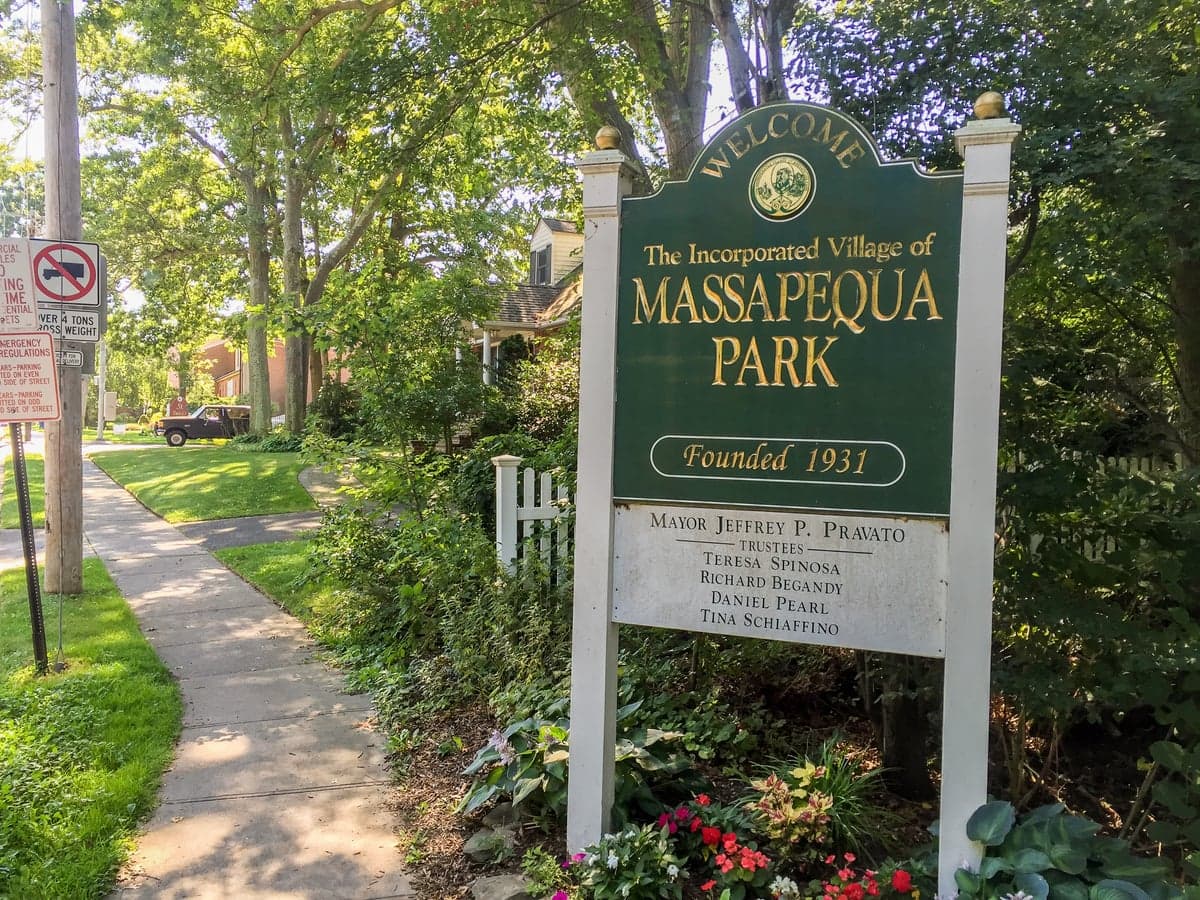
Photo: Wikipedia
Demographics of Massapequa Park, NY
Affluence Level in Massapequa Park, NY
An upper-middle-class area. Household wealth, education levels, and homeownership run ahead of national benchmarks.
People of Massapequa Park, NY
Massapequa Park, New York, is a predominantly white, middle-to-upper-middle-class village of 16,985 residents, characterized by a high rate of college attainment (53.7%) and a very low foreign-born share (0.7%). The population is overwhelmingly non-Hispanic white (88.8%), with a Hispanic minority of 4.7%, small East/Southeast Asian (1.3%) and Indian subcontinent (0.5%) communities, and a negligible Black population (0.5%). The village projects a stable, family-oriented character rooted in its post-war suburban identity, with little of the ethnic turnover seen in neighboring Long Island communities.
How the city was settled and grew
Massapequa Park was not a colonial settlement; its development is almost entirely a 20th-century story. The area was originally part of the larger Massapequa patent granted to English settlers in the late 1600s, but remained sparsely populated farmland and marshland through the 1800s. The real population wave began after the South Shore Railroad reached the area in the 1860s, drawing wealthy New York City families to build summer estates along the waterfront. The core of this early seasonal population clustered around the Massapequa Park station area and the shores of South Oyster Bay, where large homes were built on former potato fields.
The decisive growth surge came after World War II. Levitt & Sons and other builders transformed the remaining farmland into mass-produced housing for returning GIs and their families. The village was officially incorporated in 1931, but the population exploded in the 1950s and 1960s as working- and middle-class families—overwhelmingly of Italian, Irish, and German Catholic descent—moved from Brooklyn and Queens into new developments like the "Lido" section (the area south of Sunrise Highway) and the Biltmore Shores neighborhood near the water. These families were drawn by affordable single-family homes, good schools, and the promise of suburban safety. By 1970, the village was nearly entirely white and native-born, a character it has largely retained.
Modern era (post-1965)
Unlike many Long Island suburbs, Massapequa Park did not experience significant demographic transformation after the 1965 Hart-Cellar Act. The foreign-born population remains exceptionally low at 0.7%, and the white share has declined only modestly from near-totality in 1980 to 88.8% today. The village has not been a destination for new immigrant communities; instead, its population has been shaped by internal migration and generational turnover. The small Hispanic population (4.7%) is concentrated in the northern section near the Massapequa Park border, closer to the more diverse commercial corridor along Sunrise Highway. The East/Southeast Asian community (1.3%) and Indian subcontinent community (0.5%) are scattered, with no single ethnic enclave, though some families have settled in the Biltmore Shores area for its waterfront access and larger lots.
The dominant trend since 1990 has been the aging of the original post-war generation and the gradual replacement of their children with new families from elsewhere on Long Island or from New York City. These newcomers are also predominantly white and native-born, maintaining the village's demographic continuity. The high college attainment rate (53.7%) reflects the professionalization of the population—many residents now commute to white-collar jobs in Manhattan or Nassau County's tech and healthcare sectors, rather than the blue-collar trades that defined the 1950s wave.
The future
Massapequa Park's population is likely to remain stable and demographically homogeneous over the next 10–20 years. The village shows no signs of becoming a destination for immigrant communities, given its high housing costs (median home values well above $500,000) and lack of rental stock. The small Hispanic and Asian populations may grow incrementally through natural increase and a trickle of new arrivals, but the foreign-born share is unlikely to rise above 2–3%. The primary demographic shift will be generational: as the remaining post-war cohort passes away, their homes will be bought by younger families—again, predominantly white and college-educated—who value the school district and low crime rates.
The village is not tribalizing into distinct ethnic enclaves; rather, it is homogenizing around a stable, affluent, white identity. The Lido section and Biltmore Shores will likely remain the most desirable and expensive areas, while the northern border zone may see slightly more diversity as it remains the most affordable entry point.
For a conservative-leaning individual or family moving in now, Massapequa Park offers a predictable, low-turnover environment where the population is stable, well-educated, and culturally traditional. The village is not a place of rapid demographic change or ethnic vibrancy—it is a place where the population is quietly aging and being replaced by a similar demographic profile. The key trade-off is stability versus diversity: you will find a community that looks and votes much as it did in 1970, but with higher incomes and educational attainment.

* Values derived from national, state, county, city and local statistics and may differ in a specific area. Last updated: 2026-04-23T02:48:44.000Z
Narrative content on this page is AI-generated and may contain mistakes. Verify any details that matter before acting on them.
ReloMaps may earn a commission from affiliate links at no extra cost to you.

