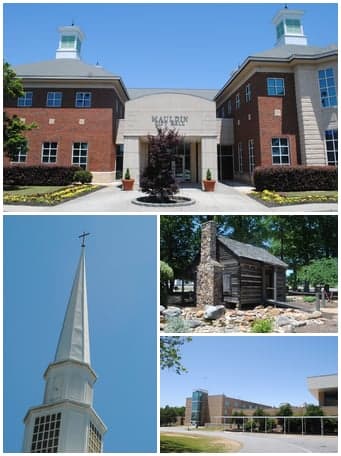
Photo: Wikipedia
Demographics of Mauldin, SC
Affluence Level in Mauldin, SC
A middle-class area roughly in line with national averages across income, home values, education, and employment.
People of Mauldin, SC
The people of Mauldin, South Carolina today number roughly 26,000, forming a dense, family-oriented suburb where White residents make up 59.1% of the population, Black residents 24.3%, and Hispanic residents 11.5%. The city is notably more diverse than many Upstate South Carolina towns, with a foreign-born population of 4.5% and a college-educated rate of 37.5% that reflects its role as a bedroom community for Greenville’s professional class. Mauldin’s identity is shaped by rapid late-20th-century growth, a strong sense of local schools and community events, and a population that is younger and more transient than the surrounding county average.
How the city was settled and grew
Mauldin was not a colonial-era settlement. The area was originally Cherokee hunting grounds, and European-American farmers arrived only after the Cherokee removal in the 1830s. The city’s true founding came in 1884 with the completion of the Atlanta and Charlotte Air Line Railway, which carved a station stop through the pine woods. The first wave of settlers were Scots-Irish and English farmers who established small cotton and timber operations. The original village clustered around the depot in what is now Old Mauldin, the historic core along East Butler Road. A second early node formed at the intersection of Main Street and Laurens Road, where a general store and post office anchored a handful of homes. These early residents were overwhelmingly White, Protestant, and agrarian, with a few Black families working as sharecroppers on surrounding farms. The population remained under 500 until the 1950s, when the construction of Interstate 85 and the expansion of Greenville’s textile mills drew the first significant in-migration of rural White families from the surrounding counties. These newcomers settled in the Mauldin Heights neighborhood, a modest grid of ranch homes built between 1955 and 1965 that remains a stable, predominantly White enclave today.
Modern era (post-1965)
The post-1965 era transformed Mauldin from a whistle-stop into a suburb. The Immigration and Nationality Act of 1965 had a modest direct effect here—Mauldin’s foreign-born share remains low at 4.5%—but the indirect effect was massive: the Sun Belt migration of domestic populations seeking jobs and lower costs. The 1970s and 1980s saw the first major wave of Black families moving to Mauldin from rural Greenville County and from the city of Greenville itself, drawn by newer housing stock and the desegregation of schools. These families concentrated in the Fox Run and Woodfield subdivisions, both developed between 1972 and 1985, where Black homeownership rates climbed steadily. The 1990s brought a surge of White professionals from the Northeast and Midwest, recruited by BMW’s 1992 plant opening in nearby Greer and by the expansion of Michelin’s North American headquarters in Greenville. These newcomers favored the Gilder Creek and Brookfield neighborhoods, large master-planned communities with golf courses and swim clubs that remain among the city’s most affluent areas. Hispanic growth began in the late 1990s, driven by construction and landscaping jobs tied to the suburban building boom. The Southridge area, a corridor of apartment complexes and townhomes along South Main Street, became the primary landing point for Hispanic families, many from Mexico and Central America. Today, the Hispanic share of 11.5% is the fastest-growing demographic segment, with a significant second-generation population now entering Mauldin’s schools. The Indian subcontinent community, at 1.9%, is a smaller but notable presence, concentrated among medical professionals at Prisma Health and engineers at nearby tech firms, with no single neighborhood majority but a visible cluster in the Ashmore Bridge area’s newer subdivisions.
The future
Mauldin’s population is heading toward greater diversity, but along distinct lines rather than wholesale integration. The White share has declined from roughly 75% in 2000 to 59.1% today, while the Hispanic and Black shares have risen. The city is not homogenizing; rather, it is tribalizing into identifiable enclaves. Old Mauldin and Mauldin Heights remain predominantly White and older, with aging homeowners and few new builds. Fox Run and Woodfield are solidly Black and middle-class, with strong neighborhood associations and stable property values. The Gilder Creek and Brookfield areas are majority White and affluent, with low turnover. Southridge is heavily Hispanic and renter-heavy, with a younger, more transient population. The Indian community is small but growing, likely to reach 3-4% by 2035 as medical and tech hiring continues. The next 10-20 years will likely see the Hispanic share rise to 15-18%, the Black share hold steady near 24%, and the White share drop below 55%. The city’s annexation of new subdivisions along the Woodruff Road corridor will accelerate this shift, as those developments attract a mix of White and Hispanic first-time homebuyers. For someone moving in now, Mauldin offers a choice of distinct communities: stable, older White neighborhoods; established Black subdivisions; newer, diverse master-planned areas; or the more transient, renter-heavy Hispanic corridor.
Mauldin is becoming a more diverse, more suburban, and more stratified city. The old image of a quiet White mill suburb is fading, replaced by a patchwork of ethnic and economic enclaves. For a conservative-leaning family or individual, the city offers strong schools, low crime relative to Greenville proper, and a range of neighborhoods that allow you to choose your level of diversity and transience. The key is knowing which neighborhood fits your priorities—and that choice is becoming more defined with each passing year.

* Values derived from national, state, county, city and local statistics and may differ in a specific area. Last updated: 2026-04-30T02:47:21.000Z
Narrative content on this page is AI-generated and may contain mistakes. Verify any details that matter before acting on them.
ReloMaps may earn a commission from affiliate links at no extra cost to you.

