Strategic Assessment of Mcalester, OK
Workable tactical position. Some exposure to population density or targets, but generally defensible in a crisis.
What does the Strategic Assessment tell us?
Our Strategic Assessment grades tactical survivability of an area. Major population centers, military targets, fallout zones, natural disasters, and border exposure all drive risk — lower exposure means a more defensible position in a crisis.
This is heavily inspired by Joel Skousen's Strategic Relocation book. Highly recommended you checkout the book ($)What does this tell us?
Our Strategic Assessment grades tactical survivability of an area. Major population centers, military targets, fallout zones, natural disasters, and border exposure all drive risk — lower exposure means a more defensible position in a crisis.
This is heavily inspired by Joel Skousen's Strategic Relocation book. Highly recommended you checkout the book ($)Strategic Pillars

Key Distances
Regional Safe Places
Below is our recommended "safe zones" in Oklahoma and the surrounding area based on our strategic heuristics. For most people, it's unrealistic to live in a “safe zone” full-time due to work, family or other personal reasons. They tend to be more rural. However, many of these areas are perfect for second homes and retreat properties that double as a vacation home or even a short-term rental.
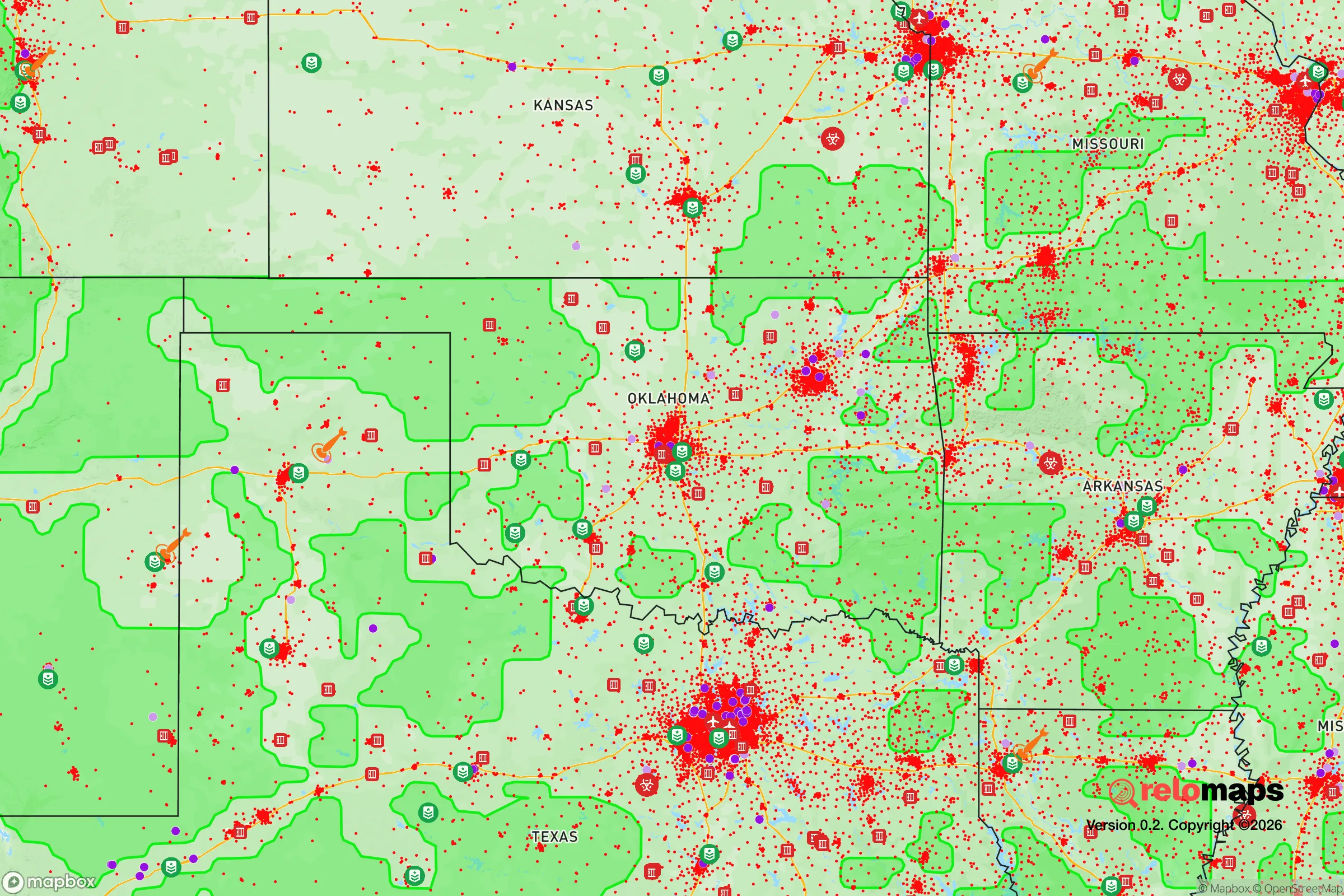
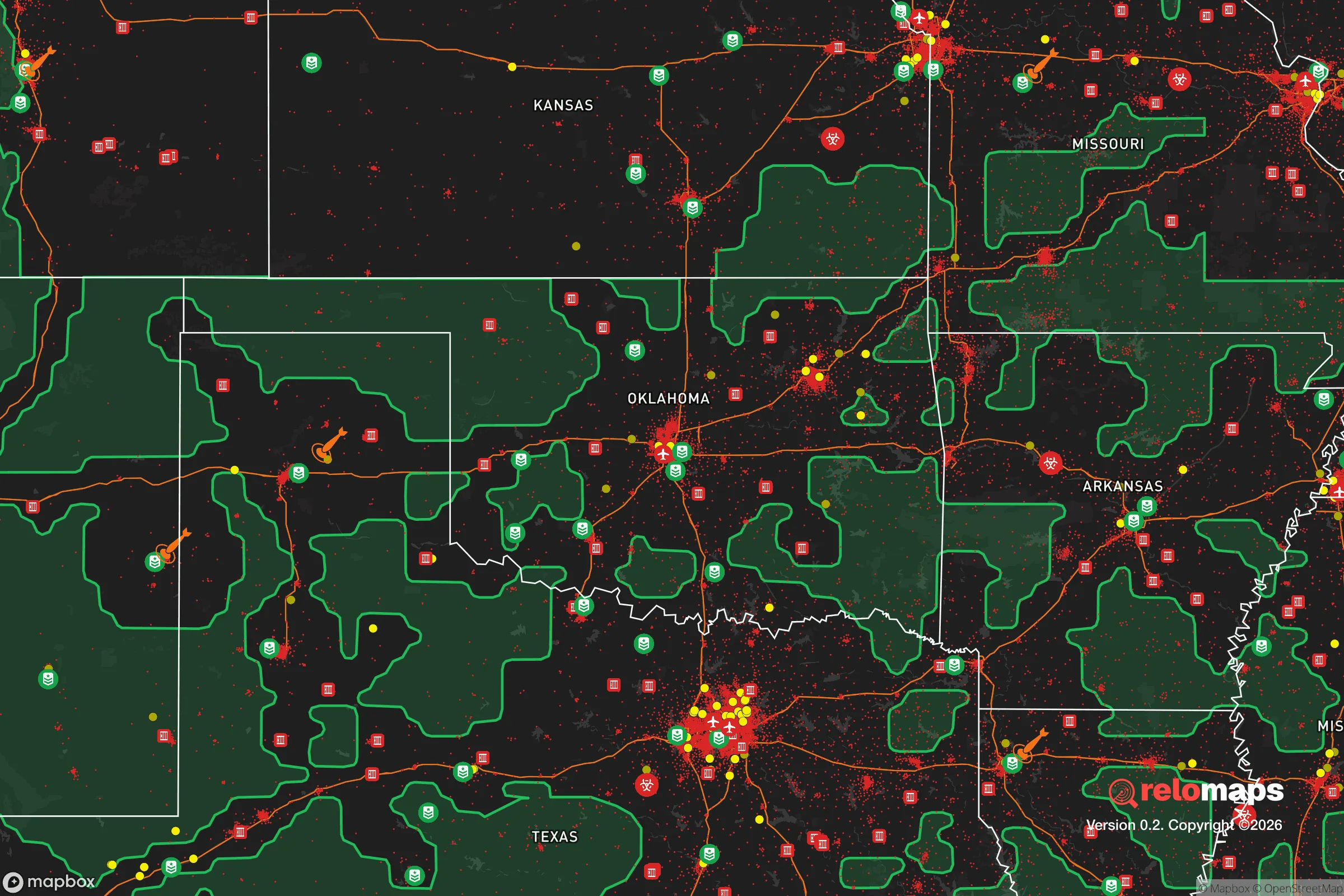


Important Note: For informational purposes only. This does not mean nothing bad ever happens in the green zones. Please use common sense. This is based on public data and modeled with AI. We tried to take a conservative approach but mistakes happen. We update this regularly as new information becomes available.
Solar Generator Recommendations
Backup power matters more here than in safer locations. We've picked three solar generators across budgets and capacity tiers — start with the budget unit if you only need a few essentials, or step up if you want to run a fridge and HVAC for days at a time.

Jackery Portable Power Station Explorer 300
Budget OptionPower on the Go: Weighing only 11 lbs, it's convenient to set up and store with book-sized foldable solar panels

BLUETTI Portable Power Station AC180
Designed for both indoor and outdoor scenarios, AC180 is highly capable as it has a robost capacity and continuous output power.

EF ECOFLOW DELTA Pro Ultra Power Station
Upgraded PickEcoFlow DELTA Pro Ultra is a whole-home energy system designed to grow with your family. Integrated with the Smart Home Panel 2, it scales to meet your evolving energy needs — keeping your home powered, intelligent, and secure through every stage of life.
We earn a commission, at no additional cost to you.
Strategic Assessment Analysis
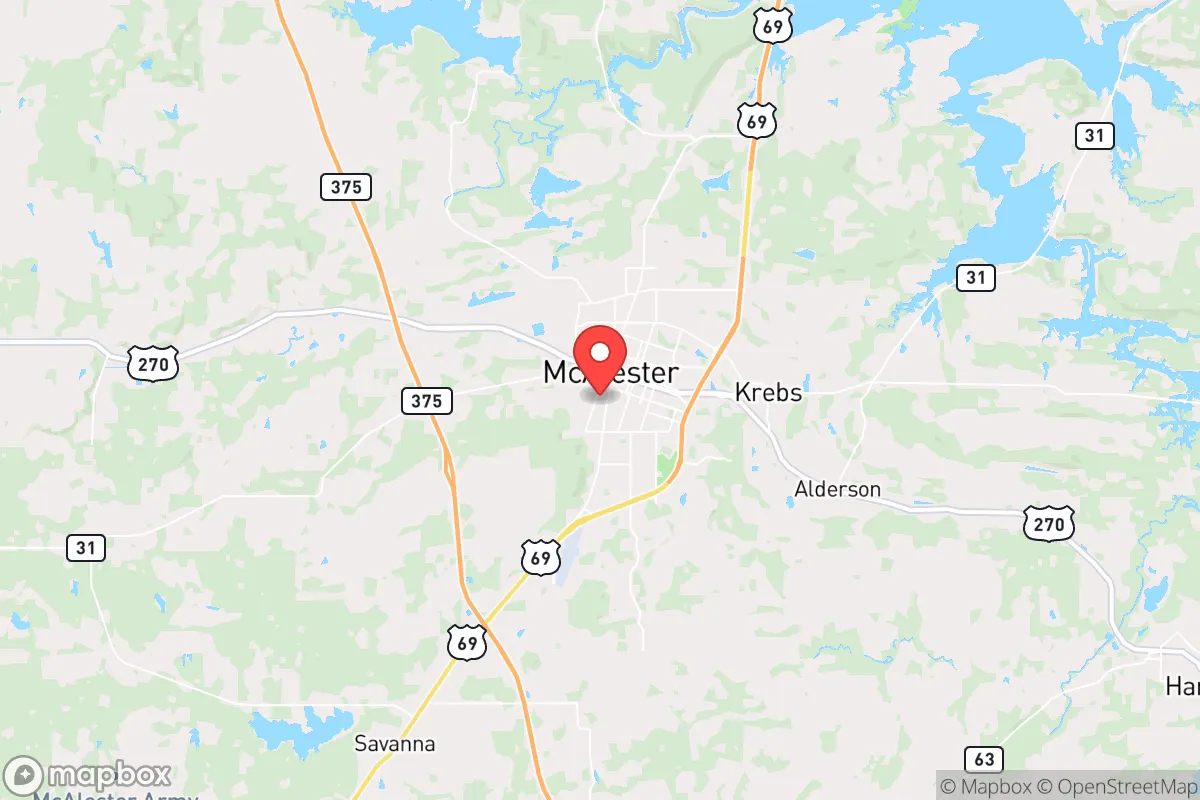
McAlester, Oklahoma, sits in a strategic sweet spot that resilience-minded relocators should take seriously. Its position roughly 90 miles south of Tulsa and 140 miles southeast of Oklahoma City places it far enough from major metro blast zones to avoid immediate fallout risks, yet close enough to access supply chains and medical infrastructure when things are stable. The city’s historic role as a railroad and coal hub gives it an industrial backbone that most small towns lack, and its location along the Indian Nation Turnpike and U.S. Highway 69 provides redundant road access in multiple directions. For someone thinking about long-term preparedness, McAlester offers a rare combination of isolation from the worst urban collapse scenarios and enough local economic heft to sustain a community through rough patches.
Geographic position and natural advantages for long-term security
McAlester sits in the rolling hills of southeastern Oklahoma, a region defined by the Ouachita Mountains to the east and the Kiamichi River watershed to the south. This terrain is a genuine asset for preppers: the hills and dense woodlands provide natural cover and defensible positions, while the region’s numerous creeks, rivers, and lakes — including Lake Eufaula just 20 miles north — offer reliable water sources. The area’s elevation, averaging around 750 feet, keeps it above the worst floodplains, and the local climate supports year-round gardening with a growing season of roughly 210 days. The soil in Pittsburg County is a mix of sandy loam and clay, workable for subsistence farming if you know what you’re doing. Timber is abundant — oak, hickory, and pine — meaning fuel and building materials are within reach without relying on distant supply chains. For a relocator, the key takeaway is that McAlester sits in a pocket of Oklahoma that’s less prone to the extreme weather events that hammer the western part of the state; tornado risk is moderate but not the constant threat you’d see in Moore or Woodward.
Risks, exposures, and proximity to fallout-relevant landmarks
The elephant in the room is the McAlester Army Ammunition Plant (MCAAP), a sprawling 45,000-acre facility just south of town that produces and stores conventional munitions for the U.S. military. This is a double-edged sword. On one hand, the plant is a major employer and brings federal infrastructure that keeps the local economy stable. On the other, it’s a high-value target in any conflict scenario — conventional or asymmetric. A direct strike or sabotage event at MCAAP would be catastrophic, potentially leveling a significant portion of the city and sending shockwaves through the region. The plant’s security is tight, but no facility of that size is invulnerable. Beyond that, McAlester is roughly 60 miles from the nearest interstate highway (I-40), which means large-scale evacuation or military movement could bottleneck on two-lane roads. The city’s proximity to the Choctaw Nation’s headquarters in Durant (about 70 miles south) adds a layer of tribal governance that could complicate federal response in a crisis. For the prepper, the calculus is simple: McAlester’s risks are concentrated and known — the ammo plant — rather than diffuse and unpredictable like the sprawl of a major metro. If you can accept that single-point vulnerability, the rest of the risk profile is manageable.
Practical resilience for a relocator: food, water, energy, and defensibility
McAlester’s practical resilience is where it shines for someone serious about self-sufficiency. The city sits atop the Arbuckle-Simpson aquifer, one of Oklahoma’s most reliable groundwater sources, and the local municipal water supply draws from Lake Eufaula and the Kiamichi River. For off-grid setups, well drilling is feasible in most of Pittsburg County, with typical depths between 100 and 300 feet. The region’s agricultural history means there’s a network of local farmers, ranchers, and feed stores that can supply seeds, livestock, and equipment without relying on big-box retailers. The McAlester Farmers Market operates year-round, and the surrounding county has a strong tradition of hunting — deer, turkey, and small game are plentiful. Energy-wise, the area is served by the Oklahoma Gas and Electric grid, but the prevalence of rural properties means solar and wind setups are common and permitted without excessive red tape. Wood heating is standard in many older homes, and the local hardware stores stock chainsaws, generators, and fuel storage tanks. Defensibility is a mixed bag: the town itself is relatively compact and walkable, with a grid layout that’s easy to patrol, but the surrounding rural areas offer better concealment and natural barriers. The local law enforcement presence is modest — Pittsburg County has about 40 deputies for a population of 44,000 — so community self-reliance is the norm, not the exception. For a relocator, the practical takeaway is that McAlester has the infrastructure to support a semi-independent lifestyle without requiring you to go full hermit in the mountains.
The overall strategic picture for McAlester is one of calculated trade-offs. It’s not a remote bunker location — you’re still within a few hours’ drive of two major cities and a major military target — but it offers a level of local resource density and community cohesion that most small towns can’t match. The ammo plant is a real liability, but it also means the federal government has a vested interest in keeping the area stable. For the conservative-minded relocator who wants to be prepared for civic unrest, supply chain disruptions, or natural disasters without disappearing into the wilderness, McAlester provides a solid middle ground. You’ll need to build your own networks — water storage, food production, and a trusted group of neighbors — but the raw materials are here. The city’s history of boom-and-bust cycles has forged a population that doesn’t panic easily, and that cultural resilience is arguably the most valuable asset of all. If you’re looking for a place to ride out the coming storms, McAlester deserves a hard look.

* Values derived from national, state, county, city and local statistics and may differ in a specific area. Last updated: 2026-04-21T11:42:01.000Z
Narrative content on this page is AI-generated and may contain mistakes. Verify any details that matter before acting on them.
ReloMaps may earn a commission from affiliate links at no extra cost to you.

