Political ClimatePolitical Climate in Mcalester, OK
District shown is the primary district for this city’s centroid. Cities may span multiple districts.
Local Political AnalysisPolitical Analysis of Mcalester, OK
McAlester sits deep in the heart of what you might call the real Oklahoma, and the numbers back that up. The Cook PVI here is a solid R+28, meaning this area votes Republican by a margin that’s nearly thirty points more conservative than the national average. That’s not a fluke or a recent trend; it’s been the bedrock of this community for as long as anyone can remember. You’ll find folks here who take their freedoms seriously—the Second Amendment, local control, and a general distrust of anyone in a far-off office telling you how to live your life. The political trajectory hasn’t shifted much, and if anything, the last few years have only hardened that resolve, especially as national conversations about government overreach have hit close to home.
How it compares
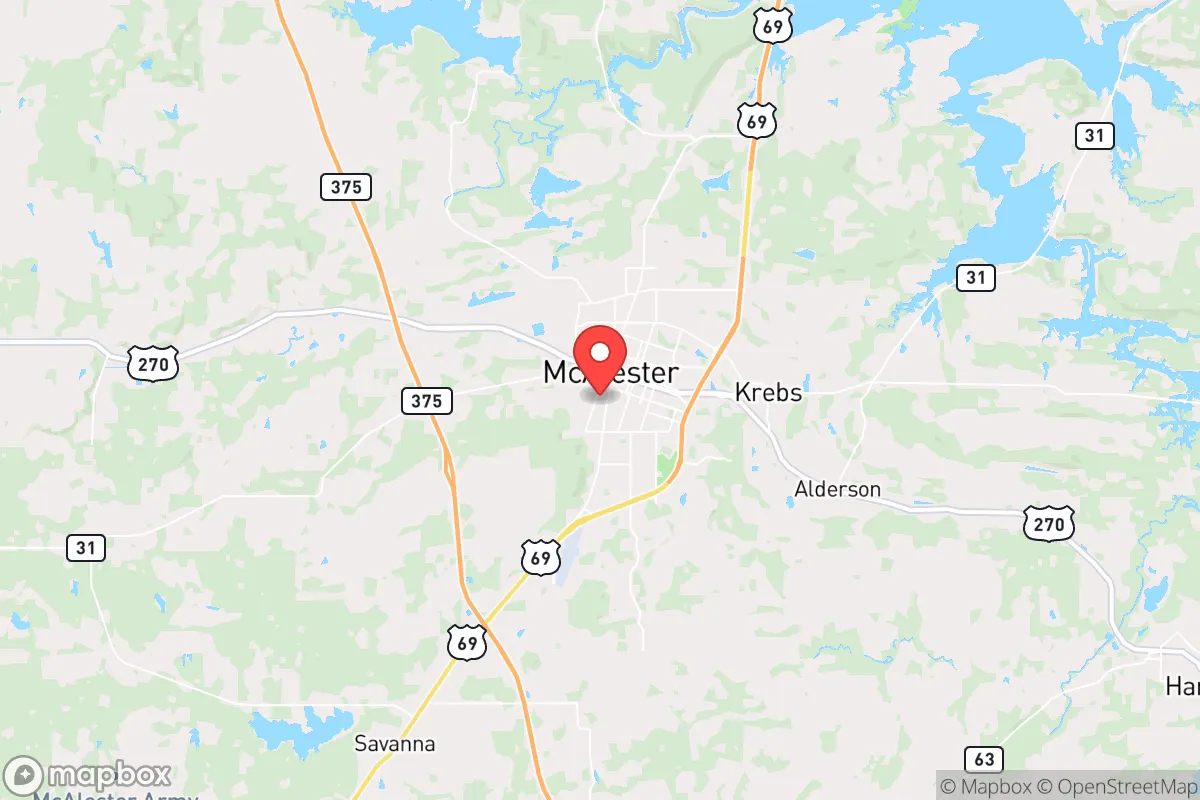
To really get a feel for McAlester’s politics, you have to look at the map around it. Drive an hour east to Poteau or an hour west to Ada, and you’ll find a similar conservative vibe, though maybe not quite as intense. The real contrast comes when you head up to Tulsa or Oklahoma City. Those places have pockets—especially inside the city limits—where you’ll see more progressive leanings, like in the Plaza District or Midtown. But down here in Pittsburg County, that kind of thinking just doesn’t take root. Even Durant, about 90 minutes south, feels more moderate by comparison. McAlester’s R+28 rating puts it in a league with the most reliably conservative rural counties in the state, and that’s a point of pride for a lot of locals. It’s not just about voting; it’s about a way of life that pushes back against the idea that the government knows better than you do.
What this means for residents
For the people who live here, that political climate translates directly into daily life. You won’t see the kind of heavy-handed local ordinances that pop up in bigger cities—no mask mandates that drag on for months, no zoning fights over who can park an RV in their own driveway. The county commission and city council tend to take a hands-off approach, trusting residents to make their own choices. That’s a big deal for families and small business owners who don’t want to deal with red tape every time they want to fix up their property or start a side gig. The downside? If you’re hoping for big government-funded projects or rapid infrastructure changes, you might be disappointed. The trade-off is that your tax dollars aren’t being funneled into programs that feel disconnected from local values. It’s a slower, more deliberate pace, and most folks here prefer it that way.
One thing that stands out about McAlester is how the culture reinforces the politics. This isn’t just a place that votes red; it’s a place where the Pittsburg County Fair and the McAlester Scottish Rite Temple are community anchors, and where the Oklahoma State Penitentiary is a major employer but also a constant reminder of the importance of law and order. You’ll hear people talk about “common sense” and “personal responsibility” in a way that’s not just campaign rhetoric—it’s how they live. The concern I hear from longtime friends is that outside influences are creeping in, especially through social media and national news, trying to push a progressive agenda that doesn’t fit here. There’s a quiet worry that if we’re not careful, the same government overreach that’s happening in places like Norman or Stillwater could start showing up in our county commission meetings. For now, though, McAlester remains a place where your rights are respected, your voice matters, and the political climate is a reflection of the people who call it home.

State Political ClimatePolitical Climate in Oklahoma
State Political AnalysisPolitical Environment in the State
Oklahoma has been a reliably red state for decades, with Republicans holding every statewide office and supermajorities in both legislative chambers, but the political climate here is more nuanced than a simple party label suggests. The state’s conservative lean is deep-rooted, driven by a strong evangelical presence, a robust oil-and-gas economy, and a cultural preference for limited government. Over the last 10-20 years, Oklahoma has shifted further right, with the GOP’s dominance solidifying after the 2010 Tea Party wave and accelerating through the 2020s, though recent in-migration from bluer states is beginning to introduce subtle demographic pressures in a few suburban pockets.
Urban vs. rural divide
The political map of Oklahoma is a classic study in contrast. Oklahoma City and Tulsa, the two major metros, are the state’s blue-leaning islands, but even they are far from progressive strongholds. Oklahoma County (Oklahoma City) voted for Donald Trump in 2024 by a narrow margin, while Tulsa County went red by about 10 points. The real action is in the rural expanse: counties like Texas County in the Panhandle, Custer County in the west, and Le Flore County in the southeast routinely deliver 80%+ Republican margins. The suburbs are where the story gets interesting. Edmond, a wealthy northern suburb of Oklahoma City, remains deeply conservative, but Norman, home to the University of Oklahoma, has become a Democratic-leaning outlier, with precincts in the city core voting blue by double digits. Broken Arrow and Jenks, suburbs of Tulsa, are solidly red, while Stillwater (Oklahoma State) and Lawton (Fort Sill) lean conservative but show pockets of purple. The rural-urban divide is stark: drive 20 minutes outside any city center, and you’re in deep-red territory where Trump flags fly year-round and local politics revolve around agriculture, energy, and gun rights.
Policy environment
Oklahoma’s policy environment is aggressively conservative, with a focus on low taxes and deregulation. The state has a flat income tax of 4.75%, which lawmakers are actively working to phase out entirely—a top priority for the 2025 session. Property taxes are among the lowest in the nation, capped by a constitutional amendment that limits annual increases to 5%. The regulatory posture is business-friendly, especially for energy and agriculture, with no state-level minimum wage above the federal $7.25 and a right-to-work law on the books. Education policy has been a flashpoint: in 2023, Oklahoma passed the nation’s first publicly funded religious charter school (St. Isidore of Seville Catholic Virtual School), though it’s currently tied up in court. The state also expanded school choice via tax-credit scholarships and open transfer laws. Healthcare is a mixed bag—Oklahoma expanded Medicaid in 2021 via a ballot initiative, which rankled conservatives, but the state has also restricted abortion to near-total prohibition (SB 612, 2022) and passed a law requiring parental consent for minors’ medical decisions. Election laws are strict: voter ID is required, absentee ballot drop boxes are banned, and the state purges inactive voters regularly. For a conservative moving in, the policy environment is largely aligned with limited-government principles, though the Medicaid expansion remains a sore spot for fiscal hawks.
Trajectory & freedom
Oklahoma is on a trajectory of expanding personal freedom in several key areas, but with some notable exceptions. On gun rights, the state is a national leader: constitutional carry (permitless carry) was signed into law in 2019 (SB 1212), and in 2024, lawmakers passed a bill prohibiting state enforcement of federal gun laws that violate the Second Amendment. Parental rights have been strengthened: the 2022 “Parental Bill of Rights” (HB 2967) gives parents explicit authority over their children’s education, medical care, and moral upbringing. Medical autonomy took a hit with the near-total abortion ban, but the state also protects medical conscience rights for providers. Property rights are robust, with no state income tax on capital gains and strong eminent domain protections. However, there are concerning trends. The state’s heavy reliance on oil-and-gas tax revenue means economic freedom is tied to a volatile industry. And in 2024, the legislature passed a bill restricting certain types of medical marijuana advertising and potency, which some see as a step back from the voter-approved 2018 medical cannabis program. Overall, Oklahoma is moving toward more freedom on guns, education, and parental rights, but watch for creeping regulation on cannabis and healthcare.
Civil unrest & political movements
Oklahoma has seen relatively little civil unrest compared to coastal states, but there have been flashpoints. The 2020 Black Lives Matter protests in Oklahoma City and Tulsa were significant, with the Tulsa protests drawing national attention given the city’s 1921 race massacre history. Those demonstrations were largely peaceful but led to some property damage and a heavy police presence. On the right, the “Oklahoma Freedom Caucus” has become a powerful force in the legislature, pushing for school choice, anti-tax measures, and election integrity reforms. Immigration politics are heated but less visible than in border states; Oklahoma passed a strict anti-sanctuary city law in 2020 (HB 4156) and a 2024 law requiring law enforcement to cooperate with federal immigration authorities. Election integrity controversies flared after 2020, leading to the ban on drop boxes and stricter voter ID rules. A new resident would notice the strong presence of “Don’t Tread on Me” flags and “Let’s Go Brandon” decals on trucks, but actual street-level conflict is rare. The most visible political movement is the push for school choice, with rallies at the state capitol drawing thousands of parents and students. Overall, the state is politically engaged but not volatile—most disagreements play out in legislative chambers, not on the streets.
Projection
Over the next 5-10 years, Oklahoma is likely to remain deeply red, but demographic shifts are worth watching. In-migration from California and Texas is accelerating, particularly to the Oklahoma City suburbs like Mustang and Yukon, and to the Tulsa area’s Bixby and Owasso. These newcomers tend to be more moderate or libertarian-leaning, which could soften the state’s hard-right edge on issues like marijuana legalization and tax policy. The state’s population is also aging, with rural counties shrinking while the metros grow. This could lead to a slow realignment: expect the Oklahoma City metro to become more competitive for Democrats, while rural areas become even redder. The push to eliminate the income tax will likely succeed, making the state even more attractive to remote workers and retirees. However, the education and healthcare debates will intensify—school choice advocates will keep pushing, while Medicaid expansion costs may force tax increases or service cuts. For someone moving in now, expect Oklahoma to be a reliably conservative state for at least another decade, but with growing internal tension between traditional rural conservatives and a more libertarian-leaning suburban influx.
For a new resident, the bottom line is this: Oklahoma offers a low-tax, high-freedom environment that aligns well with conservative values, especially on guns, parental rights, and property rights. You’ll find a welcoming community in places like Edmond, Broken Arrow, or Enid, where church attendance is high and neighbors look out for each other. But be aware of the trade-offs—public services are lean, infrastructure in rural areas is aging, and the political climate can feel insular if you’re coming from a more diverse state. If you value limited government and a slower pace of life, Oklahoma is a solid bet. Just don’t expect it to stay exactly the same—the suburbs are changing, and the next decade will bring new debates over how far “freedom” really extends.
* Values derived from national, state, county, city and local statistics and may differ in a specific area. Last updated: 2026-04-21T11:42:01.000Z
Narrative content on this page is AI-generated and may contain mistakes. Verify any details that matter before acting on them.
ReloMaps may earn a commission from affiliate links at no extra cost to you.

