
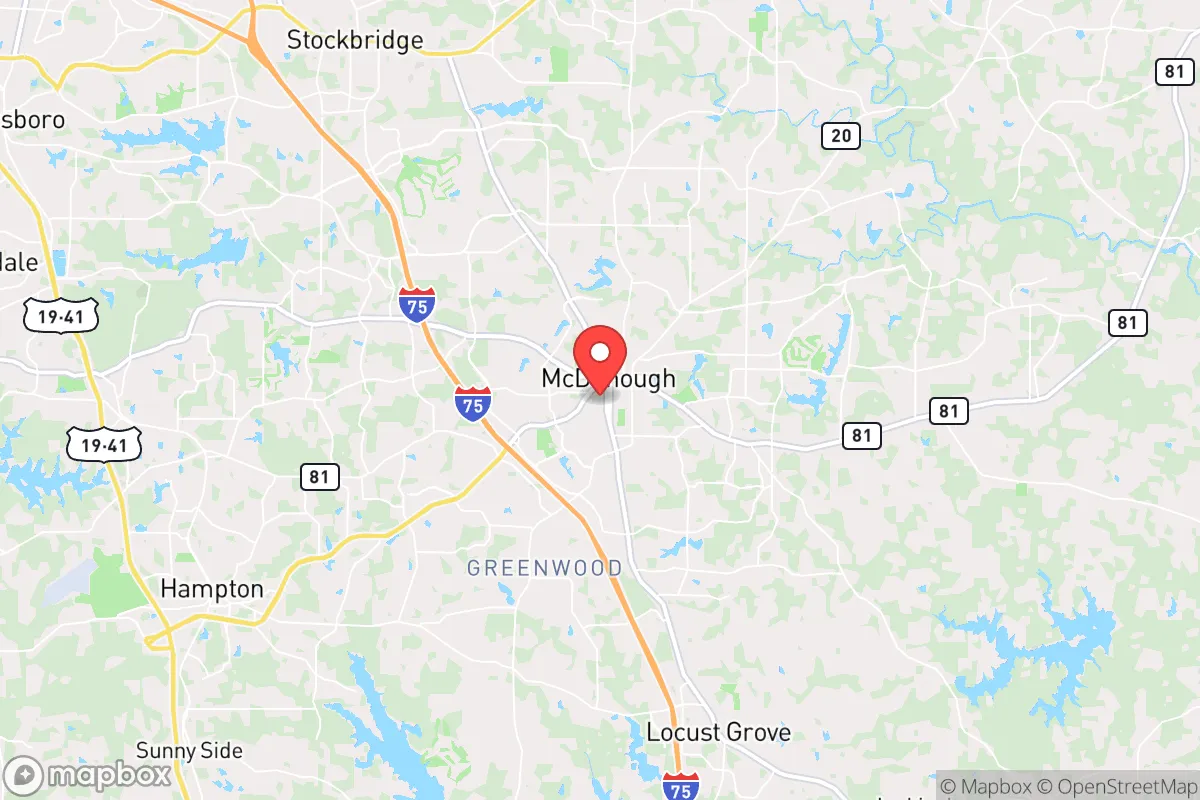
Photo: Wikipedia
Personal Sovereignty in Mcdonough, GA
Viable for self-reliance. Generally workable, though some barriers may limit total independence.
What does Personal Sovereignty tell us?
Personal Sovereignty measures your capacity for self-reliance and independence with minimal government friction. Higher scores mean fewer barriers between you and the way you want to live... but it assumes you have the space you need and good neighbors.
What does this tell us?
Personal Sovereignty measures your capacity for self-reliance and independence with minimal government friction. Higher scores mean fewer barriers between you and the way you want to live... but it assumes you have the space you need and good neighbors.
State Policy
Energy independence: Importer (12% of energy produced in-state)
Personal Liberty
Homesteading

Personal Liberty Analysis
Mcdonough, Georgia offers a notably high degree of personal sovereignty compared to many metro-adjacent areas, largely due to Georgia's strong preemption laws and a state-level political culture that resists local government overreach. While you are still within commuting distance of Atlanta’s regulatory gravity, Henry County’s practical enforcement posture and the state’s legal framework give residents significant breathing room to live, defend, and provide for themselves without constant interference. For the survivalist or prepper, Mcdonough represents a strategic balance: close enough to urban resources, far enough from urban control.
Tax burden and regulatory posture: How Georgia’s state-level policies protect your wallet and choices
Georgia’s tax structure is a clear win for personal autonomy. There is no state estate tax, no inheritance tax, and the state income tax is a flat 4.99% as of 2026, with ongoing legislative pressure to reduce it further. Property taxes in Henry County are moderate, with an effective rate around 1.1% of assessed value, but the state’s homestead exemption (up to $10,000 off assessed value for county taxes) provides a small buffer. More importantly, Georgia’s regulatory climate is among the most business-friendly in the nation, which translates to fewer occupational licensing hurdles and less red tape for anyone looking to start a side business, run a home-based trade, or engage in direct sales of goods like food or crafts. The state’s right-to-work laws and limited collective bargaining power further reduce external control over your livelihood. For the prepper, this means you can stockpile, barter, and operate a small-scale enterprise without the state breathing down your neck—something increasingly rare in blue-state jurisdictions.
Self-defense and gun law specifics: Stand your ground, constitutional carry, and what it means for you
Georgia is a constitutional carry state as of 2022, meaning no permit is required to carry a concealed firearm for anyone legally allowed to possess one. This is a foundational liberty for anyone serious about self-defense. The state also has a strong Stand Your Ground law, with no duty to retreat in any place you are lawfully present. Castle Doctrine protections extend to your vehicle and place of business, not just your home. Henry County’s sheriff’s office has historically been supportive of Second Amendment rights, and there are no local ordinances that restrict magazine capacity, firearm types, or ammunition sales—state preemption is ironclad. For the survivalist, this means you can legally own, carry, and use the tools you deem necessary for personal and family protection without navigating a patchwork of local bans. The only practical limitation is the federal NFA framework for suppressors and short-barreled rifles, but Georgia does not have its own additional restrictions. You can also legally use deadly force to defend against unlawful entry into your occupied vehicle, which is a critical detail for those who live or travel in higher-risk areas.
Self-reliance and homesteading viability: Lot sizes, zoning, and off-grid feasibility in Henry County
Mcdonough’s zoning is a mixed bag depending on which side of town you land. Within the city limits, standard residential lots are typically 0.25 to 0.5 acres, and the city enforces standard suburban codes—no chickens, no livestock, and limited outbuildings without permits. However, unincorporated Henry County is where the prepper finds real opportunity. Agricultural zoning (RA) allows lots as small as 1 acre for keeping livestock, and many rural parcels are 2 to 5 acres, with some larger tracts still available. The county allows accessory structures like barns, workshops, and greenhouses without excessive permitting, provided they meet setback requirements. Off-grid feasibility is moderate: Georgia’s solar access laws are weak, meaning HOAs or neighbors could theoretically block panels, but in unincorporated areas with no HOA, you can install solar, rainwater catchment (for non-potable use), and even a backup generator without hassle. Well water is common on larger lots, and septic systems are standard. The county does not prohibit composting toilets or graywater systems for agricultural use, though full off-grid living (no utility connection) is technically against state health codes for permanent residences. For the serious homesteader, the key is to buy outside city limits and avoid any HOA—there are plenty of such properties within 15 minutes of Mcdonough’s downtown.
Personal liberties: Parental rights, medical autonomy, speech, and property protections
Georgia has been a battleground for parental rights, and recent legislation has strengthened parents’ authority over their children’s education and medical decisions. The state’s Parents’ Bill of Rights (HB 1178, 2022) explicitly affirms that parents have the fundamental right to direct the upbringing, education, and healthcare of their minor children. This means no school district in Henry County can hide curriculum or medical information from parents, and parental consent is required for any non-emergency medical treatment. On medical autonomy, Georgia does not have a state-level vaccine mandate for adults, and while some employers may require them, the state has banned vaccine passports for government services. For the prepper concerned about medical freedom, this is a relatively safe harbor compared to states with mandatory reporting or forced treatment protocols. Property rights are also strong: Georgia’s eminent domain laws are limited to public use (not private economic development), and the state has a robust “right to farm” law that protects agricultural operations from nuisance lawsuits—useful if you plan to raise animals or grow food commercially. Free speech is protected under the state constitution, and there are no local hate speech ordinances that could chill political or religious expression. For the conservative individualist, Mcdonough’s legal environment respects the presumption that you are the best judge of your own life.
Overall, Mcdonough ranks well above the national average for personal sovereignty, especially when compared to the regulatory chokeholds of the Northeast or West Coast. The combination of constitutional carry, strong parental rights, low taxes, and permissive rural zoning creates a legal environment where a self-reliant individual or family can operate with minimal state friction. The main trade-off is proximity to Atlanta’s expanding government footprint—but as long as you stay outside city limits and avoid HOAs, you can carve out a genuinely autonomous life here. For the prepper or survivalist looking for a base in the Southeast, Mcdonough is a solid, defensible choice that doesn’t require moving to the middle of nowhere to find freedom.

* Values derived from national, state, county, city and local statistics and may differ in a specific area. Last updated: 2026-05-04T02:45:53.000Z
Narrative content on this page is AI-generated and may contain mistakes. Verify any details that matter before acting on them.
ReloMaps may earn a commission from affiliate links at no extra cost to you.

