
Photo: Wikipedia
Political ClimatePolitical Climate in Mcdonough, GA
District shown is the primary district for this city’s centroid. Cities may span multiple districts.
Local Political AnalysisPolitical Analysis of Mcdonough, GA
Mcdonough, Georgia, sits squarely in deep-red territory, with a Cook PVI of R+11 that reflects a community where conservative values aren't just a preference—they're the baseline. For decades, this town has been a stronghold for traditional principles, with most folks voting straight-ticket Republican and expecting their local leaders to keep government small and out of their personal lives. But if you've been around as long as I have, you've noticed a subtle shift in the air, especially as metro Atlanta's sprawl creeps further south, bringing in newcomers who don't always share the same instincts about what makes a community tick.
How it compares
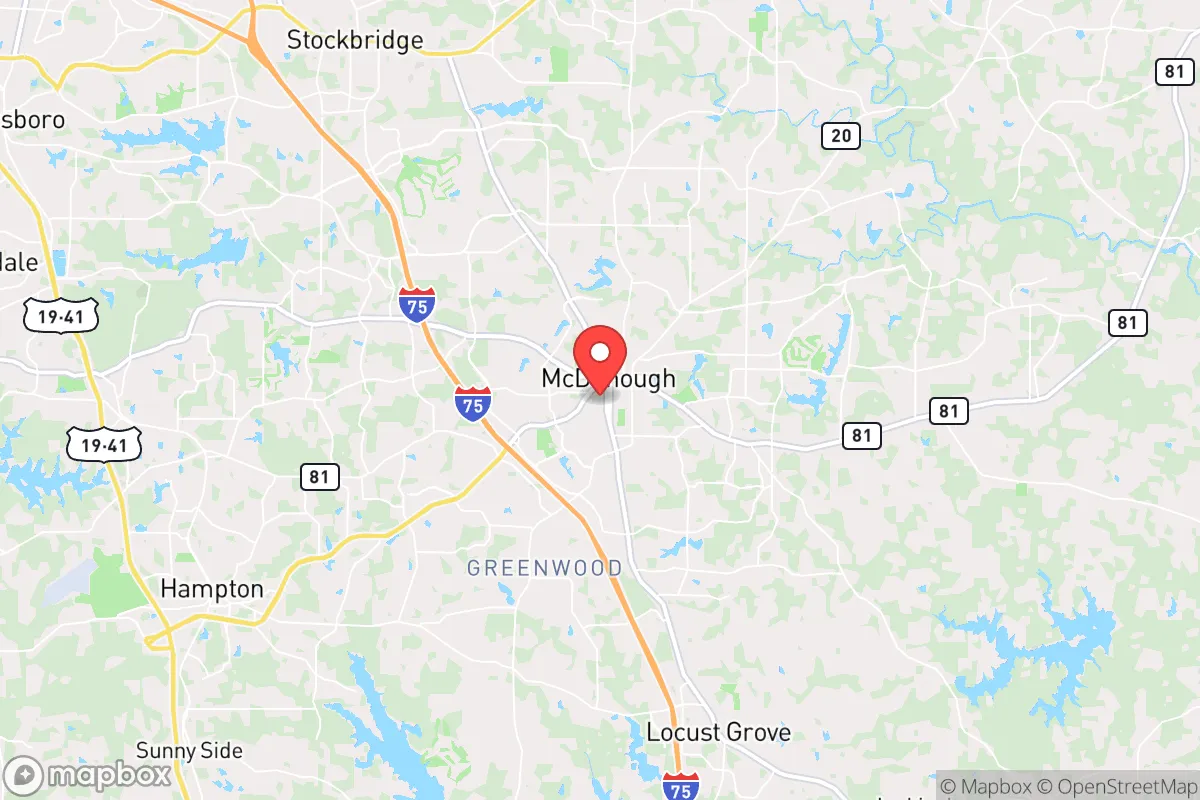
Drive 20 minutes north to Stockbridge or 30 minutes into the city of Atlanta itself, and you'll hit a completely different political universe—places where progressive policies on taxes, zoning, and even school curriculum are becoming the norm. Mcdonough, by contrast, still feels like the old guard: the county commission here has fought off attempts to raise property taxes for new transit projects, and the school board has kept a firm grip on local control, resisting state-level pushes for more centralized oversight. Compare that to nearby Hampton or Locust Grove, which lean even more conservative, and you'll see Mcdonough as a kind of buffer zone—still solidly red, but with a growing minority of residents who'd like to see more "nuance" on issues like housing density and environmental regulations. That's where the real tension lies: the old-timers remember when the biggest debate was over a new Dollar General, not whether to adopt a county-wide climate action plan.
What this means for residents
For the average family living here, the political climate translates into a few concrete realities. First, your taxes are lower than in most of metro Atlanta—the county has consistently voted down bond measures for big-ticket infrastructure, meaning roads and schools are adequate but not fancy. Second, there's a strong presumption that your personal freedoms—whether it's how you raise your kids, what you teach them, or how you run your small business—are your own business, not the government's. That said, the creeping influence of progressive ideology is something to keep an eye on. I've seen local library boards get pressured to host drag story hours, and there's been chatter about "equity audits" in the school system. So far, the conservative majority has held the line, but it takes constant vigilance. If you're the type who values a community where the government stays out of your garage and your church, Mcdonough still delivers—but you'll want to stay engaged in local elections to keep it that way.
Culturally, Mcdonough wears its conservatism on its sleeve, from the annual Veterans Day parade that shuts down the square to the fact that most churches here are still full on Sunday mornings. There's no city-wide mask mandate or vaccine passport talk—that stuff got shut down fast during the pandemic. The biggest policy distinction is probably the county's stance on property rights: you can still build a workshop in your backyard or keep a few chickens without a dozen permits, which is getting rarer in the Atlanta suburbs. But the long-term worry is that as more people move here for the lower cost of living, they'll bring the same big-government habits they fled from. For now, Mcdonough is a place where a conservative can breathe easy, but the winds are shifting, and it pays to keep your ear to the ground.

State Political ClimatePolitical Climate in Georgia
State Political AnalysisPolitical Environment in the State
Georgia has shifted from a reliably Republican stronghold to a genuine battleground state over the past two decades, with its current political climate defined by a razor-thin partisan split. The state voted for Joe Biden in 2020 by just under 12,000 votes, then re-elected both Republican Senators in 2022, and saw Donald Trump lose the state again in 2024 by roughly 2 points. The dominant coalition is now a tug-of-war between fast-growing, diversifying metro Atlanta suburbs and a deeply conservative rural and exurban base, with the state’s overall trajectory trending leftward since 2016.
Urban vs. rural divide
The political map of Georgia is starkly split between the urban core and everything else. Metro Atlanta’s core counties—Fulton, DeKalb, Cobb, Gwinnett, and Clayton—drive the Democratic vote, with Fulton and DeKalb alone delivering over 500,000 votes for Biden in 2020. These counties have seen massive in-migration from other states and countries, transforming once-purple Cobb and Gwinnett into solidly blue suburbs. Meanwhile, rural south Georgia, from Valdosta to Albany to Waycross, remains deeply Republican, often voting 70-80% for GOP candidates. The exurban ring around Atlanta, including counties like Forsyth, Cherokee, and Paulding, has become a conservative bulwark, with Forsyth County voting over 70% Republican in 2024. The key battlegrounds are the “collar counties” like Henry, Newton, and Rockdale, which are rapidly diversifying and trending Democratic. Savannah and Augusta are blue islands in otherwise red coastal and eastern Georgia, while Columbus and Macon lean Democratic but are surrounded by conservative rural areas.
Policy environment
Georgia’s policy environment is a mixed bag for conservatives. The state has a flat income tax rate of 5.49%, which was reduced from 5.75% in 2024, and there is no state-level estate tax. Property taxes are relatively low, with a median effective rate of 0.87% of home value. However, the regulatory posture is increasingly interventionist. The state has expanded Medicaid under the Affordable Care Act via a limited waiver program, but has not fully expanded. Education policy is a flashpoint: Governor Brian Kemp signed the Georgia Promise Scholarship Act in 2024, creating a $6,500 per-student education savings account for families in low-performing school districts, a win for school choice. But the state also mandates comprehensive sex education in public schools, and local school boards in metro Atlanta have pushed critical race theory-adjacent curricula, prompting conservative backlash. Election laws tightened after 2020 with SB 202, which added voter ID requirements for absentee ballots and limited drop boxes, but the law also expanded early voting hours. Gun rights are strong: Georgia is a permitless carry state since 2022, and has no red flag law. Healthcare freedom is limited—the state has not banned vaccine mandates for private employers, though it did ban them for state employees in 2023.
Trajectory & freedom
Georgia is becoming less free in several key areas, particularly regarding parental rights and medical autonomy. The Parents’ Bill of Rights (SB 449), signed in 2022, gives parents the right to review instructional materials and opt their children out of sex education, but it has been weakly enforced in blue counties. More concerning is the Georgia Medical Freedom Act (HB 270), passed in 2023, which prohibits discrimination against medical professionals who refuse to participate in procedures they object to—a win for conscience rights. However, the state has not passed a ban on gender transition procedures for minors, leaving that fight to local school boards and courts. Property rights are generally strong, with no statewide rent control and limited zoning restrictions outside of Atlanta proper. Taxation is trending in the right direction with the flat tax reduction, but the state’s budget has grown by over 30% since 2020, signaling government expansion. The biggest freedom concern is the erosion of election integrity: while SB 202 tightened rules, the state’s automatic voter registration system and widespread mail-in voting remain in place, and the 2024 election saw record turnout with no major fraud allegations—but the system’s trustworthiness remains a live issue among conservatives.
Civil unrest & political movements
Georgia has seen significant civil unrest and political activism in recent years. The 2020 protests in Atlanta over George Floyd’s death turned violent, with the Wendy’s on University Avenue burned down and the Atlanta Police Foundation’s training center becoming a flashpoint for “Stop Cop City” activists. That movement has evolved into a sustained, organized campaign of eco-terrorism and anti-police agitation, with activists occupying the proposed training center site and clashing with law enforcement. On the right, the Georgia Republican Assembly and local Tea Party groups remain active, pushing for election audits and school board takeovers. Immigration politics are heated: Georgia has no sanctuary city policy, but Atlanta’s City Council passed a resolution in 2023 limiting cooperation with ICE, though it’s largely symbolic. The Georgia Security and Immigration Compliance Act (2006) remains in effect, requiring employers to use E-Verify. Secession rhetoric is fringe, but nullification talk surfaces around federal gun laws and vaccine mandates. Election integrity remains a raw nerve: the 2020 hand recount and subsequent audits found no widespread fraud, but many conservatives remain skeptical of the state’s electronic voting machines and the lack of paper ballot backups in some counties.
Projection
Over the next 5-10 years, Georgia will likely continue its slow leftward drift, driven by demographic changes in metro Atlanta. The state is adding about 100,000 new residents annually, with a significant share coming from blue states like California and New York. These newcomers tend to be younger, more diverse, and more Democratic-leaning. The exurban counties like Forsyth and Cherokee are also diversifying, though they remain solidly red for now. The wild card is the rural vote: as rural Georgia depopulates, its political weight diminishes. By 2030, metro Atlanta’s share of the state’s population will likely exceed 60%, making statewide elections increasingly competitive. However, the state’s conservative policy infrastructure—right-to-work laws, permitless carry, school choice, and low taxes—provides a buffer. The biggest threat to freedom is the potential for a Democratic trifecta in the state legislature, which could bring gun control, higher taxes, and expanded government healthcare. A new resident moving in now should expect a state that remains politically competitive but is trending left, with the cultural and policy battles of the next decade centered on education, election integrity, and the scope of local government power.
For a conservative relocating to Georgia, the practical takeaway is that your vote and your voice matter more here than in deep-red states. You’ll find strong gun rights, low taxes, and school choice, but you’ll also need to engage locally—especially in school board and county commission races—to prevent the blue tide from washing over your community. Choose your county wisely: Forsyth, Cherokee, or Paulding for a reliably conservative environment; Henry or Newton if you’re willing to fight for the political direction of your neighborhood. The state is still worth moving to, but it’s no longer a safe bet for conservative values—it’s a battleground where your presence can make a difference.
* Values derived from national, state, county, city and local statistics and may differ in a specific area. Last updated: 2026-05-04T02:45:53.000Z
Narrative content on this page is AI-generated and may contain mistakes. Verify any details that matter before acting on them.
ReloMaps may earn a commission from affiliate links at no extra cost to you.

