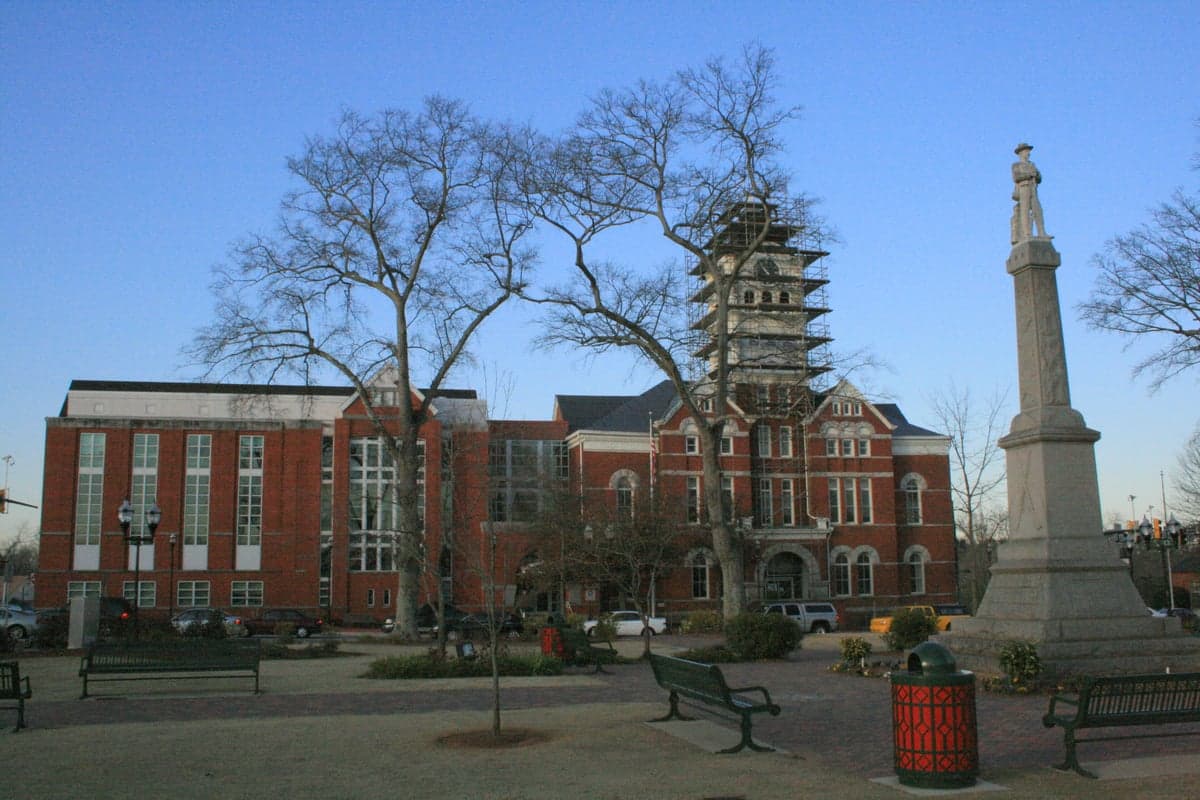
Photo: Wikipedia
Strategic Assessment of Mcdonough, GA
Meaningful friction. Expect exposure to either population pressure, blast zones, or natural disaster risk. Consider buying a retreat property.
What does the Strategic Assessment tell us?
Our Strategic Assessment grades tactical survivability of an area. Major population centers, military targets, fallout zones, natural disasters, and border exposure all drive risk — lower exposure means a more defensible position in a crisis.
This is heavily inspired by Joel Skousen's Strategic Relocation book. Highly recommended you checkout the book ($)What does this tell us?
Our Strategic Assessment grades tactical survivability of an area. Major population centers, military targets, fallout zones, natural disasters, and border exposure all drive risk — lower exposure means a more defensible position in a crisis.
This is heavily inspired by Joel Skousen's Strategic Relocation book. Highly recommended you checkout the book ($)Strategic Pillars

Key Distances
Regional Safe Places
Below is our recommended "safe zones" in Georgia and the surrounding area based on our strategic heuristics. For most people, it's unrealistic to live in a “safe zone” full-time due to work, family or other personal reasons. They tend to be more rural. However, many of these areas are perfect for second homes and retreat properties that double as a vacation home or even a short-term rental.
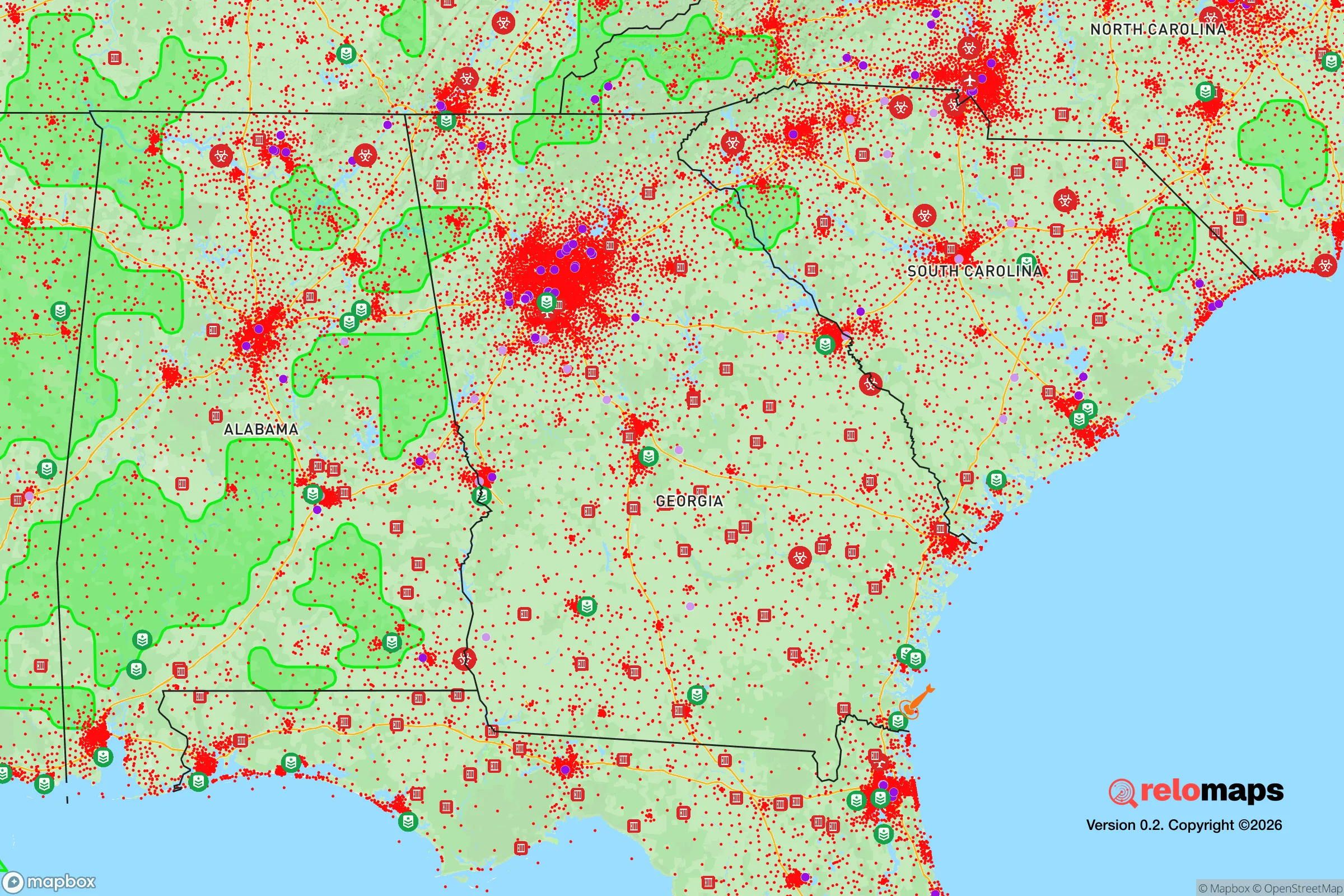
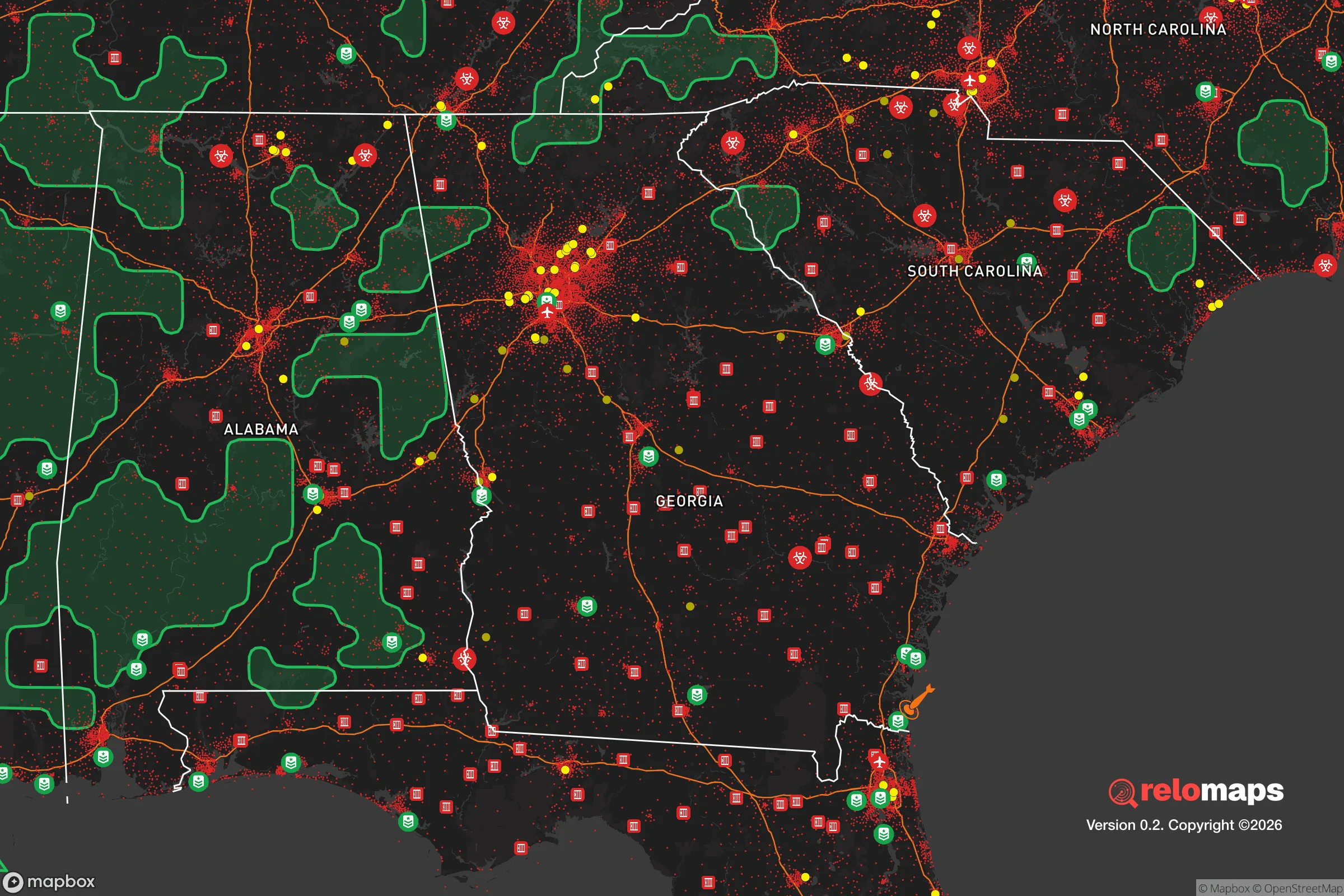


Important Note: For informational purposes only. This does not mean nothing bad ever happens in the green zones. Please use common sense. This is based on public data and modeled with AI. We tried to take a conservative approach but mistakes happen. We update this regularly as new information becomes available.
Solar Generator Recommendations
Backup power matters more here than in safer locations. We've picked three solar generators across budgets and capacity tiers — start with the budget unit if you only need a few essentials, or step up if you want to run a fridge and HVAC for days at a time.

Jackery Portable Power Station Explorer 300
Budget OptionPower on the Go: Weighing only 11 lbs, it's convenient to set up and store with book-sized foldable solar panels

BLUETTI Portable Power Station AC180
Designed for both indoor and outdoor scenarios, AC180 is highly capable as it has a robost capacity and continuous output power.

EF ECOFLOW DELTA Pro Ultra Power Station
Upgraded PickEcoFlow DELTA Pro Ultra is a whole-home energy system designed to grow with your family. Integrated with the Smart Home Panel 2, it scales to meet your evolving energy needs — keeping your home powered, intelligent, and secure through every stage of life.
We earn a commission, at no additional cost to you.
Strategic Assessment Analysis
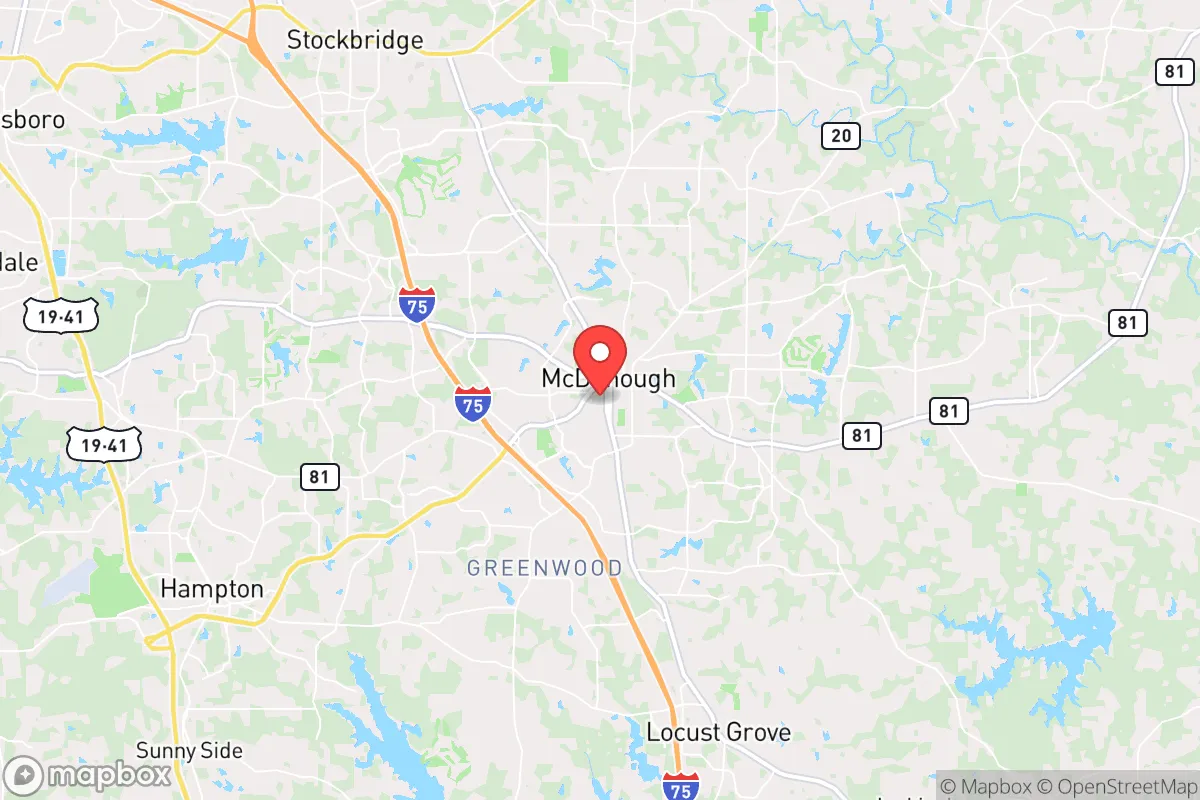
Mcdonough, Georgia, sits in a strategic pocket of the Piedmont region that offers a meaningful blend of proximity to Atlanta’s economic engine and a buffer from its most acute vulnerabilities. Located roughly 35 miles southeast of downtown Atlanta along the I-75 corridor, this Henry County seat benefits from the logistical advantages of being near a major interstate while remaining far enough from the urban core to avoid the worst of a potential evacuation crush or civil unrest spillover. For a relocator thinking in terms of resilience—food security, water access, defensible terrain, and fallout avoidance—Mcdonough presents a mixed but workable picture, provided you understand its specific exposures and plan accordingly.
Geographic position and natural advantages for long-term stability
Mcdonough sits on the edge of the Piedmont region, where rolling hills and clay-based soils give way to the flatter Coastal Plain further south. This topography offers natural defensibility: the hills provide observation points and make large-scale mechanized movement more difficult, while the clay soil, though challenging for gardening, retains moisture better than sandy alternatives. The area’s elevation—around 850 feet above sea level—keeps it above the flood-prone zones of the Flint and Ocmulgee river basins, though flash flooding from heavy rain remains a concern in low-lying subdivisions. The climate is humid subtropical, with hot summers and mild winters, which means a longer growing season for food production (roughly 220 frost-free days) but also higher humidity that can accelerate mold and rust on stored supplies. Water access is a relative strength: Henry County sits atop the Floridan Aquifer system, and while municipal water comes from surface sources like the Towaliga River and Lake Jackson, private wells are feasible in the more rural parts of the county. For a prepper, the key takeaway is that Mcdonough offers decent natural water availability and a workable growing climate, but you’ll need to invest in well drilling and rainwater catchment to achieve true independence from the municipal grid.
Risks, exposures, and proximity to fallout-relevant landmarks
The most significant risk for Mcdonough is its position along I-75, a primary evacuation route out of Atlanta. In a mass casualty event—whether from a natural disaster, a terrorist attack, or a grid-down scenario—I-75 will become a choke point, with tens of thousands of people funneling south through Henry County. Mcdonough itself sits at the intersection of I-75 and GA-155/GA-81, making it a natural bottleneck. If you’re in a subdivision near the interstate, you’ll be in the path of any panic-driven exodus. Beyond traffic, the area has several soft targets: the Atlanta Motor Speedway in nearby Hampton can host large crowds (over 100,000 on race days), and the Tanger Outlets and South Point retail corridor draw significant foot traffic. These are potential flashpoints for looting or civil unrest if law enforcement is overwhelmed. On the industrial side, Mcdonough is home to a major Amazon fulfillment center and several large distribution warehouses—these are logistical hubs that could become targets for supply-chain disruption or resource hoarding. There are no nuclear power plants within 50 miles (the closest is Plant Vogtle near Augusta, about 130 miles away), but the area does have rail lines carrying hazardous materials through the county. For a survivalist, the calculus is clear: Mcdonough’s location offers a buffer from Atlanta’s worst fallout, but you need to live well away from I-75 and the commercial corridors to avoid being caught in the secondary effects of a regional collapse.
Practical resilience for a relocator: food, water, energy, and defensibility
For a relocator serious about self-sufficiency, Mcdonough’s practical resilience depends heavily on where you buy. The city itself is suburban, with HOA-governed subdivisions that restrict livestock, rainwater collection, and visible security measures. The real opportunity lies in the unincorporated parts of Henry County, particularly south and east of Mcdonough toward Locust Grove and Hampton, where you can find 5- to 20-acre parcels with fewer restrictions. Food production is viable: the clay soil can be amended with compost and raised beds, and the long growing season supports tomatoes, peppers, squash, beans, and leafy greens. Local farmers’ markets and the Henry County Farm Bureau provide networking opportunities for seed swaps and bulk buying. Water resilience requires upfront investment—drilling a well runs $5,000–$10,000 depending on depth, and a 1,500-gallon rainwater catchment system with first-flush diverters will cost another $2,000–$4,000. Energy is a mixed bag: Georgia Power’s grid is reasonably reliable, but summer storms and occasional ice events cause outages. Solar is viable—the area averages 4.5 peak sun hours per day—but HOA restrictions can be a barrier. Off-grid solar with battery storage (a 10kW system with a Powerwall-style backup) runs $20,000–$30,000 installed. Defensibility is where Mcdonough’s suburban character hurts: most lots are flat and open, with limited natural cover. If you’re buying acreage, look for properties with tree lines, creek beds, or rolling terrain that provide natural concealment and firing lanes. A rural property with a well, solar, a root cellar, and a defensible perimeter is achievable here, but it requires deliberate selection and a willingness to live 15–20 minutes from the nearest grocery store.
The overall strategic picture for Mcdonough is one of cautious viability for the prepared relocator. It offers a reasonable balance of access to Atlanta’s resources (medical centers, supply chains, employment) and a buffer from its most acute risks, provided you choose your specific location carefully. The area’s natural advantages—decent water, a long growing season, and rolling terrain—are real but require investment to exploit fully. The downsides are equally real: the I-75 corridor is a liability in any evacuation scenario, the suburban sprawl limits defensibility, and the county’s rapid growth (Henry County added over 30,000 residents between 2010 and 2020) means more competition for resources in a crisis. For a conservative-leaning relocator who values community, self-reliance, and a lower profile, Mcdonough can work—but it’s not a bug-out location. It’s a place to build a resilient life if you’re willing to put in the work, spend the money, and stay off the main roads when things go sideways. If you’re looking for a true retreat, you’d be better served further south toward Macon or east toward the Savannah River. If you need to stay within commuting distance of Atlanta while maintaining a prepper mindset, Mcdonough is a solid B-tier choice—not perfect, but workable with the right property and plan.

* Values derived from national, state, county, city and local statistics and may differ in a specific area. Last updated: 2026-05-04T02:45:53.000Z
Narrative content on this page is AI-generated and may contain mistakes. Verify any details that matter before acting on them.
ReloMaps may earn a commission from affiliate links at no extra cost to you.

