
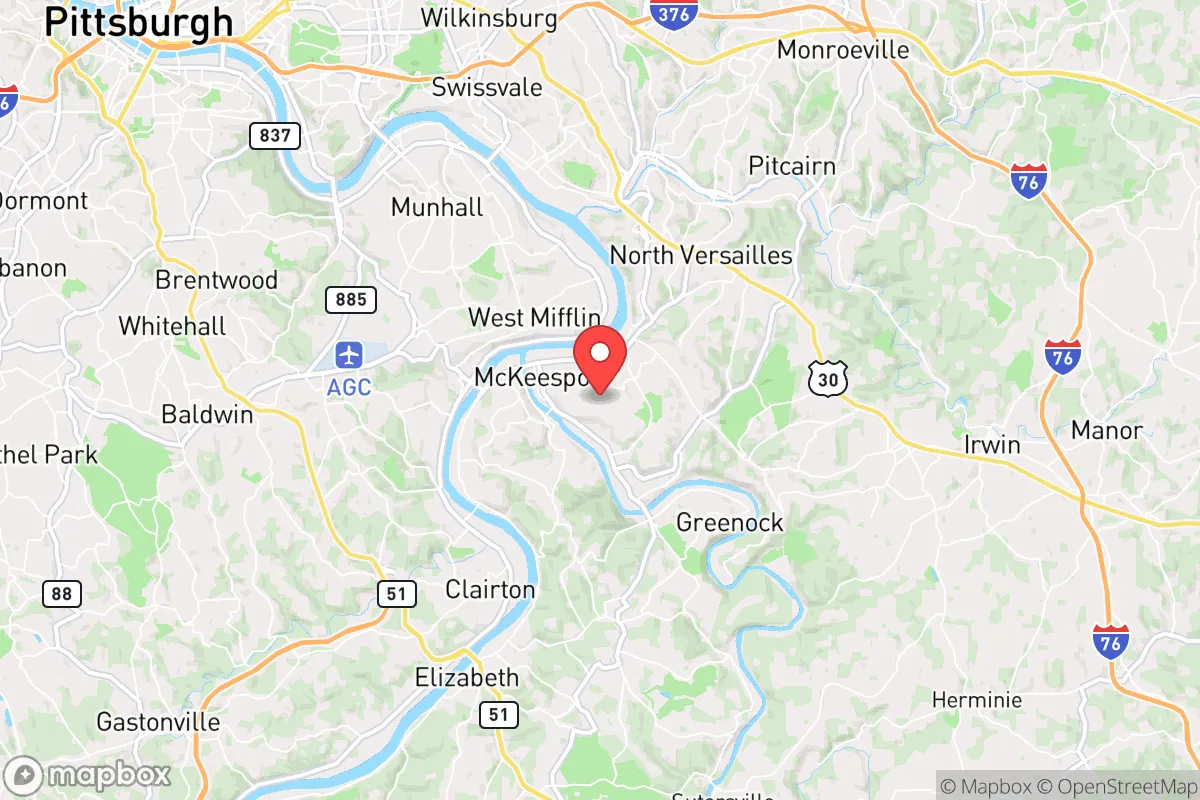
Photo by Raymond Kotewicz on Unsplash
Demographics of Mckeesport, PA
Affluence Level in Mckeesport, PA
A low-income area with significant economic hardship. Household wealth and educational attainment are well below national averages.
People of Mckeesport, PA
The people of McKeesport, Pennsylvania, today form a small, predominantly working-class city of 17,520 residents, marked by a stark racial and economic divide from its surrounding suburbs. The city is nearly evenly split between a White population (47.0%) and a Black population (38.1%), with a small Hispanic community (4.3%) and a tiny foreign-born share of just 1.1%. Only 12.3% of adults hold a college degree, reflecting a blue-collar identity that persists from the city’s industrial heyday, but the population has declined by over 60% since 1950, leaving a hollowed-out urban core with pockets of stability in older ethnic neighborhoods.
How the city was settled and grew
McKeesport’s population history is a direct product of its location at the confluence of the Monongahela and Youghiogheny rivers, which made it a natural hub for heavy industry. Founded in 1795 by John McKee, the city grew slowly until the 1850s, when the arrival of the Pennsylvania Railroad and the establishment of the National Tube Works (later U.S. Steel) triggered explosive growth. The first major wave of immigrants were German and Irish laborers who built the early mills and settled in the Lower Fifth Ward and Boston neighborhood along the riverfront. By the 1880s, Eastern European immigrants—Poles, Slovaks, Ukrainians, and Hungarians—flooded in to work the blast furnaces, forming dense ethnic enclaves in Christy Park and Versailles Borough (later annexed). These groups built Catholic parishes, fraternal halls, and row houses that still define the city’s older residential streets. The peak came in 1940, when McKeesport’s population hit 55,000, nearly all White and overwhelmingly employed by U.S. Steel. The Grandview neighborhood, perched on the hill above the mills, housed the city’s managerial and professional class, while the flatlands near the river remained working-class ethnic strongholds.
Modern era (post-1965)
The collapse of steel manufacturing after 1970 triggered a demographic revolution. Between 1970 and 2000, McKeesport lost over 30,000 residents as White families left for the suburbs of White Oak, North Versailles, and Elizabeth Township. The city’s Black population, which had been small and concentrated in the West Side neighborhood near the railroad tracks, grew rapidly as African Americans from the rural South and Pittsburgh’s Hill District moved into the now-vacant housing stock. By 2020, the Black share had risen to 38.1%, while the White share fell to 47.0%. The East End neighborhood, once solidly Polish and Slovak, became a predominantly Black area, while the Lynn Williams housing project (now demolished) concentrated poverty. The Hispanic population, mostly Puerto Rican, grew modestly to 4.3% and settled in the South Side flats near the river. The foreign-born share collapsed to 1.1%—a fraction of the 25% figure in 1910—as the city no longer attracted new immigrants. The Asian population (1.1%) is almost entirely Vietnamese and Korean families who run small businesses along Fifth Avenue, with no Indian-subcontinent presence (0.0%). The college-educated share of 12.3% is among the lowest in Allegheny County, reflecting the loss of the professional class to the suburbs.
The future
McKeesport’s population is projected to continue declining, possibly to 14,000 by 2040, as the remaining White population ages out and younger Black families move to lower-cost suburbs like Clairton or Duquesne. The city is not homogenizing but rather becoming more uniformly poor and Black, with the White share dropping by roughly 1% per year. The Hispanic community is growing slowly, but from a very small base, and is unlikely to reach 10% by 2040. The tiny Asian population is stable but not growing, as the city lacks the job base to attract new immigrants. The key demographic trend is the aging of the White ethnic population in neighborhoods like Grandview and Boston, where the median age exceeds 50, while the Black population in the East End and West Side is younger (median age 32) but faces high unemployment and poverty rates above 30%. No new immigrant gateway is forming; the foreign-born share will likely remain below 2%.
For someone moving in now, McKeesport is a city that has bottomed out demographically but has not yet stabilized. It offers very low housing costs and a strong sense of community in the remaining ethnic enclaves, but it lacks the job base, school quality, and population diversity to attract new residents from outside the region. The city is becoming a predominantly Black, low-income enclave surrounded by predominantly White, middle-class suburbs—a pattern common to many post-industrial mill towns in the Mon Valley. New arrivals should expect a tight-knit but economically struggling environment where the population will continue to shrink slowly for the foreseeable future.

* Values derived from national, state, county, city and local statistics and may differ in a specific area. Last updated: 2026-05-04T02:23:50.000Z
Narrative content on this page is AI-generated and may contain mistakes. Verify any details that matter before acting on them.
ReloMaps may earn a commission from affiliate links at no extra cost to you.

