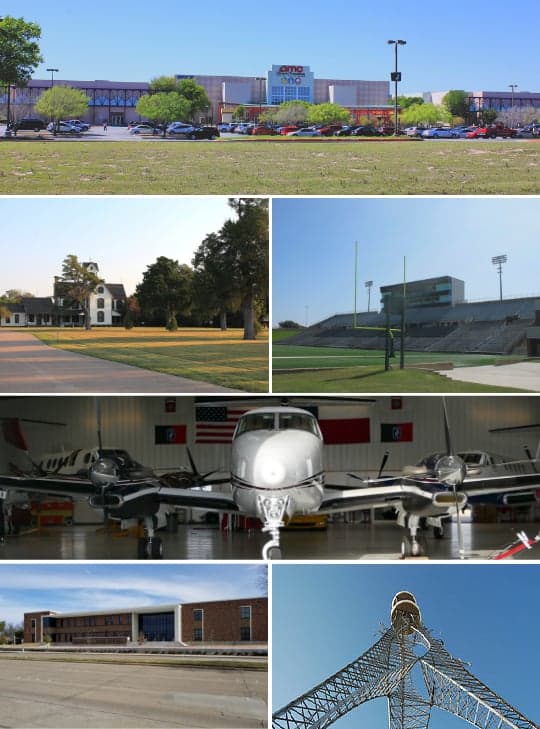
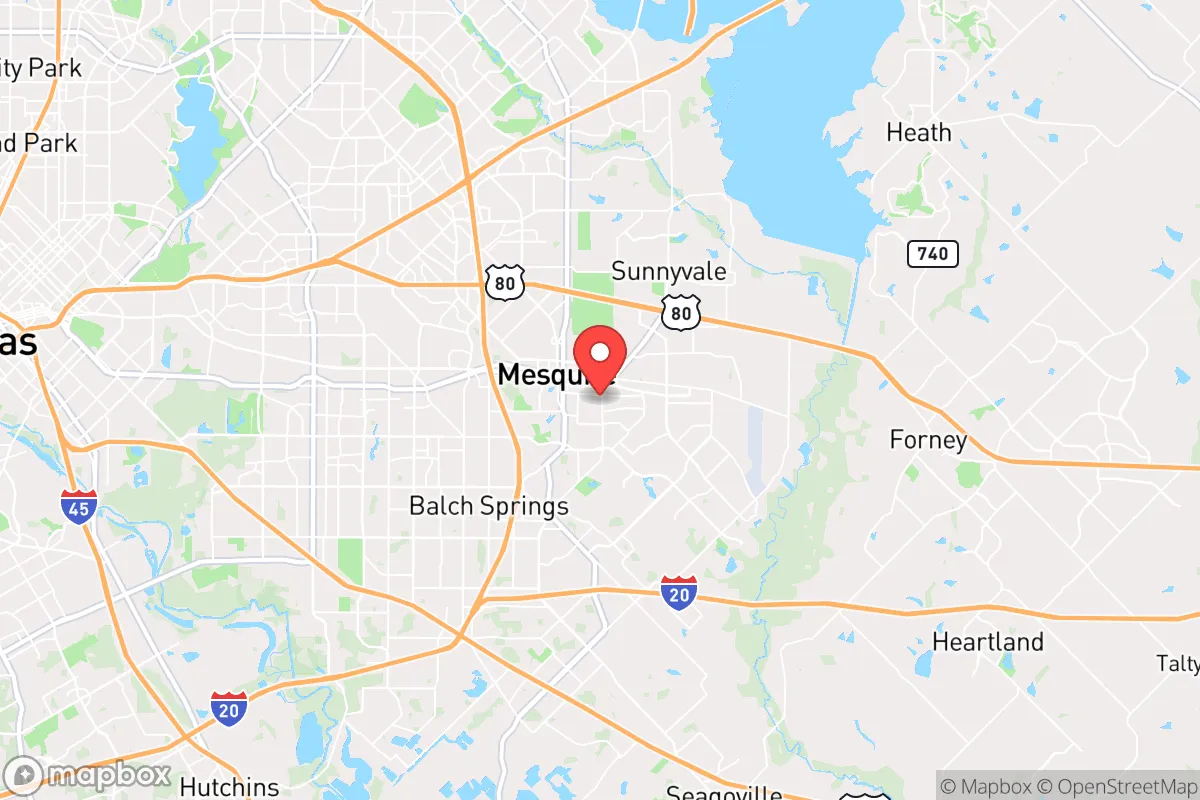
Photo: Wikipedia
Demographics of Mesquite, TX
Affluence Level in Mesquite, TX
A middle-class area roughly in line with national averages across income, home values, education, and employment.
People of Mesquite, TX
Today, Mesquite, Texas is a majority-minority city of 148,848 residents where no single ethnic group holds a numerical majority. The city is characterized by its Hispanic plurality (44.7%), a substantial Black population (24.2%), and a White population that has fallen to 24.3%, making it one of the most ethnically balanced suburbs in the Dallas-Fort Worth metroplex. With 13.0% foreign-born residents and a relatively low college attainment rate of 18.5%, Mesquite retains a strong working-class and middle-class identity, distinct from the more affluent northern suburbs of Dallas.
How the city was settled and grew
Mesquite was founded in 1873 as a railroad town along the Texas and Pacific Railway, initially drawing Anglo-American farmers and ranchers to its fertile Blackland Prairie soils. The city's original core, now known as Old Downtown Mesquite along Main Street, was settled by families from the U.S. South, particularly Tennessee and Alabama, who established cotton and corn farms. A second early wave came in the 1880s with the arrival of German and Czech immigrants, who settled in what is now the Lawson Road area, establishing small truck farms and dairies. By 1900, Mesquite remained a tiny agricultural hamlet of fewer than 500 people, almost entirely White and native-born. The city's first significant growth spurt came during the 1920s oil boom, when workers moved into the Pleasant Grove area (then unincorporated) to work in nearby East Texas oil fields, though Mesquite itself remained small through World War II.
Modern era (post-1965)
Mesquite's explosive growth began in the 1960s and 1970s as a classic Sun Belt suburb, drawing White middle-class families from Dallas seeking affordable housing and new schools. The Towne Crossing and Rodeo Drive neighborhoods were developed during this period, filling with young families employed at the new Texas Instruments and LTV Aerospace plants in Dallas. The 1980s and 1990s brought the first major demographic shift: Black families began moving east from Dallas's southern sectors into neighborhoods like Eastfield and Pioneer Park, drawn by newer housing stock and lower crime rates than inner-city Dallas. Hispanic migration accelerated after 2000, with Mexican-American and Central American families settling heavily in the Kaufman County line area and the Motley Drive corridor, where older, affordable housing stock and proximity to warehouse and construction jobs made Mesquite an attractive entry point. The White population peaked around 1980 at roughly 85% and has declined steadily since, while the Hispanic share has grown from under 10% in 1990 to 44.7% today. The Black population has remained relatively stable at around 24% since 2010, while East/Southeast Asian communities (1.9%) and Indian-subcontinent residents (1.0%) remain small but growing, concentrated in the newer Skyline area near I-30.
The future
Mesquite's population trajectory points toward continued Hispanic growth and further White decline, with the city likely becoming majority-Hispanic within the next decade. The foreign-born share (13.0%) is below the Texas average of 17%, suggesting that much of the Hispanic growth is now second- and third-generation rather than new immigration. The Black population appears stable, with little net migration from Dallas, while the small Asian and Indian communities are growing slowly through chain migration and are concentrated in the newer housing stock near Lake Ray Hubbard. The city is not tribalizing into distinct ethnic enclaves in the manner of some larger cities; rather, neighborhoods like Towne Crossing and Eastfield have become broadly mixed, with Hispanic, Black, and White families living in close proximity. The low college attainment rate (18.5%) and modest median household income suggest Mesquite will remain a working-class suburb, unlikely to attract the high-skilled immigration that is reshaping Plano or Frisco. The city's future is one of slow, organic diversification within a stable working-class framework, rather than rapid gentrification or ethnic succession.
For a conservative-leaning individual or family considering Mesquite, the city offers a genuinely integrated, middle-class environment where ethnic diversity is the norm rather than a transition point. The population is stable, family-oriented, and rooted in the local economy of logistics, construction, and municipal services. Mesquite is not becoming a hip, educated enclave or a segregated ethnic suburb—it is settling into its identity as a solid, multiethnic working-class city where most residents own their homes and send their children to public schools. That stability, rather than rapid change, defines what a new resident can expect.

* Values derived from national, state, county, city and local statistics and may differ in a specific area. Last updated: 2026-04-21T12:08:11.000Z
Narrative content on this page is AI-generated and may contain mistakes. Verify any details that matter before acting on them.
ReloMaps may earn a commission from affiliate links at no extra cost to you.

