
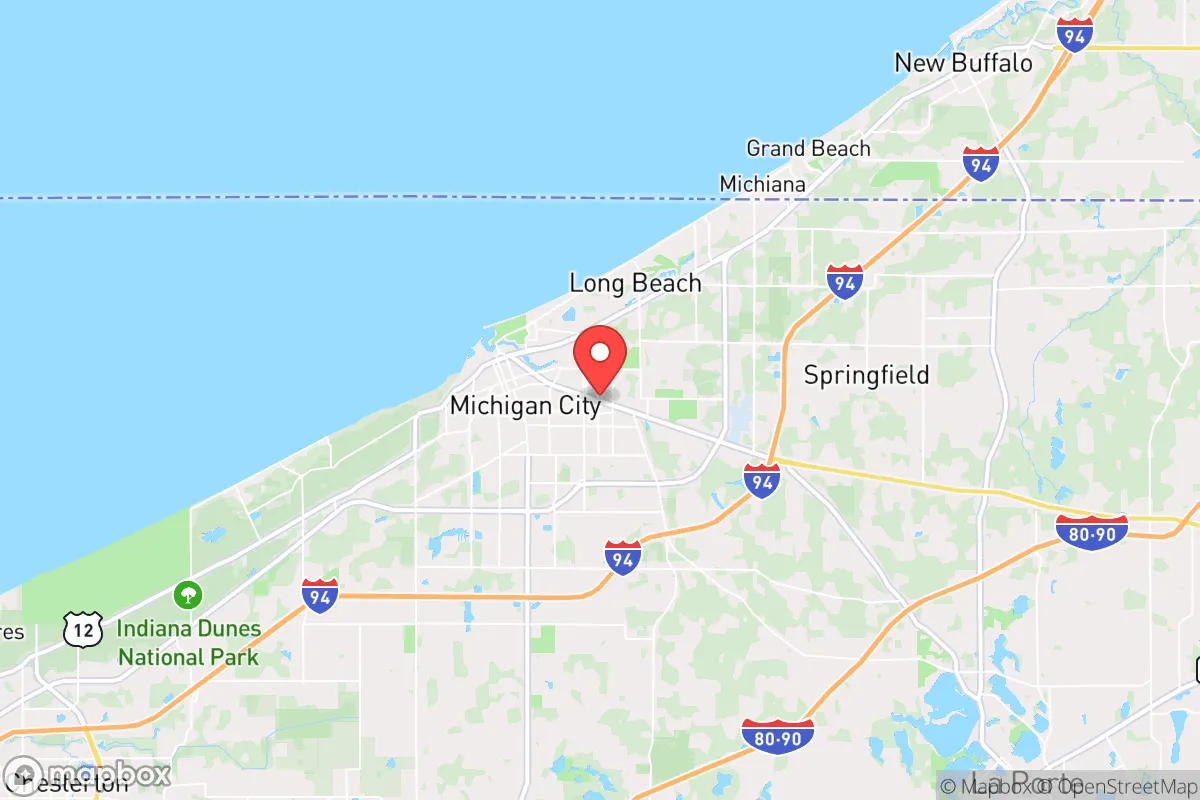
Photo: Wikipedia
Personal Sovereignty in Michigan City, IN
Viable for self-reliance. Generally workable, though some barriers may limit total independence.
What does Personal Sovereignty tell us?
Personal Sovereignty measures your capacity for self-reliance and independence with minimal government friction. Higher scores mean fewer barriers between you and the way you want to live... but it assumes you have the space you need and good neighbors.
What does this tell us?
Personal Sovereignty measures your capacity for self-reliance and independence with minimal government friction. Higher scores mean fewer barriers between you and the way you want to live... but it assumes you have the space you need and good neighbors.
State Policy
Energy independence: Importer (35% of energy produced in-state)
Personal Liberty
Homesteading

Personal Liberty Analysis
Michigan City, Indiana, offers a mixed bag for those prioritizing personal sovereignty, sitting in a state with a generally strong legal framework for self-defense and property rights but under the shadow of a county and city government that can lean interventionist. For the prepper or survivalist, the key tension here is between Indiana’s pro-liberty state laws and the local municipal codes that can restrict self-reliance activities like raising livestock or building off-grid structures. The overall autonomy environment is one where you must be vigilant—state-level protections give you a solid foundation, but you’ll need to navigate local zoning boards and city ordinances to fully exercise your freedoms.
Tax burden and regulatory posture in LaPorte County
Indiana’s tax structure is relatively friendly to personal sovereignty, with a flat state income tax rate of 3.05% as of 2025 and a state sales tax of 7% on most goods. Property taxes in Michigan City are assessed at the county level, with LaPorte County’s effective rate averaging around 1.2% of assessed home value—moderate compared to neighboring Illinois but higher than rural Indiana counties. The regulatory posture at the city level is where friction emerges: Michigan City has a building code that requires permits for most structural changes, and the city’s planning department enforces zoning rules that can complicate adding a detached workshop, root cellar, or solar array. For a prepper, this means you can likely own your home free and clear, but expanding your property’s self-sufficiency features will require paperwork and potential fees. The state’s lack of a personal property tax on business equipment is a plus for those running a home-based survival supply or repair operation.
Self-defense rights and Indiana gun law specifics
Indiana is a strong Second Amendment state, and Michigan City residents benefit directly from that. The state has constitutional carry (permitless carry) for anyone 18 or older who can legally possess a firearm, effective since July 2022. No license is needed to carry a handgun openly or concealed. For those wanting a permit for reciprocity while traveling, the Indiana License to Carry a Handgun (LTCH) is still available and is a shall-issue process with no discretionary denial by local authorities. The state also has a Stand Your Ground law, codified in IC 35-41-3-2, which removes any duty to retreat before using deadly force if you are in a place you have a legal right to be. Magazine capacity is unrestricted, and there is no state-level assault weapons ban. However, Michigan City itself has local ordinances that can be a trap: the city bans discharging a firearm within city limits except at a licensed range or in self-defense, so preppers living inside the city cannot legally train on their own property. For those serious about self-defense, living in the unincorporated areas of LaPorte County or just outside the city limits is the smarter move.
Self-reliance and homesteading viability: lot sizes, zoning, and off-grid feasibility
Homesteading in Michigan City is heavily constrained by municipal zoning. Inside the city, standard residential lots are typically 0.1 to 0.25 acres, and the city code prohibits keeping chickens, goats, or other livestock on lots under one acre. Even on larger lots, you need a special permit for any animal beyond a dog or cat. This effectively kills any serious food self-sufficiency within the city. Off-grid feasibility is also limited: the city requires connection to municipal water and sewer where available, and solar panels must comply with building codes and HOA rules if applicable. The real opportunity lies in the surrounding rural areas of LaPorte County, where you can find 1 to 10 acre parcels within a 15-minute drive of Michigan City. In those unincorporated zones, you can keep livestock, install a well and septic system, and set up solar panels without city interference. The county’s zoning is more permissive, but you still need to check for any county-level health department restrictions on rainwater collection or composting toilets. For a prepper, the viable strategy is to live just outside the city limits to access its amenities while maintaining the legal space to build true self-reliance.
Personal liberties: parental rights, medical autonomy, speech, and property
Indiana has been a battleground for personal liberties, with mixed results. On parental rights, the state passed Senate Enrolled Act 1 in 2022, which gives parents the right to review instructional materials and opt their children out of any instruction they object to—a strong tool for conservative families. Medical autonomy is more restricted: Indiana has one of the strictest abortion bans in the country (effective August 2023), which aligns with a pro-life stance, but the state also mandates certain childhood vaccinations for school attendance, with only medical and religious exemptions (no philosophical exemption). Free speech is protected under the Indiana Constitution, and there are no state-level hate speech laws that would criminalize political or religious expression. Property rights are generally strong, with Indiana being a “right to farm” state (IC 32-30-6), which protects agricultural operations from nuisance lawsuits—but this only applies to bona fide farms, not suburban homesteads. The biggest threat to property sovereignty in Michigan City is the city’s use of eminent domain for redevelopment projects, which has been a point of contention in recent years as the city pushes for lakefront revitalization. Preppers should be wary of buying property in areas flagged for future development.
Overall, personal sovereignty in Michigan City is a study in contrasts: you get the full benefit of Indiana’s strong state-level protections for guns, self-defense, and parental rights, but you must actively work around the city’s restrictive zoning and regulatory posture. Compared to a place like rural Texas or Idaho, Michigan City falls short on homesteading freedom and off-grid feasibility. Compared to Chicago or most of coastal California, it is a fortress of liberty. For the strategic relocator with a survivalist mindset, the smart play is to buy land in the unincorporated areas of LaPorte County, use Michigan City for its hospitals and supply chains, and keep your primary residence outside the city’s jurisdictional reach. That is where you will find the highest concentration of personal sovereignty in this region.

* Values derived from national, state, county, city and local statistics and may differ in a specific area. Last updated: 2026-04-22T08:59:38.000Z
Narrative content on this page is AI-generated and may contain mistakes. Verify any details that matter before acting on them.
ReloMaps may earn a commission from affiliate links at no extra cost to you.

