 Popular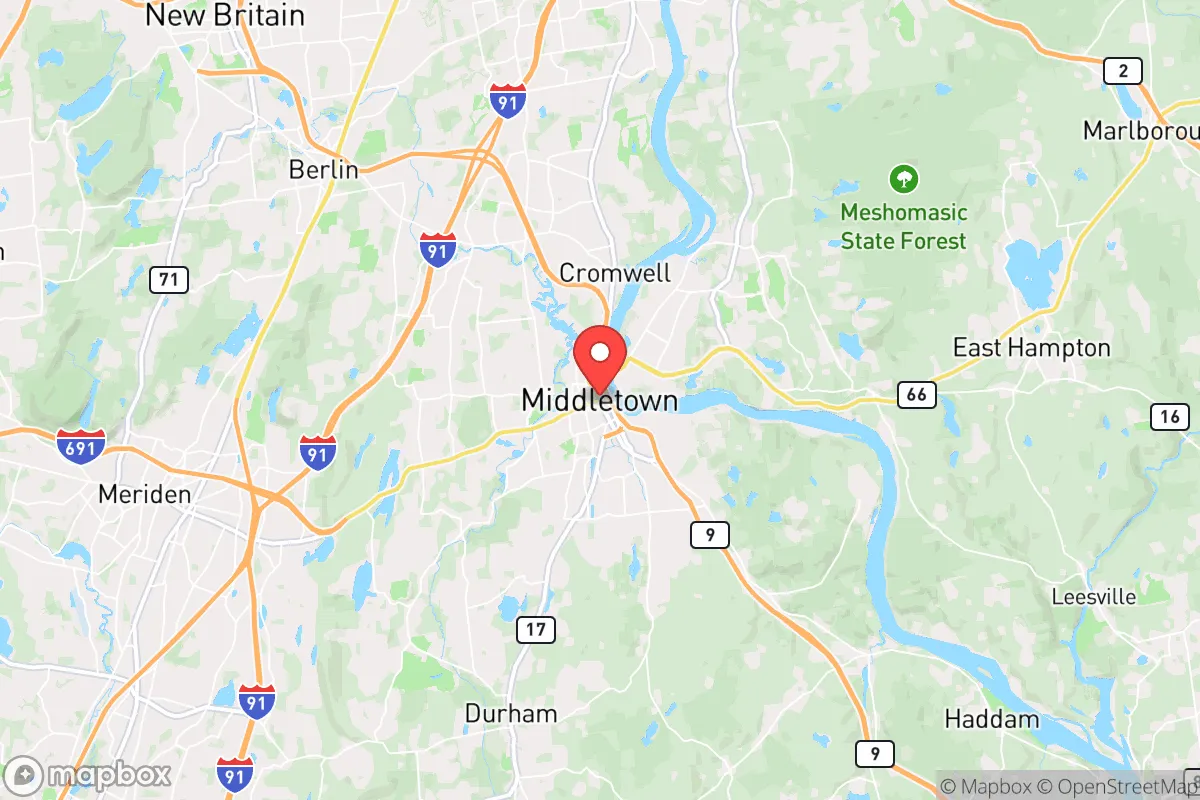
Political ClimatePolitical Climate in Middletown, CT
District shown is the primary district for this city’s centroid. Cities may span multiple districts.
Local Political AnalysisPolitical Analysis of Middletown, CT
Middletown, Connecticut, has a Cook PVI of D+12, meaning it leans heavily Democratic, and that shift has been pretty steady over the last decade. It wasn't always this way—I remember when this town had a more balanced mix of voices, where a conservative could speak their mind at a town hall without getting side-eyed. But the political climate here has moved decidedly left, and it's not just about voting patterns; it's about how that ideology is shaping daily life, from local ordinances to school policies.
How it compares
If you drive just a few miles out of Middletown, you'll hit towns like Middlefield or Durham, where the political vibe is noticeably more moderate or even conservative. Those places still have a "live and let live" feel, with lower taxes and less government meddling. In contrast, Middletown's city council and school board have embraced progressive priorities—things like equity initiatives in schools and zoning changes that push for higher-density housing, often overriding neighborhood concerns. Compared to nearby New Britain (which leans blue but is more working-class and pragmatic) or Wallingford (a bit more purple), Middletown stands out as a place where the progressive agenda is fully embraced, sometimes at the expense of personal freedoms like property rights or school choice.
What this means for residents
For a conservative or even a moderate living here, the biggest concern is the steady creep of government overreach. Local tax rates have climbed to fund expanded social programs and a growing municipal staff, and there's a push for more regulations on small businesses—like paid leave mandates and stricter health codes that hit mom-and-pop shops harder than chains. On the education front, the school system has moved away from traditional academics toward social-emotional learning and DEI training, which some parents feel sidelines core subjects and parental input. If you value limited government and personal responsibility, you'll find yourself increasingly at odds with the local direction. The housing market is also feeling it: new development rules favor apartment complexes over single-family homes, which changes the character of neighborhoods and can drive up costs for those who want a yard and some privacy.
What sets Middletown apart culturally and politically
One thing that really stands out is how Wesleyan University influences the town's politics. The university brings in a young, activist-minded population that pushes for things like defunding the police (which was debated here a few years back) and more public spending on social justice causes. That energy spills into city hall, making it harder for more traditional voices to be heard. There's also a strong push for sanctuary city policies and environmental regulations that go beyond state mandates—like banning natural gas hookups in new construction. For a long-time resident like me, it feels like the town is being reshaped by outsiders who don't always understand the local culture or the value of keeping government small. If this trajectory continues, I worry we'll lose the independent, neighborly spirit that made Middletown a great place to raise a family.

State Political ClimatePolitical Climate in Connecticut
State Political AnalysisPolitical Environment in the State
Connecticut has shifted from a classic swing state to a reliably blue stronghold over the past two decades, with Democrats now holding every statewide office, both U.S. Senate seats, and a supermajority in the state House. The state voted for Hillary Clinton by 14 points in 2016, Joe Biden by 20 points in 2020, and Kamala Harris by roughly 16 points in 2024, reflecting a durable Democratic lean driven by the affluent, educated suburbs of Fairfield County and the urban cores of Hartford and New Haven. For a conservative considering relocation, the state’s political trajectory is unmistakably leftward, with a policy environment that increasingly prioritizes government expansion over individual liberty.
Urban vs. rural divide
The political map of Connecticut is a tale of three distinct regions. The southwestern corner, anchored by Stamford, Greenwich, and Norwalk, is the engine of the Democratic vote—these are wealthy, highly educated suburbs where residents commute to New York City and vote overwhelmingly blue. The old industrial cities of Hartford, New Haven, and Bridgeport are deep blue strongholds, delivering margins of 70-80% for Democrats thanks to large minority populations and unionized public-sector workers. In contrast, the eastern and northwestern parts of the state—places like Litchfield County, Windham County, and towns such as Torrington and Killingly—vote reliably Republican, but their populations are too small to offset the coastal and urban blocs. The divide is stark: Fairfield County alone accounts for nearly a third of the state’s vote, and it’s trending bluer every cycle as New Yorkers flee high taxes but bring their politics with them. The rural-urban split isn’t just cultural; it’s demographic, with the rural areas aging and shrinking while the cities and suburbs grow through immigration and in-migration from blue states.
Policy environment
Connecticut’s policy environment is a case study in progressive governance with real consequences for personal freedom. The state has the highest per-capita tax burden in the nation, with a progressive income tax topping at 6.99% and property taxes among the highest in the country—the median effective property tax rate is 2.14%, nearly double the national average. The regulatory posture is heavy: the state has a $15.69 minimum wage (indexed to inflation), strict environmental regulations that drive up energy costs, and a paid family leave program funded by a 0.5% payroll tax on all workers. On education, Connecticut spends more per pupil than almost any other state, yet test scores have stagnated, and the state has aggressively pushed critical race theory and DEI mandates in public schools. Election laws are among the most permissive in the nation: no-excuse absentee voting, same-day registration, and automatic voter registration are all in place, with early voting expanded in 2023. The state also has some of the strictest gun laws in the country, including a 2023 law that bans open carry, raises the purchasing age to 21, and requires a permit for all firearm purchases—a direct infringement on Second Amendment rights that conservatives view as government overreach.
Trajectory & freedom
Connecticut is becoming less free by nearly any measure, and the trend has accelerated since 2020. The 2023 gun control law, Public Act 23-53, is the most restrictive in state history, effectively banning the carry of firearms in most public spaces and creating a de facto permit-to-purchase system that critics say violates the Bruen decision. On parental rights, the state passed a law in 2022 that prohibits schools from notifying parents if a child changes their gender identity or pronouns, a clear erosion of family autonomy. Medical freedom took a hit with the 2021 mandate that all healthcare workers receive the COVID-19 vaccine, a policy that remains in effect despite the end of the public health emergency. Property rights are constrained by strict zoning laws that limit development, particularly in affluent suburbs, and by a statewide property tax system that effectively penalizes homeownership. The state’s tax burden is not just high—it’s growing, with the 2023 budget including a new 1% surcharge on capital gains over $500,000. For conservatives, the trajectory is clear: each legislative session brings new restrictions on personal liberty, from speech (a 2023 law criminalizing “hate speech” in public schools) to economic freedom (a 2024 law banning non-compete agreements for most workers, which sounds good but actually limits contractual freedom).
Civil unrest & political movements
Connecticut has seen its share of political flashpoints, though they tend to be quieter than in neighboring states. The 2020 Black Lives Matter protests in Hartford and New Haven were large but largely peaceful, leading to calls for police reform that resulted in a 2020 law banning chokeholds and requiring body cameras. The state’s sanctuary status—Connecticut is a “Trust Act” state, meaning local police cannot cooperate with federal immigration enforcement—has made it a magnet for illegal immigration, with towns like Danbury and Norwalk seeing significant increases in migrant populations. This has sparked local backlash, particularly in Danbury, where the mayor has clashed with the state over sanctuary policies. On the right, the “Second Amendment sanctuary” movement gained traction in rural towns like Woodstock and Canterbury, where local boards passed resolutions vowing not to enforce new gun laws. Election integrity has been a persistent concern: the 2020 election saw widespread use of no-excuse absentee ballots, and a 2023 law made early voting permanent, raising fears among conservatives about ballot security. The most visible flashpoint for a new resident would be the constant tension between the state’s progressive policies and the growing conservative resistance in the rural and exurban areas, a dynamic that plays out in local town hall meetings and school board elections.
Projection
Over the next 5-10 years, Connecticut will likely become even more Democratic and more progressive, driven by two demographic trends. First, the state’s population is aging and shrinking—it lost population in the 2020 census—but the people moving in are disproportionately from New York and Massachusetts, bringing their blue-state politics with them. Second, the urban and suburban cores are growing through immigration, both legal and illegal, which tends to boost Democratic turnout. The rural Republican strongholds will continue to lose political influence as their populations decline, and the state’s gerrymandered legislative districts will ensure Democratic control for the foreseeable future. Expect more gun control, more tax increases, and more restrictions on parental rights and free speech. The only wild card is the state’s fiscal crisis: Connecticut has one of the highest debt burdens in the nation, and a future recession could force painful cuts that might shift public opinion. But for now, the trajectory is clear: Connecticut is a state where government power expands, and individual freedom contracts, with no sign of reversal.
For a conservative moving to Connecticut, the bottom line is this: you will be living in a state where your political views are in the minority, where your taxes will be among the highest in the nation, and where your rights—to bear arms, to direct your children’s education, to control your medical decisions—are under constant assault. The best you can hope for is to find a redoubt in a rural town like Litchfield or Kent, where local politics still reflect traditional values, but even there, the state government in Hartford will override local control at every opportunity. If you value freedom, Connecticut is not the place to be—and the trend lines suggest it will only get worse.
* Values derived from national, state, county, city and local statistics and may differ in a specific area. Last updated: 2026-04-19T07:28:28.000Z
Narrative content on this page is AI-generated and may contain mistakes. Verify any details that matter before acting on them.
ReloMaps may earn a commission from affiliate links at no extra cost to you.

