
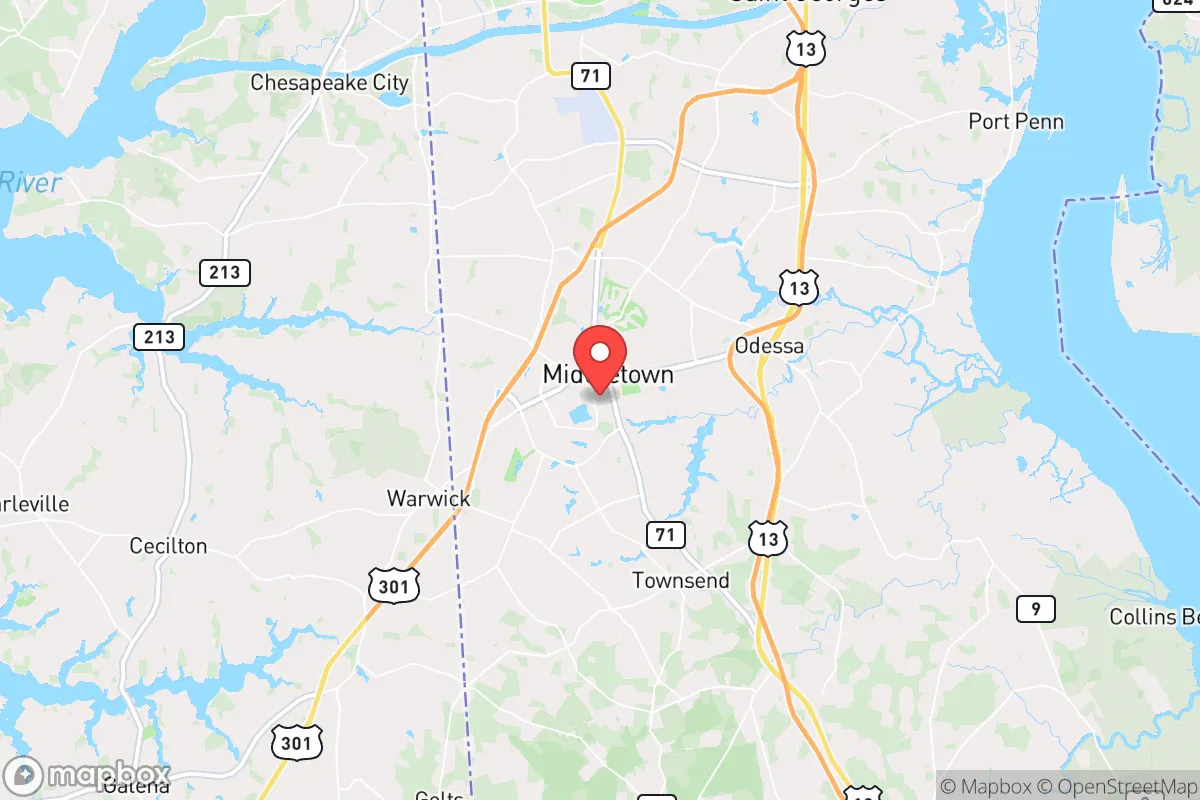
Photo: Wikipedia
Personal Sovereignty in Middletown, DE
Viable for self-reliance. Generally workable, though some barriers may limit total independence.
What does Personal Sovereignty tell us?
Personal Sovereignty measures your capacity for self-reliance and independence with minimal government friction. Higher scores mean fewer barriers between you and the way you want to live... but it assumes you have the space you need and good neighbors.
What does this tell us?
Personal Sovereignty measures your capacity for self-reliance and independence with minimal government friction. Higher scores mean fewer barriers between you and the way you want to live... but it assumes you have the space you need and good neighbors.
State Policy
Energy independence: Importer (2% of energy produced in-state)
Personal Liberty
Homesteading

Personal Liberty Analysis
Middletown, Delaware offers a mixed bag for those prioritizing personal sovereignty, with a state-level legal framework that provides some breathing room but also imposes notable constraints. While Delaware’s tax-friendly posture and relatively permissive gun laws attract those seeking autonomy, its regulatory environment and zoning restrictions can frustrate homesteading and off-grid ambitions. For a conservative-leaning individual or family weighing relocation, the key question is whether the town’s practical advantages outweigh the creeping influence of state-level overreach.
Tax burden and regulatory posture: How Delaware’s policies affect your wallet and freedom
Delaware’s tax structure is a clear win for sovereignty-minded residents. The state has no sales tax, which means every purchase—from groceries to firearms—avoids an extra layer of government extraction. Property taxes in Middletown are also low, with an effective rate around 0.55% of assessed value, well below the national average. This keeps housing costs predictable and reduces the financial leash tying you to local government. Income taxes are moderate, with a top marginal rate of 6.6%, but the absence of a sales tax and the state’s business-friendly incorporation laws signal a lighter regulatory touch than neighboring Maryland or New Jersey. However, Delaware’s regulatory posture is not uniformly libertarian. The state imposes strict environmental and building codes, particularly in New Castle County, which can slow or block construction projects. Zoning in Middletown leans suburban, with minimum lot sizes often around 0.25 to 0.5 acres in newer developments, limiting the ability to expand structures or operate small-scale enterprises without permits. For those seeking to minimize government interference in daily finances and property use, Delaware’s tax advantages are real, but the regulatory overhead is a persistent friction point.
Self-defense and gun law specifics: What you can and cannot do in Middletown
Delaware is a shall-issue state for concealed carry, meaning the government must issue a permit if you meet basic criteria—no subjective “good cause” requirement that gives officials veto power. This is a solid foundation for self-defense rights. Open carry is legal without a permit for anyone 18 or older, and the state preempts local gun ordinances, so Middletown cannot impose its own bans or restrictions. However, there are significant caveats. Delaware has a red flag law (Extreme Risk Protection Order) that allows authorities to seize firearms based on a court order without a criminal conviction—a tool many conservatives view as ripe for abuse. The state also bans “assault weapons” and large-capacity magazines, defined broadly enough to cover many popular rifles and handgun magazines over 15 rounds. These restrictions were enacted in 2022 and are actively enforced. For a prepper mindset, this means your ability to stockpile defensive tools is legally limited. Background checks are required for all firearm transfers, including private sales, which adds a bureaucratic layer to building an armory. While the right to carry is protected, the state’s appetite for gun control is growing, and Middletown residents must navigate a legal landscape that could tighten further.
Self-reliance and homesteading viability: Lot sizes, zoning, and off-grid feasibility
Middletown’s suburban character makes serious homesteading a challenge. Most residential lots in the town proper are 0.25 to 0.5 acres, with homeowners’ associations (HOAs) in many developments imposing restrictions on livestock, gardens, and outbuildings. Raising chickens is often permitted but limited to a few hens, and larger animals like goats or pigs are typically banned. Zoning in unincorporated areas of New Castle County allows for 1- to 5-acre parcels, but these are increasingly rare and expensive, with prices often exceeding $100,000 per acre. Off-grid living is effectively impossible within town limits—Middletown requires connection to municipal water and sewer, and building codes mandate grid-tied electrical systems. Solar panels are allowed but must be approved by the HOA or local planning board, and battery storage for full independence is not standard. For those willing to look beyond the town’s borders, southern New Castle County and nearby Kent County offer more rural zoning, but the regulatory hurdles for well water, septic systems, and alternative energy remain. The state’s net metering policy is favorable for solar, but the upfront cost and permitting process can deter all but the most determined. In short, Middletown is not a homesteading haven; it’s a bedroom community where self-reliance is limited to backyard gardens and emergency supplies, not land-based independence.
Personal liberties: Parental rights, medical autonomy, speech, and property
Delaware’s record on parental rights is mixed. The state has no explicit parental rights statute in its education code, meaning school boards have broad authority over curriculum and health policies. In practice, Middletown’s Appoquinimink School District has adopted progressive policies on gender identity and sex education, with opt-out options available but not always clearly communicated. Medical autonomy is similarly constrained—Delaware has a mandatory vaccine schedule for school attendance with limited religious exemptions and no philosophical exemption. The state also expanded Medicaid under the ACA and has a state-run health insurance exchange, reflecting a preference for government-managed healthcare. Free speech protections align with the First Amendment, but Delaware’s hate crime laws and anti-discrimination statutes can be used to prosecute speech deemed harassing, which some conservatives view as chilling. Property rights are generally strong, with no statewide rent control and a straightforward eviction process, but the state’s environmental regulations can restrict land use, particularly near wetlands or agricultural areas. For a survivalist mindset, the lack of robust parental and medical autonomy protections is a red flag—Delaware’s government is willing to override individual choice in education and health, which could escalate in a crisis.
Overall, Middletown’s personal sovereignty profile is a study in contrasts. The low tax burden and permissive concealed carry laws provide tangible freedoms that many conservative relocators will appreciate. But the state’s regulatory creep—red flag laws, assault weapon bans, mandatory vaccines, and suburban zoning—limits the depth of autonomy available. Compared to rural areas in the South or Mountain West, Middletown offers less room for off-grid living and self-reliance. For those willing to work within a system that grants some liberties while restricting others, it’s a viable option. But for those seeking maximum sovereignty with minimal government footprint, Delaware’s blue-state tendencies make it a compromise, not a sanctuary.

* Values derived from national, state, county, city and local statistics and may differ in a specific area. Last updated: 2026-04-29T22:24:52.000Z
Narrative content on this page is AI-generated and may contain mistakes. Verify any details that matter before acting on them.
ReloMaps may earn a commission from affiliate links at no extra cost to you.

