Photo: Wikipedia
Demographics of Middletown, DE
Affluence Level in Middletown, DE
An upper-middle-class area. Household wealth, education levels, and homeownership run ahead of national benchmarks.
People of Middletown, DE
Middletown, Delaware, is a rapidly growing town of 24,071 residents that has transformed from a quiet agricultural crossroads into a majority-minority suburb with a distinctive blend of established Black families, a growing Indian-subcontinent professional class, and a shrinking white plurality. The population is notably well-educated, with 45.5% holding a college degree, and is overwhelmingly native-born, as only 2.8% of residents are foreign-born. The town’s character is shaped by its position as an affordable alternative to northern Delaware suburbs, attracting families seeking newer housing stock and good schools while maintaining a relatively low density compared to Newark or Wilmington. The racial composition—55.1% white, 27.8% Black, 5.7% Hispanic, 4.6% Indian, and 1.0% East/Southeast Asian—reflects distinct settlement waves that have layered atop one another over the past three centuries.
How the city was settled and grew
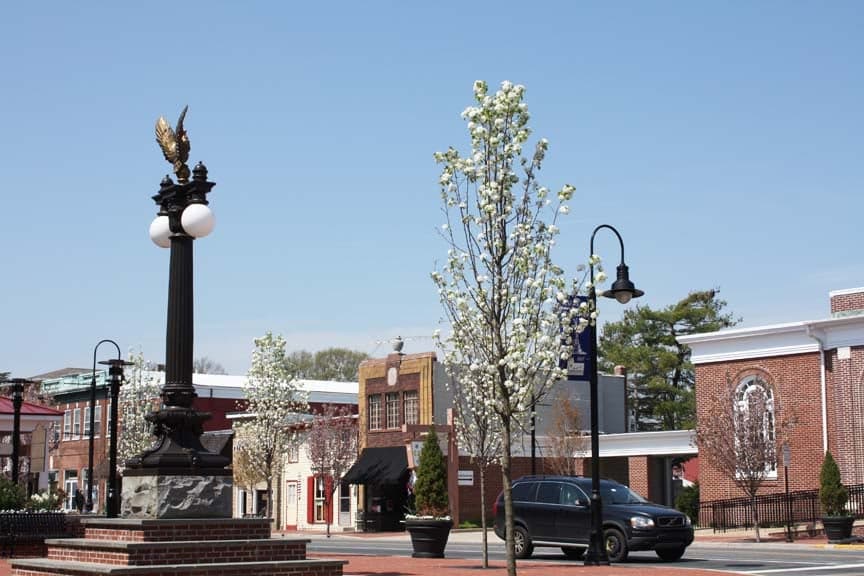
Middletown’s original population was English and Scots-Irish farmers drawn to the fertile Piedmont soils of the Appoquinimink Hundred in the late 17th and early 18th centuries. The town was formally laid out in 1761 as a market center for surrounding tobacco and grain plantations, and its early residents were predominantly small farmers, merchants, and craftsmen of British descent. The construction of the Delaware Railroad in the 1850s connected Middletown to Wilmington and the Eastern Shore, bringing a modest influx of German and Irish laborers who settled in what is now the Historic District around Cochran Square and along Main Street. By the early 20th century, the population remained overwhelmingly white and rural, with a small but established Black community concentrated in the West Side neighborhood near the railroad tracks, where many worked as domestic servants and farm laborers for white landowners. The town’s growth stagnated through the mid-20th century, with the 1960 census recording just 2,700 residents, as young people left for Wilmington and Philadelphia and the agricultural economy contracted.
Modern era (post-1965)
The post-1965 transformation of Middletown began slowly but accelerated dramatically after 1990. The first major shift was the arrival of Black families from Wilmington and northern Delaware, drawn by the construction of Interstate 95 and the expansion of the Middletown-Odessa-Townsend corridor as a bedroom community for Dover Air Force Base and Wilmington employers. These families settled primarily in the Bunker Hill and Silver Lake subdivisions, which offered affordable single-family homes on larger lots than the aging rowhouses of Wilmington. By 2000, the Black population had grown to roughly 20% of the town’s 6,000 residents, and the white share had fallen from near-total to about 75%. The second wave, beginning around 2005, was driven by the expansion of the Summit Bridge Road corridor and the construction of master-planned communities like Village of Westover and Clearview, which attracted Indian-subcontinent professionals—many working in healthcare, engineering, and finance in Newark, Wilmington, and Philadelphia. These families, largely from India and Pakistan, now make up 4.6% of the population and are concentrated in the newer subdivisions east of Route 301, where homes built after 2010 offer the square footage and school districts these families prioritize. The Hispanic population, at 5.7%, is more dispersed but has a visible presence in the Bunker Hill area and in service-sector jobs in the town’s growing retail corridor. East/Southeast Asian residents, at just 1.0%, are a small but growing presence, primarily in the Clearview and Village of Westover subdivisions, working in similar professional fields.
The future
Middletown’s population is heading toward further diversification, but the pattern is one of distinct enclaves rather than full integration. The white share, now 55.1%, is declining steadily as older residents age in place in the Historic District and older subdivisions, while younger white families increasingly choose newer developments in nearby Townsend or Smyrna. The Black population, at 27.8%, is stable and increasingly middle-class, with second-generation families moving from Bunker Hill into newer subdivisions like Clearview. The Indian-subcontinent community, at 4.6%, is the fastest-growing segment, driven by continued professional migration and chain migration from existing families; this group is likely to reach 7-8% of the population by 2035, concentrated in the newer eastern subdivisions. The Hispanic population is growing slowly, primarily through natural increase rather than new immigration, and remains the most economically diverse group, with families spread across both older and newer neighborhoods. The foreign-born share, at just 2.8%, is low for a suburb of this size, suggesting that most growth comes from domestic migration rather than international immigration. Over the next decade, Middletown will likely become a majority-minority town, with no single group holding a majority, but with distinct neighborhoods reflecting each wave’s timing and housing preferences.
For a conservative-leaning family or individual considering relocation, Middletown offers a stable, family-oriented environment with good schools and relatively low crime, but the town is clearly in demographic transition. The population is becoming more diverse, more educated, and more suburban, with the Historic District retaining a small-town feel while newer subdivisions feel like any other mid-Atlantic exurb. The key question for newcomers is which neighborhood aligns with their priorities: the established Black community in Bunker Hill and Silver Lake, the Indian-professional enclaves in Clearview and Village of Westover, or the older, whiter Historic District. The town’s future is one of managed growth and gradual integration, not rapid upheaval, making it a solid choice for those who value stability and community over urban amenities or rural isolation.

* Values derived from national, state, county, city and local statistics and may differ in a specific area. Last updated: 2026-04-29T22:24:52.000Z
Narrative content on this page is AI-generated and may contain mistakes. Verify any details that matter before acting on them.
ReloMaps may earn a commission from affiliate links at no extra cost to you.

