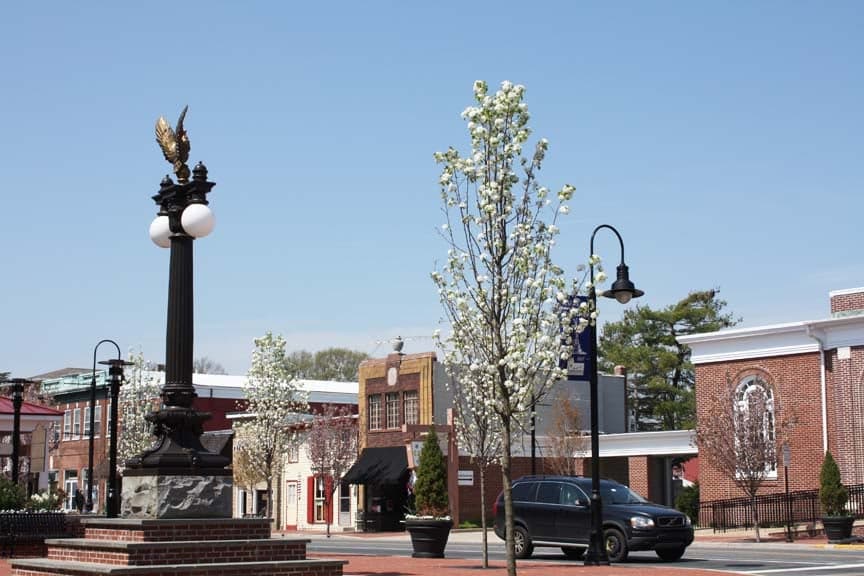
Photo: Wikipedia
Political ClimatePolitical Climate in Middletown, DE
District shown is the primary district for this city’s centroid. Cities may span multiple districts.
Inherited from parent state — no local data available.
Local Political AnalysisPolitical Analysis of Middletown, DE
Look, I’ve lived in Middletown long enough to remember when this was a quiet farming town where folks kept to themselves and the biggest political debate was whether to pave another road. Today, with a Cook PVI of D+8, the area has shifted hard to the left—a trend that’s accelerated as waves of new residents from New Jersey, New York, and Maryland have poured in over the last decade. The local elections and policy decisions now lean reliably Democratic, and that’s a real departure from the independent, live-and-let-live spirit that used to define this place.
How it compares
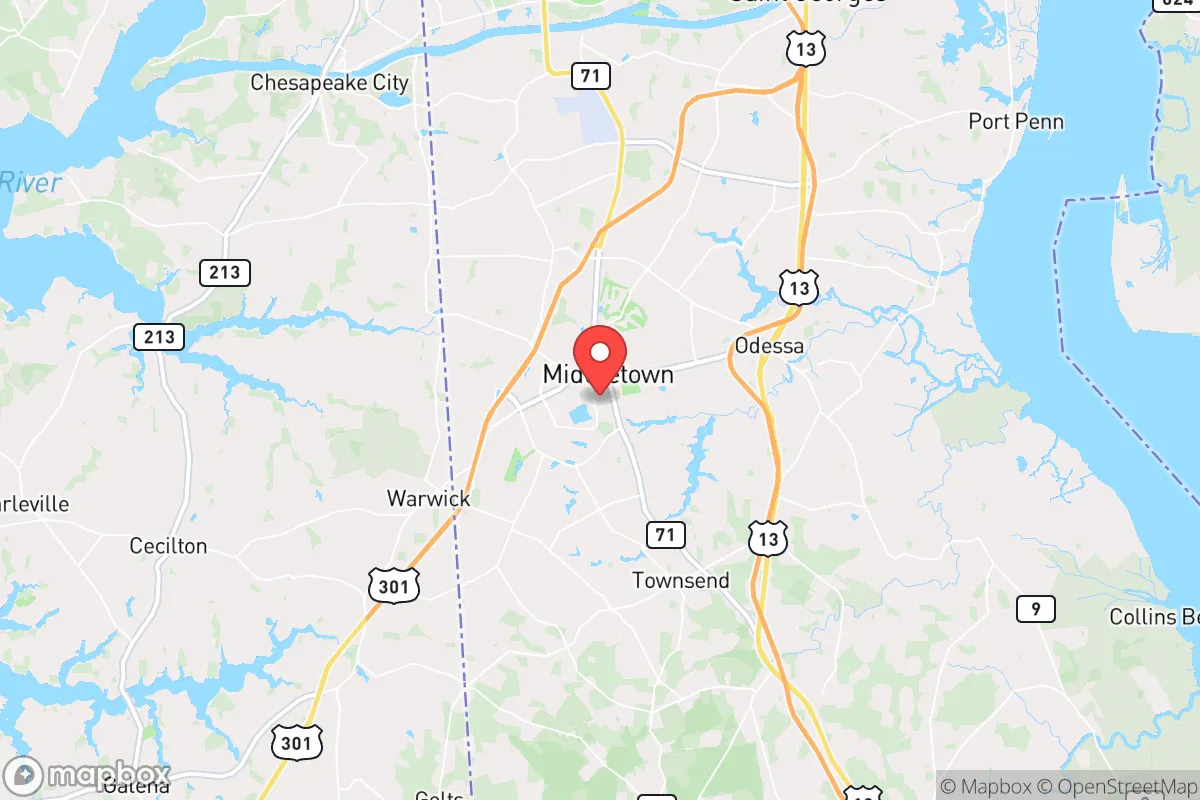
Drive 15 minutes south to Smyrna or 20 minutes west to Townsend, and you’ll feel the political temperature drop. Those towns still vote more conservative, with Republican margins of 5 to 10 points in recent county races. Even Odessa, just north on Route 1, hasn’t swung as hard as Middletown. The contrast is stark: while Smyrna’s town council debates property tax caps and Second Amendment resolutions, Middletown’s leaders are pushing zoning changes for higher-density housing and expanding public transit—moves that feel like they’re designed for a commuter suburb, not a historic small town. It’s like we’re becoming an outlier in our own county, and that rubs a lot of longtime residents the wrong way.
What this means for residents
For folks who value personal freedoms and limited government, the shift is concerning. You’re seeing more local ordinances that nibble at the edges of daily life—stricter noise regulations, limits on short-term rentals, and a school board that’s increasingly focused on DEI initiatives over core academics. Property taxes have crept up faster than in surrounding areas, partly to fund new municipal staff positions tied to grant programs from Dover. The real worry is that this progressive momentum could lead to overreach: think mask mandates that outlast state guidance, or business licensing requirements that favor chain stores over mom-and-pops. If you’re a gun owner or someone who values low regulation, you’re starting to feel like your voice is drowned out by newcomers who want Middletown to be a mini-Wilmington rather than what it was.
What’s distinct about Middletown’s culture and policy
One thing that still sets Middletown apart is its strong sense of community—at least among the old guard. The annual Apple Scrapple Festival and the local farmers’ market remain fiercely independent, with vendors who’ll tell you straight up they don’t appreciate the new politics. But the cultural divide is real: you’ve got two distinct groups now—those who’ve been here 20+ years and those who moved in post-2015. The policy battles reflect that. The recent fight over the town’s comprehensive plan was a perfect example—longtime residents wanted to preserve rural character and keep development low-density, but the council pushed through a plan that allows for more apartments and mixed-use projects. It’s not just about politics; it’s about whether Middletown will still feel like home in five years. If the trend holds, I’d expect more friction over school curriculum, land use, and tax policy. Keep an eye on the 2026 local elections—that’s where the real fight will be.

State Political ClimatePolitical Climate in Delaware
State Political AnalysisPolitical Environment in the State
Delaware has long been a blue state in presidential elections, voting for Democrats by double digits in every cycle since 2008, but its political climate is far more nuanced than that headline suggests. The state’s dominant coalition is built on the heavily populated, left-leaning New Castle County (home to Wilmington and Newark), which reliably delivers 60%+ margins for Democrats, while the more rural Kent and Sussex counties have been trending redder over the past two decades. Over the last 10-20 years, the overall partisan lean has shifted from a competitive purple state to a solidly blue one, driven by explosive growth in the northern suburbs and a steady influx of out-of-state professionals, though the southern half remains a conservative stronghold that feels increasingly disconnected from Dover’s policy direction.
Urban vs. rural divide
The political map of Delaware is essentially a tale of three counties. New Castle County, anchored by Wilmington and the sprawling suburbs of Newark, Pike Creek, and Hockessin, is the Democratic engine room — it casts roughly 40% of the state’s total votes and routinely delivers 62-65% for Democratic candidates. This area is dominated by corporate professionals, university faculty (University of Delaware), and a significant African American population in Wilmington that votes overwhelmingly Democratic. In contrast, Sussex County — the beach and farming region including Rehoboth Beach, Lewes, and Georgetown — has become the state’s most reliably Republican territory, with GOP candidates often winning by 10-15 points. Kent County, home to Dover and the state capital, is the true battleground: it’s split almost evenly, with the city of Dover leaning Democratic and the surrounding rural areas (like Smyrna and Milford) leaning Republican. The divide isn’t just geographic — it’s cultural. Northern Delaware feels like an extension of the Philadelphia metroplex, while southern Delaware shares more in common with the Eastern Shore of Maryland and Virginia.
Policy environment
Delaware’s policy environment is a mixed bag that should give any freedom-minded person pause. On taxes, the state is a double-edged sword: there’s no state sales tax (a huge plus), but income tax rates are steep, topping out at 6.6% on income over $60,000, and property taxes are moderate. The regulatory posture is decidedly progressive — Delaware was one of the first states to mandate paid family leave (2022) and has some of the strictest environmental regulations on the East Coast, particularly around coastal development and wetlands. Education policy is a flashpoint: the state’s school choice program is decent, with charter schools and vouchers available, but the teachers’ union is powerful and has successfully blocked most school accountability reforms. Healthcare is heavily regulated, with the state running its own exchange and expanding Medicaid aggressively under the ACA. Election laws are a concern: Delaware has no voter ID requirement, offers same-day registration, and has universal mail-in voting (enacted in 2024), which critics argue opens the door to fraud. The state also has a “sanctuary” policy that limits cooperation between local law enforcement and ICE, which has become a hot-button issue in Sussex County.
Trajectory & freedom
Over the past five years, Delaware has been moving decisively in the direction of less personal freedom. The most alarming trend is on gun rights: in 2023, the legislature passed a sweeping “assault weapons” ban (HB 124) and a 10-round magazine limit, along with a permit-to-purchase requirement and a ban on open carry. These laws were pushed through by Governor John Carney and a Democratic supermajority, despite fierce opposition from rural counties. On parental rights, the state passed a law in 2022 (HB 322) that prohibits schools from notifying parents if a child changes their gender identity or pronouns — a direct assault on family authority. Medical autonomy has also taken a hit: Delaware legalized recreational marijuana in 2023, but the state’s medical board has imposed strict vaccine mandates for healthcare workers and school staff, with no religious exemption. Property rights are under pressure from aggressive land-use regulations, particularly in Sussex County, where new development is often blocked by environmental lawsuits. On the positive side, Delaware has no estate tax and no inheritance tax, which is a rare bright spot for wealth preservation.
Civil unrest & political movements
Delaware has seen its share of political flashpoints, though they tend to be more legal than violent. The most visible movement is the growing conservative backlash in Sussex County, where groups like the Sussex County Republican Committee and the Delaware Family Policy Council have organized large rallies against the gun ban and parental notification laws. In 2020, Wilmington saw several nights of protests and looting following the George Floyd incident, which led to a permanent increase in police presence downtown. Immigration politics are tense: the sanctuary policy has led to a steady stream of illegal immigrants being released into the state, particularly in New Castle County, and there have been several high-profile incidents of ICE detainers being ignored. Election integrity remains a sore spot — the 2020 and 2022 elections saw widespread use of drop boxes and mail-in ballots, and a 2024 audit of voter rolls found thousands of potentially ineligible registrations, though the state refused to purge them. There’s also a small but vocal secession movement in Sussex County, with some residents pushing for a “Delmarva” breakaway state, though it’s mostly symbolic.
Projection
Looking ahead 5-10 years, the trajectory is concerning for anyone who values limited government. Demographic trends are working against conservatives: New Castle County is growing faster than the rest of the state, driven by young professionals fleeing high taxes in New Jersey and New York, and they tend to bring their progressive voting habits with them. The Hispanic population in Sussex County is also growing rapidly, and while many are conservative on social issues, they tend to vote Democratic on economic ones. The Democratic supermajority in the legislature is likely to hold or even expand, meaning more gun control, more vaccine mandates, and more restrictions on parental rights. The one wild card is the potential for a Republican governor in 2028 — if the GOP can find a moderate candidate who appeals to the beach towns, they could slow the leftward march. But realistically, anyone moving to Delaware now should expect the state to become more like New Jersey or Maryland over the next decade: higher taxes, more regulation, and less personal freedom.
Bottom line for a new resident: If you’re a conservative looking to relocate, Delaware offers a few bright spots — no sales tax, decent school choice, and a strong sense of community in the southern counties — but the political winds are blowing hard against you. The northern suburbs are solidly blue and getting bluer, the state government is hostile to gun rights and parental authority, and the sanctuary policies are a real concern. If you do move here, stick to Sussex County (especially areas like Lewes, Georgetown, or Millsboro) where you’ll find like-minded neighbors and a slower pace of life. But don’t expect the state to become more friendly to your values — it’s almost certainly going the other way.
* Values derived from national, state, county, city and local statistics and may differ in a specific area. Last updated: 2026-04-29T22:24:52.000Z
Narrative content on this page is AI-generated and may contain mistakes. Verify any details that matter before acting on them.
ReloMaps may earn a commission from affiliate links at no extra cost to you.

