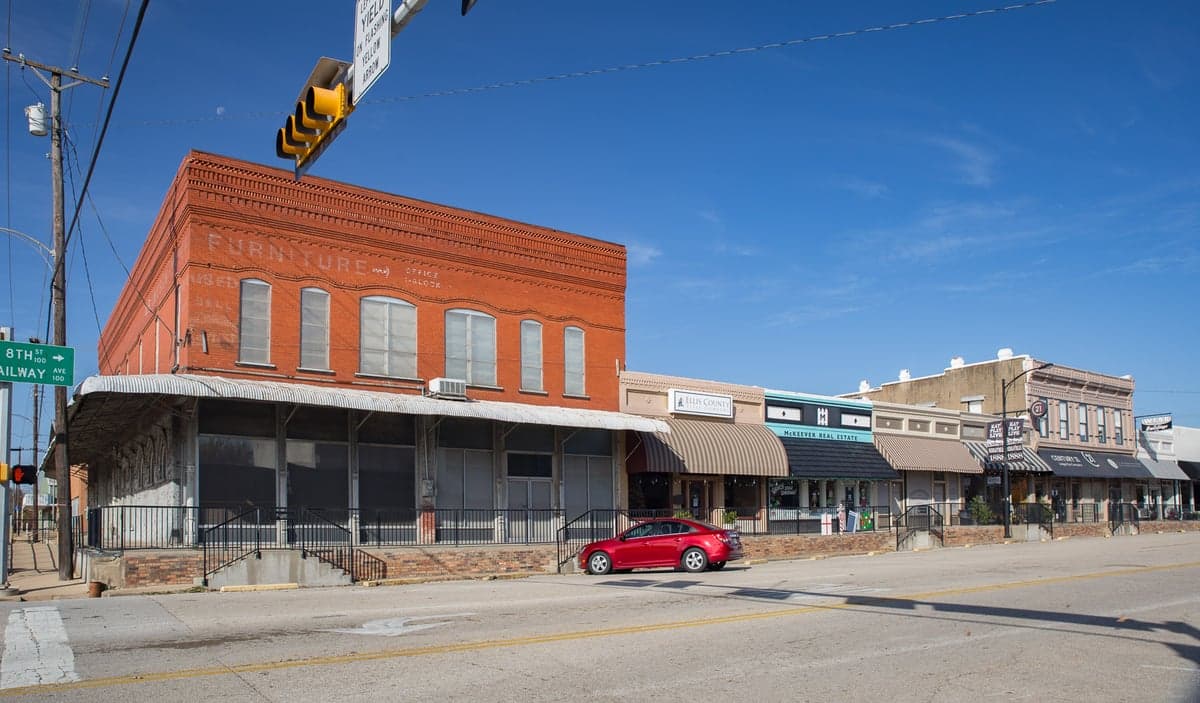
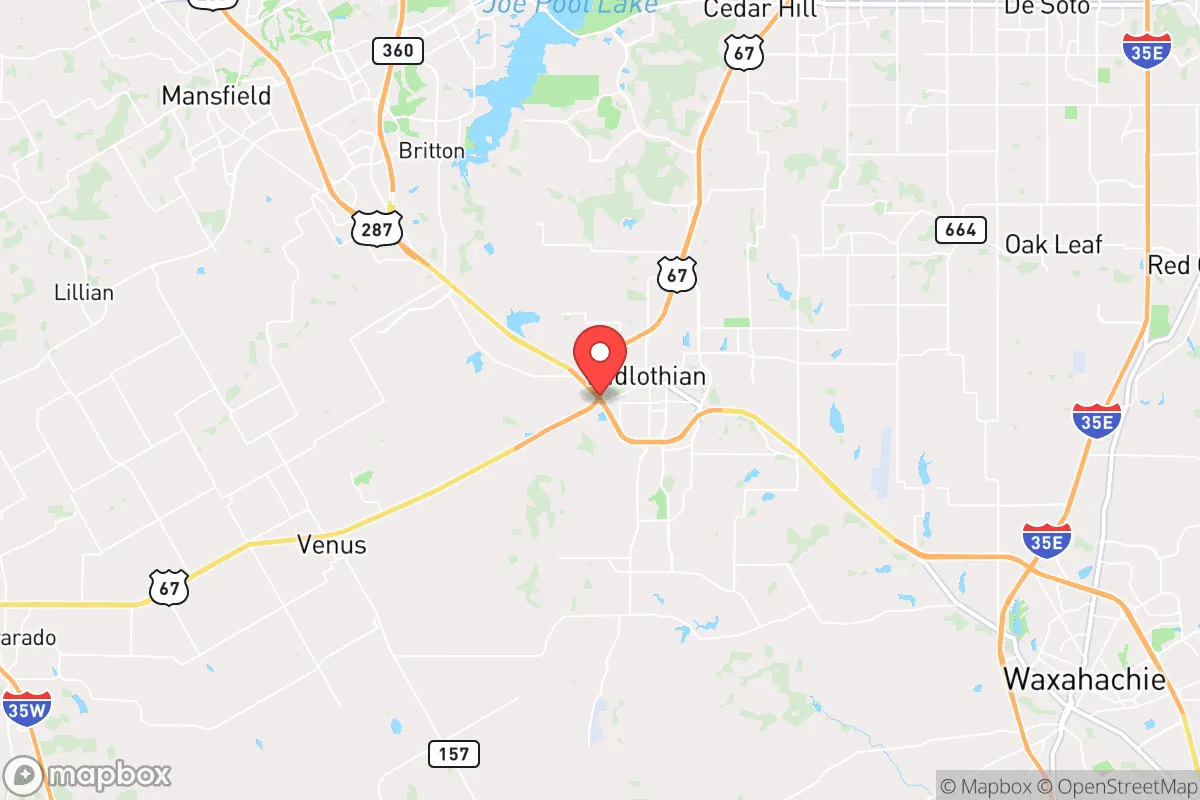
Photo: Wikipedia
Personal Sovereignty in Midlothian, TX
Strong independent fundamentals that actively favor personal liberty and low regulation.
What does Personal Sovereignty tell us?
Personal Sovereignty measures your capacity for self-reliance and independence with minimal government friction. Higher scores mean fewer barriers between you and the way you want to live... but it assumes you have the space you need and good neighbors.
What does this tell us?
Personal Sovereignty measures your capacity for self-reliance and independence with minimal government friction. Higher scores mean fewer barriers between you and the way you want to live... but it assumes you have the space you need and good neighbors.
State Policy
Energy independence: Net exporter (220% of energy produced in-state)
Personal Liberty
Homesteading

Personal Liberty Analysis
Midlothian, Texas, offers a notably high degree of personal sovereignty compared to many parts of the country, particularly for those who prioritize minimal government interference in daily life. Located in Ellis County, a reliably conservative area south of the Dallas-Fort Worth metroplex, the town operates within a state framework that actively limits local overreach on issues like taxation, self-defense, and parental authority. For the strategic relocator with a prepper or survivalist mindset, Midlothian represents a solid balance—close enough to urban resources for supply runs and employment, yet far enough to avoid the heavy regulatory hand found in cities like Dallas or Austin. The local culture and governance lean heavily toward individual responsibility, making it a viable base for those seeking to insulate themselves from broader societal instability.
Tax burden and regulatory posture in Ellis County
Texas’s lack of a state income tax is the headline benefit, but the real sovereignty advantage in Midlothian lies in its local tax structure and regulatory climate. Ellis County maintains a relatively low property tax rate compared to neighboring counties like Dallas or Tarrant, with the Midlothian Independent School District’s rate hovering around 1.3% of assessed value—a figure that, while not negligible, is competitive for the region. The county’s approach to zoning and land use is notably permissive: there is no county-wide zoning in unincorporated areas, and even within Midlothian city limits, regulations are far less restrictive than in major metro hubs. For a prepper, this means fewer hurdles for building a workshop, storing supplies, or constructing auxiliary structures like a storm shelter or root cellar. The state’s Chapter 233 of the Texas Local Government Code also limits municipal ability to impose overly burdensome building codes on agricultural or rural properties, preserving a degree of autonomy that is increasingly rare in urbanized Texas.
Self-defense and gun law specifics in Midlothian
Texas is a constitutional carry state, and Midlothian fully reflects that posture. No permit is required to carry a handgun openly or concealed for anyone legally allowed to possess a firearm, and the city has no local ordinances that restrict this right beyond state law. For the survivalist, this means immediate, unencumbered access to self-defense tools without bureaucratic delays. Ellis County is also a strong Second Amendment sanctuary county, with local law enforcement publicly stating they will not enforce federal gun control measures they deem unconstitutional. The sheriff’s office is known for a pro-citizen stance on defensive use of force, and Texas’s Castle Doctrine and Stand Your Ground laws apply fully here—no duty to retreat in your home, vehicle, or any place you have a legal right to be. For those building a defensive stockpile, there are no local magazine capacity bans, no firearm registration requirements, and no waiting periods beyond the federal NICS check. This is a jurisdiction where the legal framework aligns with the principle that personal safety is an individual responsibility.
Self-reliance and homesteading viability in Midlothian
Midlothian’s zoning and lot sizes make it a strong candidate for those pursuing a self-reliant lifestyle. While the city itself has standard suburban lots (typically 0.25 to 0.5 acres), the surrounding unincorporated areas of Ellis County offer acreage parcels from 1 to 20+ acres at prices significantly lower than comparable land in Collin or Denton counties. A 5-acre plot with a well and septic can often be found for under $100,000, making off-grid infrastructure financially feasible. The county’s zoning code explicitly allows for agricultural uses, including livestock, beekeeping, and crop cultivation on parcels as small as 2 acres in most rural districts. Rainwater harvesting is legal and encouraged, with no state-level restrictions on collection. Solar panel installation is straightforward, though homeowners should check with their specific homeowners’ association if buying in a subdivision—many newer developments have restrictions that can limit off-grid independence. For the prepper, the key takeaway is that Ellis County’s regulatory environment does not actively obstruct self-sufficiency; the main barriers are HOA covenants, not government overreach.
Personal liberties: parental rights, medical autonomy, speech, and property
Midlothian sits in a state that has aggressively moved to protect parental rights in education. Texas law requires school districts to adopt policies that allow parents to review curriculum and instructional materials, and the Parental Bill of Rights (HB 547) explicitly affirms that parents have the fundamental right to direct their child’s upbringing. In practice, Midlothian ISD has been responsive to parent concerns, with a school board that leans conservative and a superintendent who has publicly supported transparency. On medical autonomy, Texas has banned vaccine passports and prohibits employers from mandating COVID-19 vaccines in most circumstances, though private businesses retain some discretion. For the survivalist, this means fewer state-level mandates that could interfere with personal health decisions. Free speech is robustly protected under the Texas Religious Freedom Restoration Act and state laws that limit local governments from restricting public expression. Property rights are similarly strong: Texas has no state-level eminent domain abuse comparable to some northeastern states, and Ellis County’s appraisal district is known for relatively fair valuations. The overall environment is one where the individual—not the government—is presumed to have the final say in most personal matters.
In the broader context of the United States, Midlothian ranks as a strong contender for those prioritizing personal sovereignty. It lacks the extreme libertarian lean of rural Idaho or Montana, but it offers a more practical balance of access to urban infrastructure and a legal environment that respects individual autonomy. The main trade-offs are the property tax burden (which funds a well-regarded school system and emergency services) and the proximity to a major metro area that could be a target in a crisis scenario. For the strategic relocator who values self-defense, minimal regulation, and the ability to live as they see fit without government interference, Midlothian provides a solid foundation—one that is likely to remain stable even as other parts of the country drift toward greater centralization of power.

* Values derived from national, state, county, city and local statistics and may differ in a specific area. Last updated: 2026-04-19T07:11:01.000Z
Narrative content on this page is AI-generated and may contain mistakes. Verify any details that matter before acting on them.
ReloMaps may earn a commission from affiliate links at no extra cost to you.

