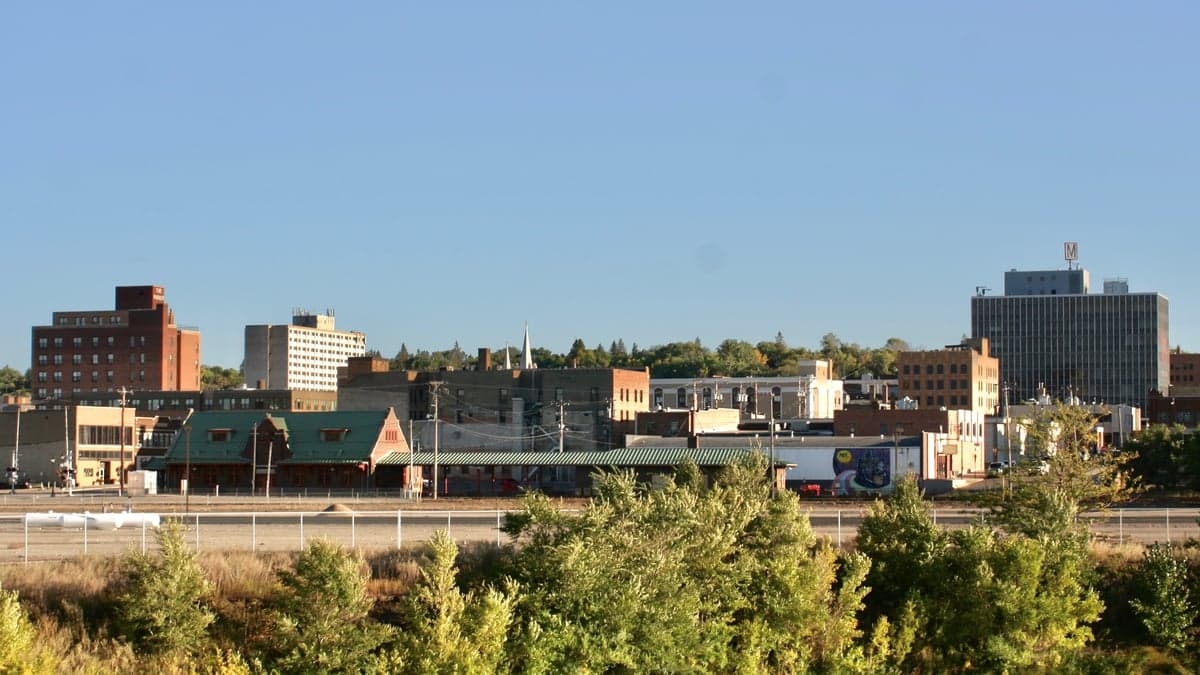
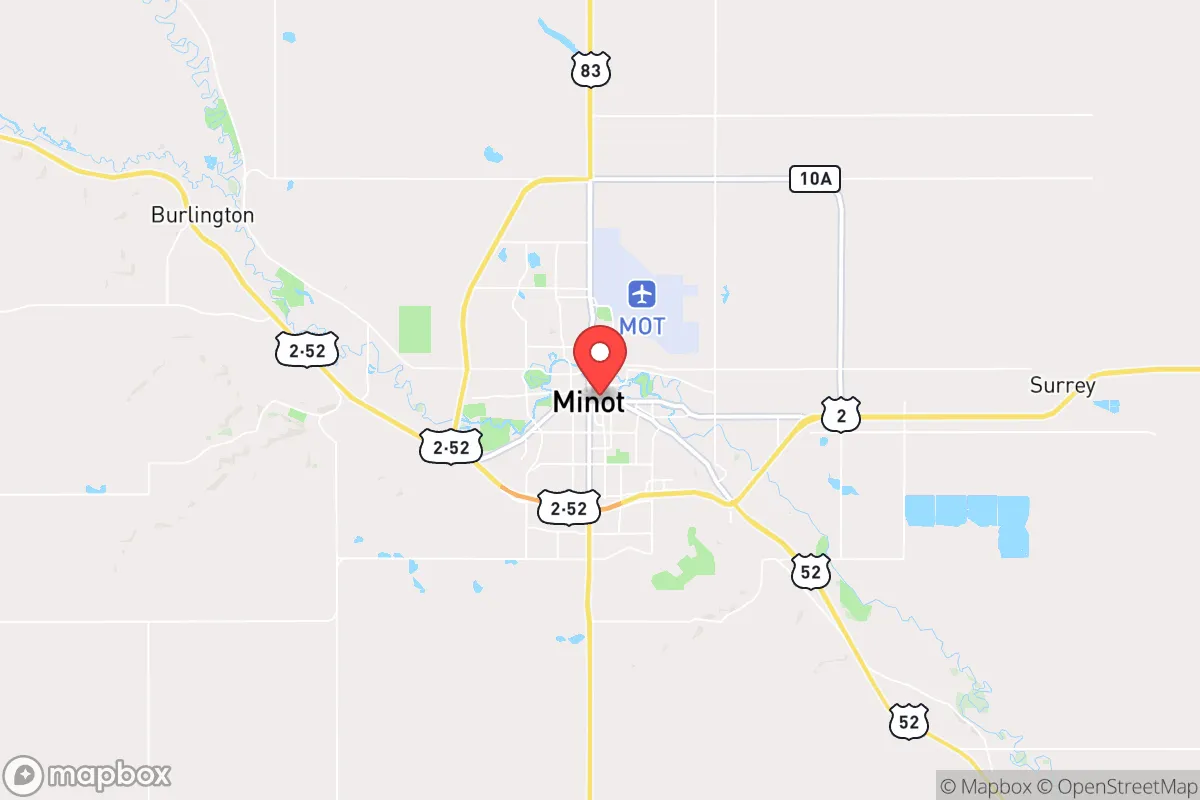
Photo: Wikipedia
Demographics of Minot, ND
Affluence Level in Minot, ND
A middle-class area roughly in line with national averages across income, home values, education, and employment.
People of Minot, ND
The people of Minot, North Dakota, today number 47,922 and form a predominantly white, family-oriented community with a strong military and agricultural heritage. The city’s identity is shaped by its role as a regional trade and service hub, anchored by Minot Air Force Base, and by a population that is 79.4% white, 7.2% Hispanic, 4.7% Black, and 1.7% East/Southeast Asian. With a foreign-born share of just 2.9% and a college-educated rate of 29.9%, Minot remains less diverse and less highly educated than the national average, but its character is evolving as new industries and military rotations bring fresh arrivals.
How the city was settled and grew
Minot was founded in 1886 as a railroad town on the Great Northern Railway line, named after investor Henry D. Minot. The original population was overwhelmingly Northern European—Norwegian, German, and Scandinavian immigrants drawn by the promise of homesteading land under the 1862 Homestead Act and later the 1909 Enlarged Homestead Act. These settlers built the city’s earliest neighborhoods: Scandinavian Heritage Park area in the north-central part of town commemorates this wave, while the Eastwood Park and North Hill neighborhoods were developed by early 20th-century workers employed by the railroad and the region’s booming wheat and cattle industries. A second major wave came during the 1950s and 1960s with the establishment of Minot Air Force Base in 1957, which brought military families from across the United States. The Airport Area and South Hill neighborhoods expanded rapidly to house base personnel, creating a distinct military-adjacent community within the city. By the 1970 census, Minot’s population had grown to over 32,000, and the city’s demographic base remained overwhelmingly white and native-born.
Modern era (post-1965)
Post-1965 immigration reforms had a modest effect on Minot compared to larger cities. The city’s foreign-born population remains low at 2.9%, but the composition has shifted. The largest non-white group today is Hispanic residents at 7.2%, many of whom arrived in the 2000s and 2010s to work in construction, meatpacking, and agriculture. They have concentrated in the West Minot area, particularly around the 16th Street corridor, where lower-cost housing and proximity to industrial employers drew families. The Black population, at 4.7%, is largely tied to the Air Force base; active-duty and retired Black service members and their families live in the Airport Area and South Hill neighborhoods, alongside white military families. East/Southeast Asian residents (1.7%) include Vietnamese and Filipino families, many with military connections, clustered near the base. The Indian-subcontinent population is negligible at 0.2%. Suburbanization has been limited; the Fox Run subdivision in the southeast and newer developments near Burdick Expressway have attracted middle-class families, but Minot’s core neighborhoods remain stable and largely white.
The future
Minot’s population is projected to remain stable or grow slowly, driven by the base’s continued presence and the region’s energy sector (oil and gas in the Bakken formation). The Hispanic share is likely to increase gradually as agricultural and service-sector jobs attract more families, but the city is not experiencing rapid diversification. The white population, while still dominant, is aging; the median age is 34.7, and younger families are often military or energy workers who may not stay long-term. The city is not tribalizing into distinct ethnic enclaves—neighborhoods remain mixed, with the exception of the military-heavy Airport Area. The next 10–20 years will likely see a slow rise in Hispanic and East/Southeast Asian shares, but Minot will remain a predominantly white, family-oriented community where the Air Force and agriculture anchor the economy and the social fabric.
For someone moving to Minot now, the city offers a stable, safe, and community-focused environment with a strong military presence and a conservative political lean. The population is not highly diverse, but it is welcoming to newcomers, especially those connected to the base or the energy sector. The key trade-off is between a low cost of living and a limited range of cultural and educational amenities—a reality that suits families and single individuals seeking a quiet, predictable lifestyle in the northern Plains.

* Values derived from national, state, county, city and local statistics and may differ in a specific area. Last updated: 2026-04-19T05:54:22.000Z
Narrative content on this page is AI-generated and may contain mistakes. Verify any details that matter before acting on them.
ReloMaps may earn a commission from affiliate links at no extra cost to you.

