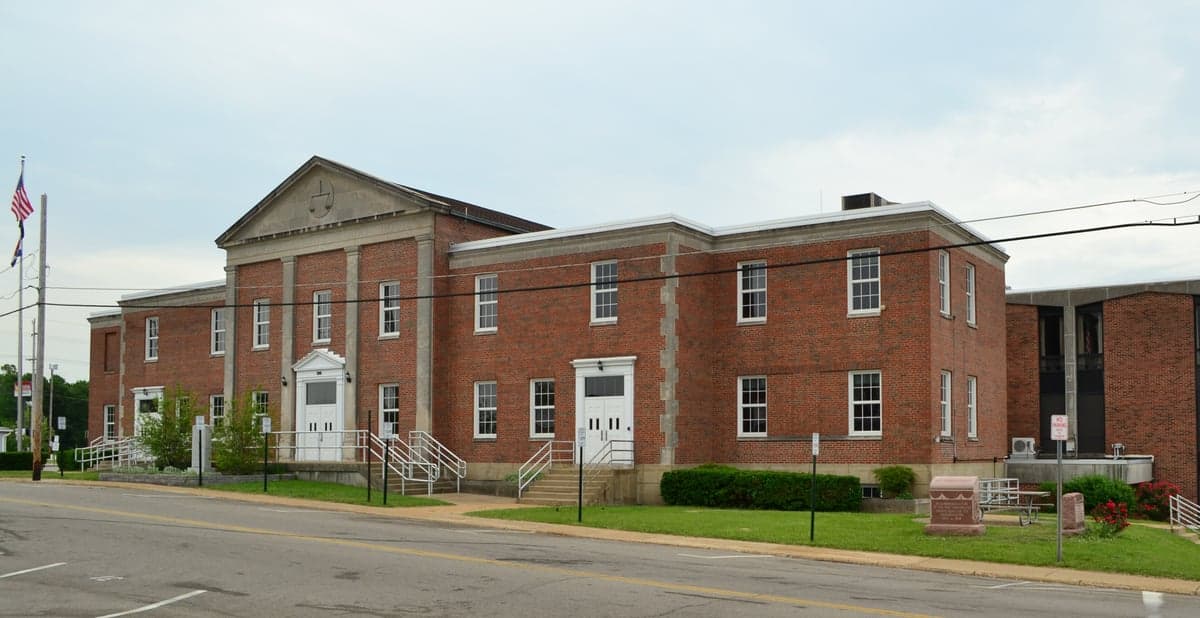
Photo: Wikipedia
Political ClimatePolitical Climate in Jefferson County
Showing district-level results — no local-only data available.
Local Political AnalysisPolitical Analysis of Jefferson County
Jefferson County, Missouri, has long been a reliably Republican stronghold, and that hasn't changed. The county's Cook Partisan Voting Index (PVI) of R+13 puts it a solid five points to the right of the state of Missouri as a whole, which sits at R+8. This isn't a new development; the area has been trending redder for decades, though the pace has accelerated since the 2016 election. If you're looking at the county as a monolith, you'd miss the real story, because the political reality on the ground is more nuanced than a single number suggests.
How it compares
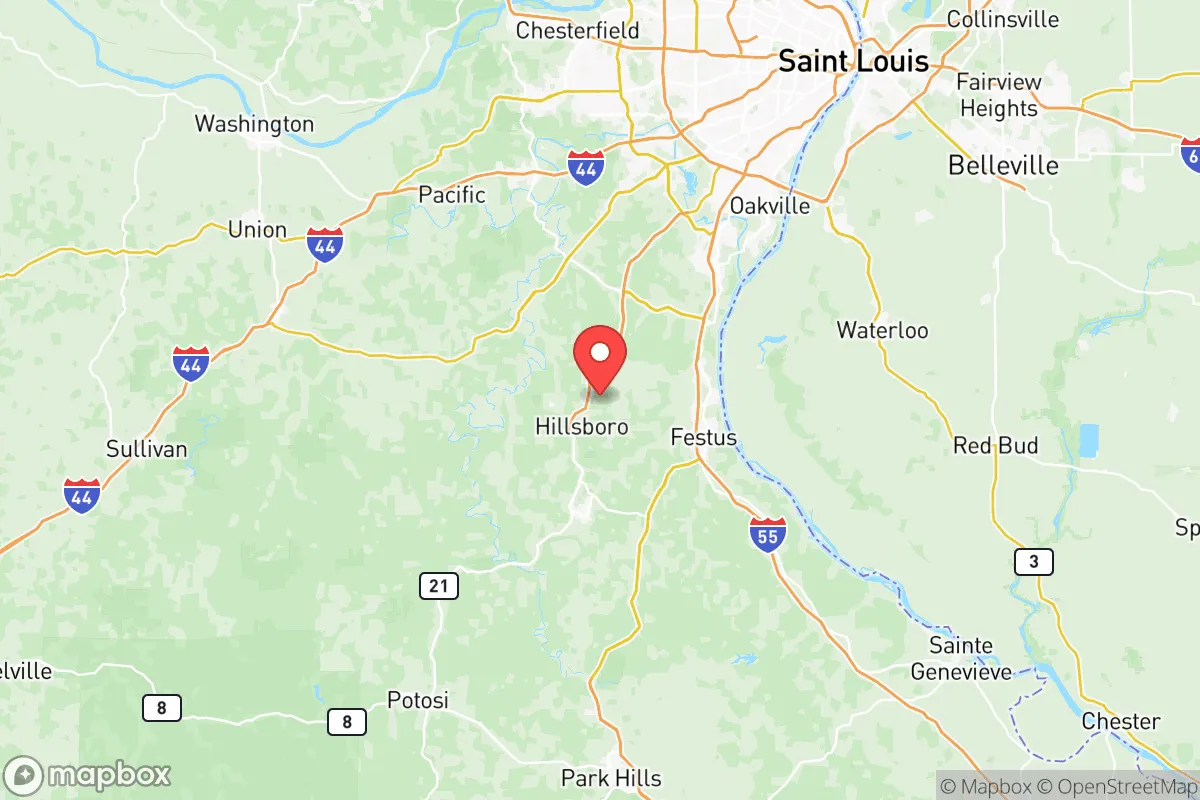
The R+13 rating means Jefferson County is significantly more conservative than the state average, but it's not a deep-red rural county like those further north. The real action is in the internal splits. The northern part of the county, particularly the suburbs of Arnold and Imperial, are where you see the most competitive races. These areas, closer to St. Louis County, have a higher concentration of moderate voters and a growing number of younger families. In the 2020 presidential election, Arnold's precincts were about 55-45 for Trump, while the more rural precincts around De Soto and Festus hit 70-30 or even 75-25. The swing precincts are almost all in the northern corridor along I-55, where the mix of union workers, suburbanites, and new arrivals from St. Louis County creates a more fluid political environment. Meanwhile, the southern and western parts of the county, around Hillsboro and Cedar Hill, are as reliably red as any place in the state.
What this means for residents
For a conservative resident, this is a comfortable place to live. Local elections are almost always decided in the Republican primary, and the county commission, sheriff, and most municipal offices are held by Republicans. Policy debates tend to center on property taxes, road funding, and Second Amendment issues, with little pushback from the left. For a liberal resident, the reality is different. You're in a clear minority, but not an invisible one. In Arnold and Imperial, you'll find like-minded neighbors, and the local Democratic party has a small but active presence. You won't face open hostility, but you will find that your vote rarely matters in countywide races. The practical effect is that the county's political culture is conservative, but not aggressively so. There's a live-and-let-live attitude in most of the towns, especially compared to the more polarized atmosphere in St. Louis County just to the north.
The cultural and policy distinctions are subtle but real. Jefferson County is more rural in character than its PVI might suggest, and that shows in the local priorities. There's a strong emphasis on local control and skepticism of state mandates, whether from Jefferson City or Washington. The county has been a battleground over mask mandates and public health orders, with the county council often pushing back against state-level restrictions. On the other hand, the area's proximity to St. Louis means it's not as insular as some deep-red counties. You'll find a mix of old-timers who remember when the county was more Democratic (it voted for Bill Clinton in 1992 and 1996) and newcomers who moved here specifically for the lower taxes and more conservative governance. The long-term trajectory is clear: Jefferson County will remain a Republican stronghold, but the internal dynamics will continue to shift as the northern suburbs grow and the rural south holds steady. For anyone moving here, the key is to understand that the county's politics are not a monolith, and the experience of living here varies a lot depending on which town you choose.

State Political ClimatePolitical Climate in Missouri
State Political AnalysisPolitical Environment in the State
Missouri is a solidly Republican state with a Cook PVI of R+8, meaning it typically votes about eight points more conservative than the national average. Over the past 20 years, the state has shifted rightward, driven by the exodus of rural and suburban voters from the Democratic coalition and the realignment of working-class white voters. While Democrats can still win statewide in a wave year (as Senator Claire McCaskill did as recently as 2012), the GOP now controls every statewide office, both chambers of the legislature, and six of the eight U.S. House seats. The state hasn't backed a Democrat for president since Bill Clinton in 1996, and Donald Trump carried it by 15 points in 2020 and 18 points in 2024.
Urban vs. rural divide
The political map of Missouri is a textbook case of the urban-rural split. The two major metros—St. Louis and Kansas City—are deep blue islands in a sea of red. St. Louis City and County, along with Jackson County (Kansas City), consistently deliver 60-70% of their votes to Democrats. These areas are home to the state's most diverse populations, major universities, and corporate headquarters like Emerson Electric and Cerner. In contrast, the rest of the state is overwhelmingly Republican. The rural counties along I-44 and I-70, like Phelps County (Rolla) and Boone County (Columbia), are more competitive but still lean right. The most conservative strongholds are the southwestern corner around Springfield and Joplin, and the southeastern Bootheel, where evangelical churches and agricultural interests dominate. A notable exception is St. Charles County, a fast-growing St. Louis suburb that flipped from purple to deep red over the past decade, now reliably voting 60%+ Republican. Platte County north of Kansas City has followed a similar trajectory.
Policy environment
Missouri's policy environment is aggressively conservative on most fronts. The state has a flat income tax rate of 4.8% (down from 5.4% in 2022, with a trigger to drop to 4.5% if revenue targets are met). There is no state property tax on vehicles, and the state sales tax is 4.225%, though local add-ons can push it over 10% in some cities. The state is a right-to-work state (though the law was repealed by ballot initiative in 2018, the legislature has since passed a new version). Missouri is a "stand your ground" state with permitless carry for concealed firearms. On education, the state has a robust charter school sector in St. Louis and Kansas City, and a growing school choice movement—the Missouri Empowerment Scholarship Accounts program provides tax credits for private school tuition. The state has some of the most restrictive abortion laws in the country, with a near-total ban in effect since the 2022 Dobbs decision, though a 2024 ballot initiative to enshrine abortion rights in the state constitution is pending. Election laws have tightened: voter ID is required, absentee ballot applications must be notarized (with limited exceptions), and the state purged over 100,000 inactive voters from the rolls in 2023.
Recent policy direction
The last five years have seen a sharp rightward turn in Jefferson City. In 2021, the legislature passed a "Second Amendment Preservation Act" (SAPA) that declared federal gun laws unenforceable in Missouri—a move that drew a federal lawsuit and criticism from law enforcement. The law was partially struck down in 2023, but the legislature has since passed a revised version. On parental rights, the "Save Adolescents from Experimentation (SAFE) Act" bans gender-affirming care for minors, and a 2022 law requires schools to notify parents of any "sexually explicit" materials in curricula. The state also passed a "Critical Race Theory" ban in K-12 schools, though it's largely symbolic. On property rights, Missouri is a "right to farm" state, with a constitutional amendment protecting agricultural practices from nuisance lawsuits. The state has no statewide rent control, and zoning is largely left to local governments. On privacy, Missouri passed a data privacy law in 2023 that gives residents the right to opt out of data collection by businesses. The state has also expanded its "castle doctrine" to include vehicles and workplaces. On voting, the legislature has made it harder to vote by mail, but easier to vote early in person—a compromise that reflects the GOP's internal debate on election security.
Civil unrest & political movements
Missouri has a history of high-profile civil unrest, most notably the 2014 Ferguson protests after the shooting of Michael Brown, which sparked the Black Lives Matter movement nationally. Since then, protests have been smaller and more localized, but the state remains a flashpoint for racial justice activism, particularly in St. Louis. On the right, the Missouri Freedom Caucus has become a powerful force in the legislature, pushing for further tax cuts, gun rights expansion, and anti-abortion measures. The state has seen a surge in "constitutional sheriff" movements in rural counties, with some sheriffs refusing to enforce federal gun laws. Immigration politics are less intense than in border states, but there have been controversies over sanctuary city policies in St. Louis and Kansas City, both of which have "welcoming city" ordinances that limit cooperation with ICE. The state has no official secession movement, but there is a persistent "Show-Me State" libertarian streak that resists federal overreach. Election integrity remains a hot-button issue: the 2020 election saw Trump's legal team challenge results in St. Louis, and the 2022 gubernatorial race was marred by allegations of voter fraud in St. Louis City, though no widespread irregularities were found.
Projection
Over the next 5-10 years, Missouri is likely to become even more Republican, but with important caveats. The fast-growing suburbs of St. Louis and Kansas City—places like St. Charles, O'Fallon, and Lee's Summit—are trending redder as they fill with families fleeing urban school districts and taxes. At the same time, the urban cores are losing population, which reduces the Democratic vote share. However, the 2024 abortion rights ballot initiative could drive turnout among suburban women and younger voters, potentially making statewide races more competitive. The state's demographic future is mixed: it's aging faster than the national average, and in-migration is mostly from other Midwestern states, not from high-growth regions. The rural population is shrinking, which could eventually force the GOP to moderate on issues like Medicaid expansion (which voters approved in 2020) and infrastructure spending. But for now, the trajectory is clear: expect more tax cuts, more school choice, and more restrictions on abortion and transgender rights. A new resident moving in today should expect to live in a state where the political pendulum is firmly on the right, with no sign of swinging back anytime soon.
For a new resident, the bottom line is this: if you're conservative, you'll find a state that largely aligns with your values on taxes, guns, and education. If you're liberal, you'll find yourself in a minority, but with strong urban enclaves in St. Louis and Kansas City where you can find community and political representation. The state's politics are stable but not static—the abortion ballot initiative and ongoing suburban growth could introduce some unpredictability. Either way, Missouri offers a relatively low-cost, low-regulation environment that appeals to many relocators, regardless of their party affiliation. Just know that the culture wars are real here, and they show up in everything from school board meetings to state legislation.
* Values derived from national, state, county, city and local statistics and may differ in a specific area. Last updated: 2026-08-03T22:14:07.000Z
Narrative content on this page is AI-generated and may contain mistakes. Verify any details that matter before acting on them.
ReloMaps may earn a commission from affiliate links at no extra cost to you.

