
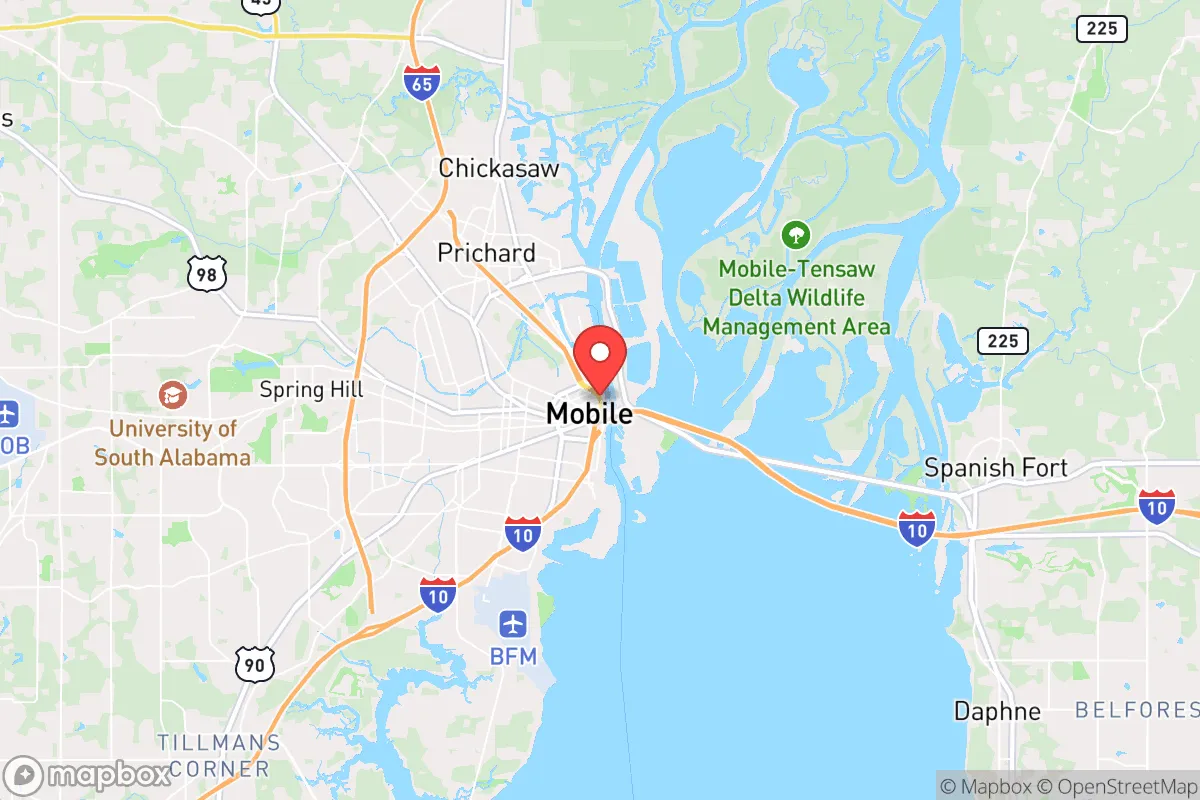
Photo: Wikipedia
Personal Sovereignty in Mobile, AL
Viable for self-reliance. Generally workable, though some barriers may limit total independence.
What does Personal Sovereignty tell us?
Personal Sovereignty measures your capacity for self-reliance and independence with minimal government friction. Higher scores mean fewer barriers between you and the way you want to live... but it assumes you have the space you need and good neighbors.
What does this tell us?
Personal Sovereignty measures your capacity for self-reliance and independence with minimal government friction. Higher scores mean fewer barriers between you and the way you want to live... but it assumes you have the space you need and good neighbors.
State Policy
Energy independence: Importer (45% of energy produced in-state)
Personal Liberty
Homesteading

Personal Liberty Analysis
Mobile, Alabama offers a notably high degree of personal sovereignty compared to many coastal and Midwestern jurisdictions, particularly for those prioritizing autonomy from state-level overreach. The city sits within a state framework that consistently ranks among the most constitutionally protective of individual rights, with a legal culture that generally presumes liberty unless explicitly restricted. For the survivalist or prepper-minded individual, Mobile provides a strategic Gulf Coast location where the balance of power tilts noticeably toward the citizen rather than the state, though local municipal ordinances in the city proper require careful navigation.
Tax burden and regulatory posture: How Alabama's fiscal conservatism protects your income and property
Alabama's tax structure is a significant draw for those seeking to maximize retained earnings and minimize government claims on personal resources. The state levies a flat income tax of 5% on taxable income over $3,000 for single filers, with no progressive brackets that punish higher earners. Property taxes in Mobile County are among the lowest in the nation, with effective rates typically ranging from 0.4% to 0.6% of assessed value — a fraction of what homeowners pay in states like New York, Illinois, or California. The state's homestead exemption further shields primary residences from excessive valuation. Sales tax is a consideration, with Mobile's combined city-county-state rate hovering around 10%, but this is a consumption tax you control by your spending choices. Critically, Alabama has no state-level estate or inheritance tax, meaning wealth you build passes to heirs without a government cut. The regulatory environment is equally favorable: Alabama is a right-to-work state, occupational licensing requirements are less burdensome than in many peer states, and the state government consistently ranks in the bottom tier for regulatory restrictions on small businesses and land use. For the prepper, this means fewer bureaucratic hurdles to establishing home-based enterprises, storing supplies, or modifying property for self-sufficiency.
Self-defense and gun law specifics: Constitutional carry and castle doctrine in Mobile
Alabama is a constitutional carry state, meaning no permit is required to carry a concealed handgun for any law-abiding adult 18 or older. This is a foundational sovereignty right that Mobile respects fully — local ordinances cannot preempt state firearms laws. The state's castle doctrine is among the strongest in the country, with no duty to retreat anywhere you are lawfully present, including your vehicle. Stand-your-ground protections apply in public spaces, and the legal presumption favors the defender in self-defense shootings. Mobile County's sheriff's office is generally supportive of Second Amendment rights, with permitless carry in effect since 2022. For those building a defensive capability, Alabama law explicitly protects the right to keep and bear arms for self-defense, hunting, and sport, and there are no state-level magazine capacity bans, assault weapon restrictions, or firearm registration requirements. The only notable limitation is that carrying on posted private property or in certain government buildings remains prohibited, but these are standard restrictions. For the survivalist, Mobile offers a legal environment where defensive preparation is not just tolerated but constitutionally protected, and local law enforcement culture aligns with that view.
Self-reliance and homesteading viability: Lot sizes, zoning, and off-grid feasibility in Mobile
Mobile's zoning and land-use patterns present a mixed picture for serious homesteading within city limits. Inside the urban core, standard residential lots range from 5,000 to 10,000 square feet, which limits large-scale gardening, livestock, or water harvesting. However, Mobile County's unincorporated areas — particularly west toward the Mississippi line and north toward Mount Vernon — offer rural parcels of 1 to 10 acres at prices under $5,000 per acre, making them accessible for those willing to commute. The city's zoning code does allow backyard chickens in most residential districts, and beekeeping is permitted with registration. Rainwater collection is legal and unregulated at the state level, though Mobile's high annual rainfall (about 66 inches) makes this a practical water security strategy. Solar panel installation faces no state-level HOA restrictions, though subdivision covenants in newer developments may impose aesthetic limits. Off-grid living — meaning no connection to municipal water, sewer, or power — is feasible in unincorporated Mobile County, where building codes are less stringent and no county-wide occupancy permit is required for owner-built dwellings. The primary regulatory hurdle is the Alabama Department of Public Health's requirement for septic system permits, which are generally issued without excessive delay. For the prepper seeking a balance of coastal access and rural self-sufficiency, the areas just outside Mobile city limits offer the best combination of low land costs, minimal zoning interference, and climate suitable for year-round food production.
Personal liberties: Parental rights, medical autonomy, speech, and property protections
Alabama has been at the forefront of protecting parental rights in education and healthcare. The state's Parents' Bill of Rights, enacted in 2022, guarantees parents access to all educational and medical records, the right to opt children out of any curriculum or activity, and the right to direct their children's upbringing without state interference. Homeschooling is deregulated — parents need only provide a notice of intent and maintain attendance records, with no curriculum approval or standardized testing requirements. Medical autonomy is robust: Alabama has no state-level vaccine mandate for adults, and while childhood vaccination requirements exist for school attendance, religious and philosophical exemptions are available. The state's 2019 chemical abortion ban and subsequent near-total abortion prohibition reflect a legal environment that prioritizes fetal life, which aligns with conservative values on the sanctity of life. Free speech protections are strong, with no state-level hate speech laws or social media censorship mandates that would chill political expression. Property rights are constitutionally protected, and Alabama's eminent domain laws are among the most restrictive in the country — private property cannot be taken for economic development purposes, only for genuine public use with just compensation. For the individual concerned about government overreach into family decisions, medical choices, and property ownership, Mobile's legal framework provides substantial insulation from federal and state intrusion.
In the broader landscape of American personal sovereignty, Mobile ranks favorably against most urban areas in blue states, though it does not match the extreme libertarian posture of rural Idaho or Alaska. The city's practical advantage lies in its combination of constitutional carry, low property taxes, minimal homeschooling regulation, and affordable rural land within a short drive. The primary sovereignty trade-offs are the higher sales tax and the need to navigate city zoning if living inside Mobile proper. For the conservative-leaning individual or family seeking a Gulf Coast location where government stays out of your gun safe, your child's education, and your property decisions, Mobile represents a strategic choice — a place where the state's legal framework actively supports self-reliance rather than undermining it. The key is to locate in the county's unincorporated areas to maximize the autonomy that Alabama's laws already provide.

* Values derived from national, state, county, city and local statistics and may differ in a specific area. Last updated: 2026-04-19T18:58:18.000Z
Narrative content on this page is AI-generated and may contain mistakes. Verify any details that matter before acting on them.
ReloMaps may earn a commission from affiliate links at no extra cost to you.

