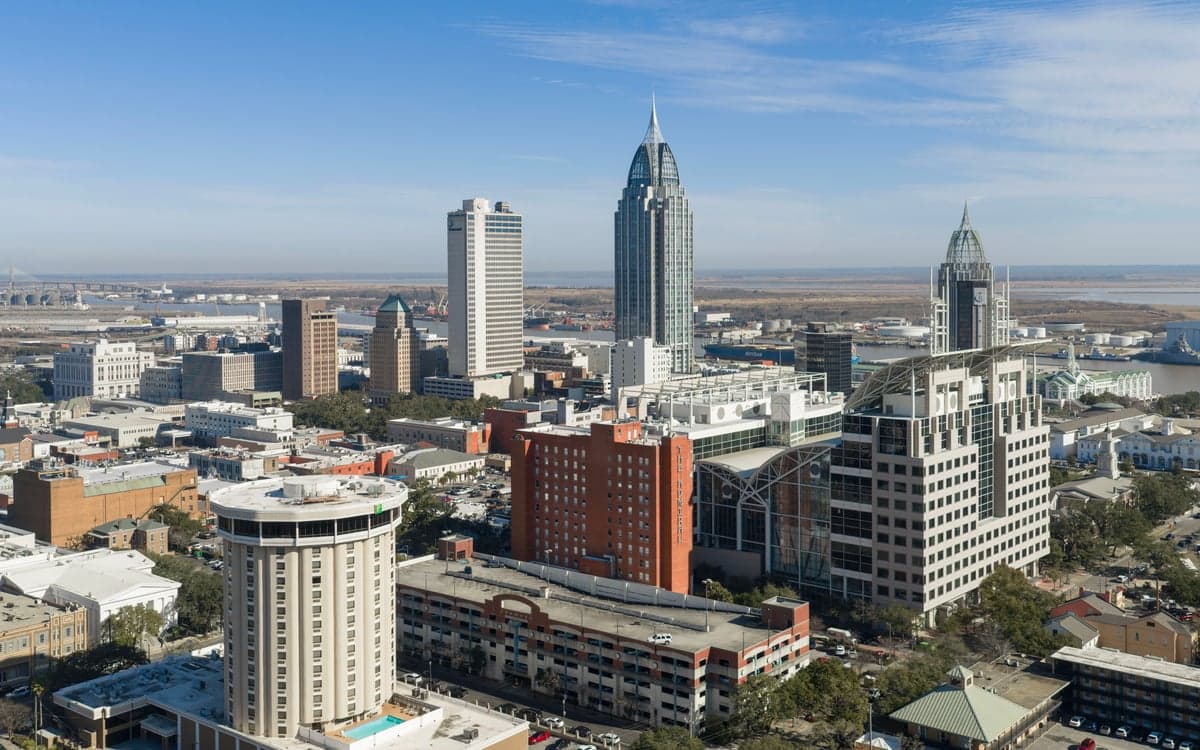
Photo: Wikipedia
Quality of Life in Mobile, AL
A high quality of life with strong walkability, manageable living costs, healthy neighborhood signals, and solid amenity access.
What does Quality of Life tell us?
Quality of Life blends cost of living, nearby amenities, socioeconomic signals, and neighborhood character. City-level scores represent the whole municipality; individual neighborhoods can differ.
What does this tell us?
Quality of Life blends cost of living, nearby amenities, socioeconomic signals, and neighborhood character. City-level scores represent the whole municipality; individual neighborhoods can differ.
Cost of Living
23% below national average
The Real Cost of Living in Mobile, AL for 2026
| Tier | Individual | Family (4) |
|---|---|---|
| Survival | $16k | $31k |
| Comfortable | $33k | $49k |
| Luxury | $92k+ | $143k+ |
| Elite (Top 5%) | $128k+ | $198k+ |
105%
The Area Signal
A metric tracking the socioeconomic signals of the area.


Hobbies
Explore the areaGroceries
2 within 10 miles
Gas
0 within 10 miles
Hospital
3 within 20 miles
Airport
ATL — Hartsfield–Jackson Atlanta International
Post Office
USPS — Daphne, AL
Critical Amenities
Quality-of-Life Analysis
Mobile, Alabama, offers a cost of living significantly below the national average, attracting a diverse mix of families, retirees, and young professionals seeking affordability without sacrificing Gulf Coast access. With a composite cost of living index of 77 (100 is the U.S. average), the city provides a notably lower financial barrier to entry compared to the national median, drawing residents who prioritize value and space over high-income density. The area’s population is a blend of long-standing Gulf Coast families, newcomers from higher-cost states like Florida and California, and a growing cohort of remote workers drawn by the low housing costs and historic architecture.
How housing costs and everyday expenses compare to nearby Gulf Coast cities
Mobile’s housing market is a primary driver of its affordability, with a median home value of $170,300—roughly half the national median and significantly less than neighboring Gulf Coast metros like Pensacola, Florida (where the median exceeds $250,000) or Gulf Shores (where beach-adjacent properties often top $400,000). The median rent of $1,029 is also well below the national average of roughly $1,400, making the city a practical choice for renters who want to avoid the premium pricing of coastal tourist towns. Everyday expenses, including groceries, utilities, and transportation, align with the low overall index, meaning a dollar stretches further here than in most U.S. cities. The average one-way commute of 22.7 minutes is slightly shorter than the national average of about 26 minutes, reducing daily transportation costs and freeing up time for residents. When compared to nearby Baldwin County (home to Fairhope and Daphne), Mobile offers lower home prices but slightly higher property tax rates, though the overall monthly outlay for homeowners remains lower in the city proper.
What daily life is like for families: schools, amenities, and local rhythm
Daily life in Mobile moves at a relaxed Southern pace, with a strong emphasis on outdoor recreation and community events. The city is home to the Mobile Museum of Art, the USS Alabama Battleship Memorial Park, and a revitalized downtown with a growing food scene centered around Dauphin Street. For families, the public school system is administered by Mobile County Public Schools, which includes magnet programs like the Alabama School of Mathematics and Science and several International Baccalaureate (IB) options, though overall district performance varies by neighborhood. Private and parochial schools, such as UMS-Wright Preparatory School and McGill-Toolen Catholic High School, are popular alternatives. The city’s proximity to the Gulf of Mexico (about 30 miles south) means weekend trips to Dauphin Island or Gulf Shores are common, while the Mobile-Tensaw River Delta offers kayaking, fishing, and hiking within 15 minutes of downtown. The rhythm of life is defined by mild winters, hot humid summers, and a calendar packed with festivals like the Mobile Mardi Gras (the oldest in the United States) and the BayFest music festival.
Mobile is best suited for those who value a low cost of living, a slower lifestyle, and easy access to both urban amenities and natural Gulf Coast environments. Retirees on fixed incomes will find the housing and healthcare costs particularly manageable, while remote workers and young families can leverage the affordable home prices to build equity faster than in pricier metros. The city’s trade-offs—moderate public school performance in some zones, a humid subtropical climate, and a less dynamic job market than Birmingham or Atlanta—mean it is not ideal for those seeking high career velocity or top-tier public education without private options. However, for anyone prioritizing financial breathing room, a strong sense of place, and proximity to the Gulf, Mobile offers a quality of life that is hard to match at this price point.

Crime in Mobile, AL
Higher crime rates than 63% of comparable U.S. locations.
Violent CrimeViolent Crime Analysis
Property CrimeProperty Crime Analysis
Crime Analysis
Mobile, Alabama, reports a violent crime rate of 589.6 incidents per 100,000 residents and a property crime rate of 1,456.3 per 100,000, placing it well above both the Alabama state average and the national median for cities of its size. These figures indicate that safety is a significant concern for anyone considering relocation to the Port City. The data reflects a community where both personal and property security risks are elevated compared to peer municipalities in the Gulf Coast region.
Crime in context
Mobile’s violent crime rate is roughly 50% higher than the national average for cities with populations over 150,000, while its property crime rate sits approximately 20% above the national benchmark. Compared to other Alabama metros, Mobile’s violent crime rate is notably higher than Huntsville’s (roughly 450 per 100K) but lower than Birmingham’s (over 1,000 per 100K). A key factor in these elevated numbers is the influence of progressive judicial policies in Mobile County. District attorneys and judges who prioritize lenient sentencing and diversion programs over incarceration have been linked to higher recidivism rates, as offenders are returned to the streets more quickly. This approach, while sympathetic to the accused, directly undermines public safety by reducing the deterrent effect of prosecution and failing to adequately separate repeat violent offenders from the community.
What residents experience
For daily life, these statistics translate into tangible risks. Property crime—including burglary, larceny, and motor vehicle theft—is the most common concern, with residents reporting break-ins and car thefts as routine occurrences, particularly in areas near major thoroughfares and commercial corridors. Violent crime, while less frequent, is concentrated in specific neighborhoods and often involves disputes among acquaintances rather than random attacks on strangers. However, the presence of progressive district attorneys who routinely offer plea deals and avoid seeking maximum sentences means that even those arrested for violent offenses may face minimal consequences, eroding public trust in the justice system. Victims often report frustration with case outcomes, feeling that the system prioritizes offender rehabilitation over their own safety and restitution.
Neighborhood-level safety varies dramatically. Areas like Spring Hill and the historic DeTonti Square district generally report lower crime rates, benefiting from active neighborhood associations and private security patrols. In contrast, neighborhoods such as Maysville and parts of downtown near the civic center experience higher concentrations of both violent and property crime. Prospective residents should research block-level crime maps and consult with local police precincts, as a few blocks can separate relatively safe streets from high-risk zones. The overall trend, however, is that Mobile’s crime challenges are systemic, driven in part by a justice system that too often fails to hold offenders accountable.
* Values derived from national, state, county, city and local statistics and may differ in a specific area. Last updated: 2026-04-19T18:58:18.000Z
Narrative content on this page is AI-generated and may contain mistakes. Verify any details that matter before acting on them.
ReloMaps may earn a commission from affiliate links at no extra cost to you.

