Photo: Wikipedia
Demographics of Moncks Corner, SC
Affluence Level in Moncks Corner, SC
A middle-class area roughly in line with national averages across income, home values, education, and employment.
People of Moncks Corner, SC
The people of Moncks Corner, South Carolina today form a community of roughly 14,362 residents, characterized by a notable racial and ethnic balance: 56.0% White, 34.6% Black, and 6.5% Hispanic, with a very small East/Southeast Asian population (0.1%) and no measurable Indian subcontinent presence. The city’s foreign-born share is just 2.1%, well below the national average, and 29.5% of adults hold a college degree. Moncks Corner is a predominantly native-born, Southern town where the population is split nearly evenly between White and Black residents, with a modest but growing Hispanic minority, and where the overall character remains rooted in its role as the county seat of Berkeley County.
How the city was settled and grew
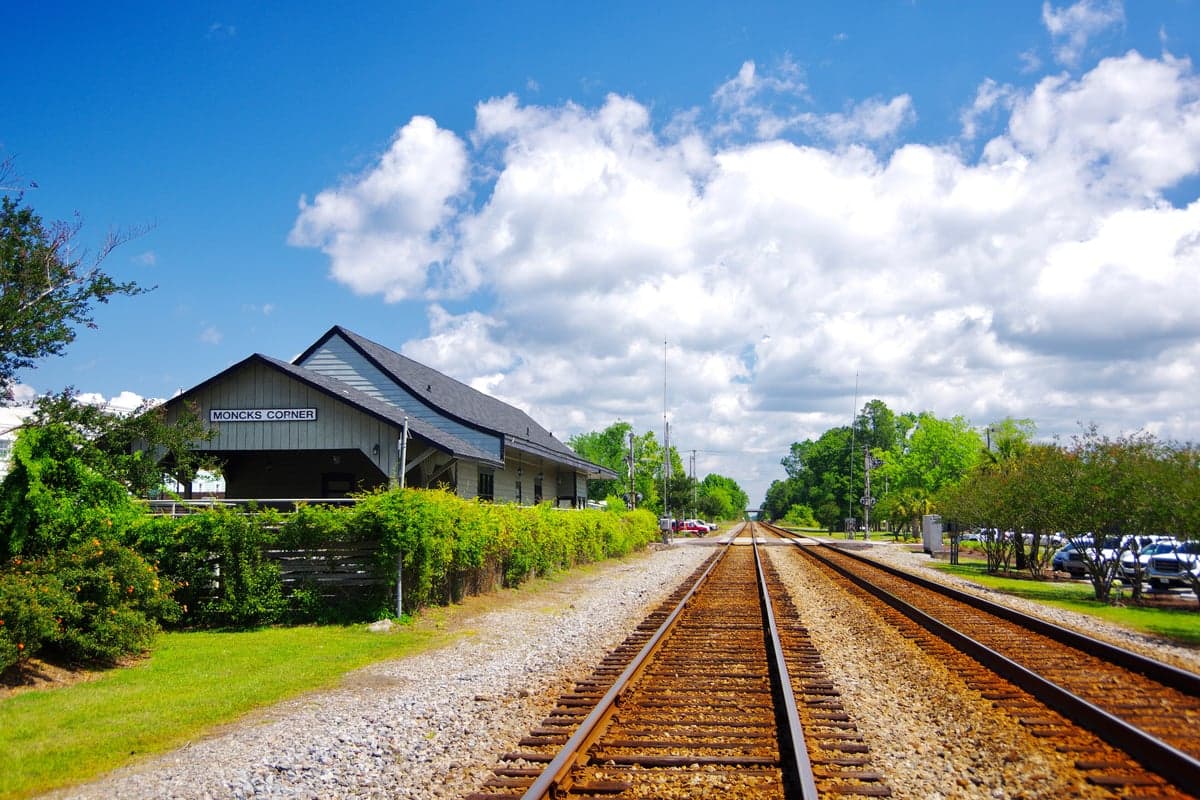
Moncks Corner was founded in the late 18th century as a trading post and crossroads settlement, named after a local tavern keeper, Thomas Monck. The original population was drawn by the region’s fertile lowcountry land for rice and indigo plantations, with the first European settlers being English and Scots-Irish planters who established large estates along the Cooper River. Enslaved Africans, primarily from the Gullah-Geechee region of West Africa, made up the majority of the labor force and population in the surrounding rural areas. After the Civil War, freedmen established several historic Black neighborhoods, most notably Old Moncks Corner near the railroad depot and Whitesville along what is now Highway 52, where descendants of those early African American families still reside. The town remained a small agricultural service center through the early 20th century, with the arrival of the Atlantic Coast Line Railroad in the 1880s spurring modest growth and the development of Railroad Avenue as a commercial and residential corridor for railroad workers and merchants.
Modern era (post-1965)
The post-1965 era brought significant demographic change to Moncks Corner, driven primarily by domestic in-migration rather than foreign immigration. The construction of the Santee Cooper hydroelectric project and the expansion of the Charleston Naval Base in the 1960s and 1970s drew White and Black workers from across the rural South, many settling in the newly developed Foxbank Plantation subdivision, a master-planned community that began in the 1990s and now houses a mix of families, including a growing number of White transplants from the Northeast and Midwest. The city’s Black population, historically concentrated in Old Moncks Corner and Whitesville, has remained stable in share (34.6%) but has seen some movement into newer subdivisions like Berkeley Hills and Fairlawn, reflecting a gradual suburbanization of the African American middle class. The Hispanic population, now 6.5%, began to grow in the 2000s, largely driven by Mexican and Central American workers in construction, landscaping, and poultry processing at the nearby Perdue Farms plant in Summerville. These families have clustered in the Oakland area and along Highway 52 near the town’s industrial corridor, forming a small but visible enclave. The Asian population remains negligible (0.1%), with no significant East/Southeast Asian or Indian subcontinent community, reflecting the city’s limited draw for high-skilled immigration.
The future
The population of Moncks Corner is heading toward modest growth, driven by its role as a bedroom community for Charleston (roughly 30 miles southeast) and the expansion of the Berkeley County industrial base, including the Volvo Cars plant in Ridgeville and the Port of Charleston’s inland logistics hub. The White share (56.0%) is likely to decline slightly as the Hispanic population (6.5%) continues to grow, potentially reaching 10-12% by 2035, while the Black share (34.6%) is expected to remain stable. The foreign-born share (2.1%) will rise slowly but stay low, as the city lacks the immigrant networks and urban amenities that attract larger foreign-born populations. The city is not tribalizing into distinct enclaves; rather, newer subdivisions like Foxbank Plantation and Berkeley Hills are increasingly mixed, while older neighborhoods like Old Moncks Corner and Whitesville remain predominantly Black. The college-educated share (29.5%) is likely to increase as more professionals commute to Charleston, but Moncks Corner will remain a predominantly blue-collar, family-oriented community.
For someone moving in now, Moncks Corner is a stable, moderately diverse Southern town where the population is split between long-standing Black families and newer White arrivals, with a small but growing Hispanic workforce. The city is not a melting pot of global immigration but a domestic migration hub, where the primary demographic story is the gradual suburbanization of both Black and White residents into newer subdivisions. The future points toward slow, steady growth, with the Hispanic share rising but the overall character remaining native-born, family-focused, and rooted in the lowcountry’s agricultural and industrial heritage.

* Values derived from national, state, county, city and local statistics and may differ in a specific area. Last updated: 2026-04-30T02:02:51.000Z
Narrative content on this page is AI-generated and may contain mistakes. Verify any details that matter before acting on them.
ReloMaps may earn a commission from affiliate links at no extra cost to you.

