Demographics of Monroe, LA
Affluence Level in Monroe, LA
A low-income area with significant economic hardship. Household wealth and educational attainment are well below national averages.
People of Monroe, LA
The people of Monroe, Louisiana today form a predominantly Black-majority city of 47,241 residents, with a White population of 32.7% and a notably small foreign-born share of just 1.2%. The city’s character is shaped by deep-rooted family networks, a strong presence of historically Black colleges and universities (HBCUs), and a relatively low college attainment rate of 28.8%. Monroe’s identity is distinctly Southern and African American, with a modest but growing Hispanic community (3.0%) and tiny East/Southeast Asian (1.1%) and Indian-subcontinent (0.5%) populations that have not yet formed large ethnic enclaves.
How the city was settled and grew
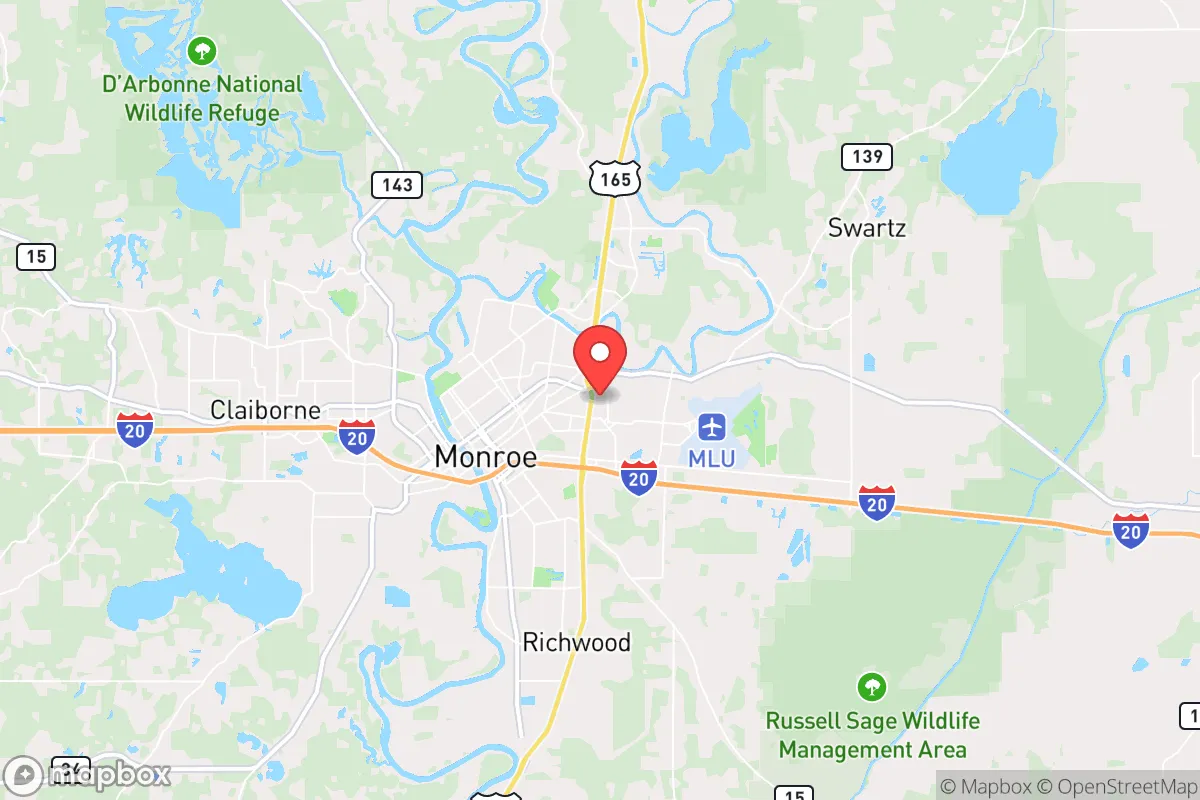
Monroe was founded in 1785 as a trading post on the Ouachita River, originally named Fort Miro. The first major population wave came from Anglo-American settlers moving west after the Louisiana Purchase in 1803, drawn by cotton plantation agriculture. The city’s early growth centered on the riverfront and the historic Downtown Monroe district, where merchants and planters built homes and businesses. The arrival of the railroad in the 1850s spurred a second wave of European immigrants—primarily German and Irish laborers—who settled in the Garden District and Southside neighborhoods, working in the cotton trade and emerging timber industry. By the early 20th century, Monroe’s Black population grew rapidly as formerly enslaved people and their descendants moved into the city for industrial jobs at the Ouachita River’s paper mills and the Monroe Gas and Electric Company. The Boley Addition and Richwood neighborhoods became the primary residential areas for Black families, with Richwood developing as a separate unincorporated community just south of the city limits. The discovery of natural gas in the Monroe Gas Field in 1916 brought a brief boom, attracting oil workers and their families to the Parkview area, though the city’s population remained overwhelmingly native-born and Southern.
Modern era (post-1965)
The post-1965 period saw Monroe’s White population begin a steady decline, a pattern common across the Deep South. The 1970s and 1980s brought significant suburbanization, with many White families moving to newer developments in West Monroe (a separate city across the river) and the Kiroli Park area, while Black families increasingly concentrated in the Boley Addition and Richwood neighborhoods. The city’s Black share rose from roughly 40% in 1970 to over 60% by 2020, driven by both White flight and natural increase. The foreign-born population remained negligible throughout this period—Monroe never attracted the immigrant waves that reshaped larger Southern cities like Houston or Atlanta. The small Hispanic community (3.0%) is largely composed of Mexican-origin families working in agriculture and construction, concentrated in the South Monroe area near the interstate. East/Southeast Asian residents (1.1%) are mostly Vietnamese and Filipino families who arrived in the 1990s and 2000s, often employed in healthcare at the University of Louisiana Monroe or St. Francis Medical Center; they live scattered across the city rather than in a single ethnic neighborhood. The Indian-subcontinent population (0.5%) is almost entirely professionals—doctors, engineers, and university faculty—with no distinct enclave.
The future
Monroe’s population is projected to continue its slow decline, from a peak of about 57,000 in 1980 to the current 47,241, with further losses expected as younger residents leave for larger job markets. The city is not homogenizing into a single identity but rather tribalizing along racial and economic lines: the Boley Addition and Richwood remain overwhelmingly Black and lower-income, while the Garden District and Parkview are predominantly White and middle-class. The Hispanic share is likely to grow modestly, reaching perhaps 5-6% by 2040, as agricultural and service-sector jobs continue to draw families. The East/Southeast Asian and Indian-subcontinent populations are expected to remain small and stable, as Monroe lacks the tech or manufacturing sectors that drive larger immigrant inflows. The city’s future is one of slow demographic drift rather than dramatic transformation—a stable, majority-Black Southern city with a small White minority and tiny immigrant communities that are not reshaping the cultural landscape.
For someone moving in now, Monroe offers a deeply rooted, family-oriented community where race and neighborhood history still strongly shape daily life. The city is not becoming more diverse in the way that larger metros are; instead, it is consolidating its existing Black-majority identity while the White population continues a slow, generational retreat to the suburbs. New residents should expect a place where social networks are tight, change is gradual, and the population is more likely to shrink than to grow in the coming decades.

* Values derived from national, state, county, city and local statistics and may differ in a specific area. Last updated: 2026-05-01T22:53:41.000Z
Narrative content on this page is AI-generated and may contain mistakes. Verify any details that matter before acting on them.
ReloMaps may earn a commission from affiliate links at no extra cost to you.

