Strategic Assessment of Monroe, LA
Workable tactical position. Some exposure to population density or targets, but generally defensible in a crisis.
What does the Strategic Assessment tell us?
Our Strategic Assessment grades tactical survivability of an area. Major population centers, military targets, fallout zones, natural disasters, and border exposure all drive risk — lower exposure means a more defensible position in a crisis.
This is heavily inspired by Joel Skousen's Strategic Relocation book. Highly recommended you checkout the book ($)What does this tell us?
Our Strategic Assessment grades tactical survivability of an area. Major population centers, military targets, fallout zones, natural disasters, and border exposure all drive risk — lower exposure means a more defensible position in a crisis.
This is heavily inspired by Joel Skousen's Strategic Relocation book. Highly recommended you checkout the book ($)Strategic Pillars

Key Distances
Regional Safe Places
Below is our recommended "safe zones" in Louisiana and the surrounding area based on our strategic heuristics. For most people, it's unrealistic to live in a “safe zone” full-time due to work, family or other personal reasons. They tend to be more rural. However, many of these areas are perfect for second homes and retreat properties that double as a vacation home or even a short-term rental.

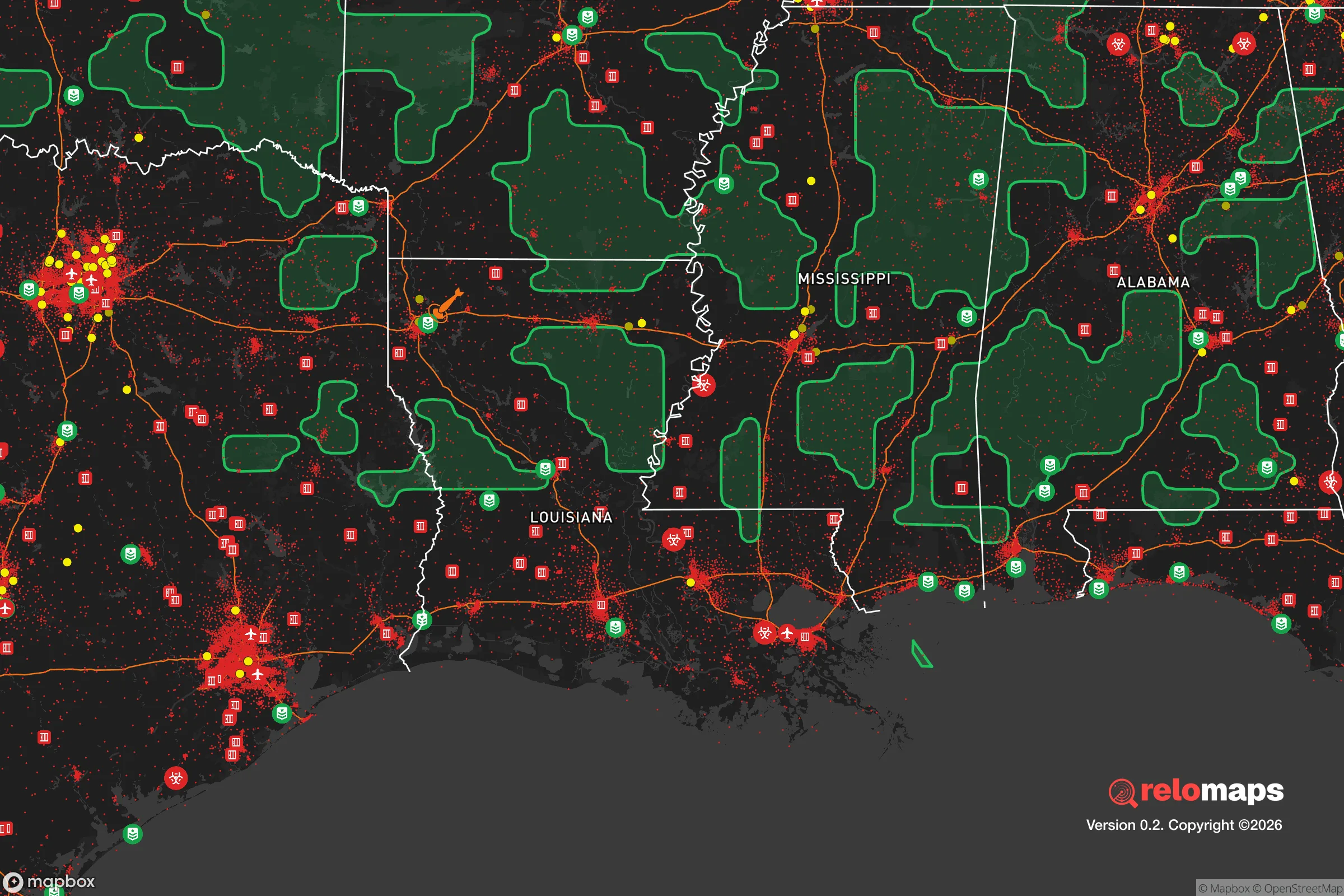


Important Note: For informational purposes only. This does not mean nothing bad ever happens in the green zones. Please use common sense. This is based on public data and modeled with AI. We tried to take a conservative approach but mistakes happen. We update this regularly as new information becomes available.
Solar Generator Recommendations
Backup power matters more here than in safer locations. We've picked three solar generators across budgets and capacity tiers — start with the budget unit if you only need a few essentials, or step up if you want to run a fridge and HVAC for days at a time.

Jackery Portable Power Station Explorer 300
Budget OptionPower on the Go: Weighing only 11 lbs, it's convenient to set up and store with book-sized foldable solar panels

BLUETTI Portable Power Station AC180
Designed for both indoor and outdoor scenarios, AC180 is highly capable as it has a robost capacity and continuous output power.

EF ECOFLOW DELTA Pro Ultra Power Station
Upgraded PickEcoFlow DELTA Pro Ultra is a whole-home energy system designed to grow with your family. Integrated with the Smart Home Panel 2, it scales to meet your evolving energy needs — keeping your home powered, intelligent, and secure through every stage of life.
We earn a commission, at no additional cost to you.
Strategic Assessment Analysis
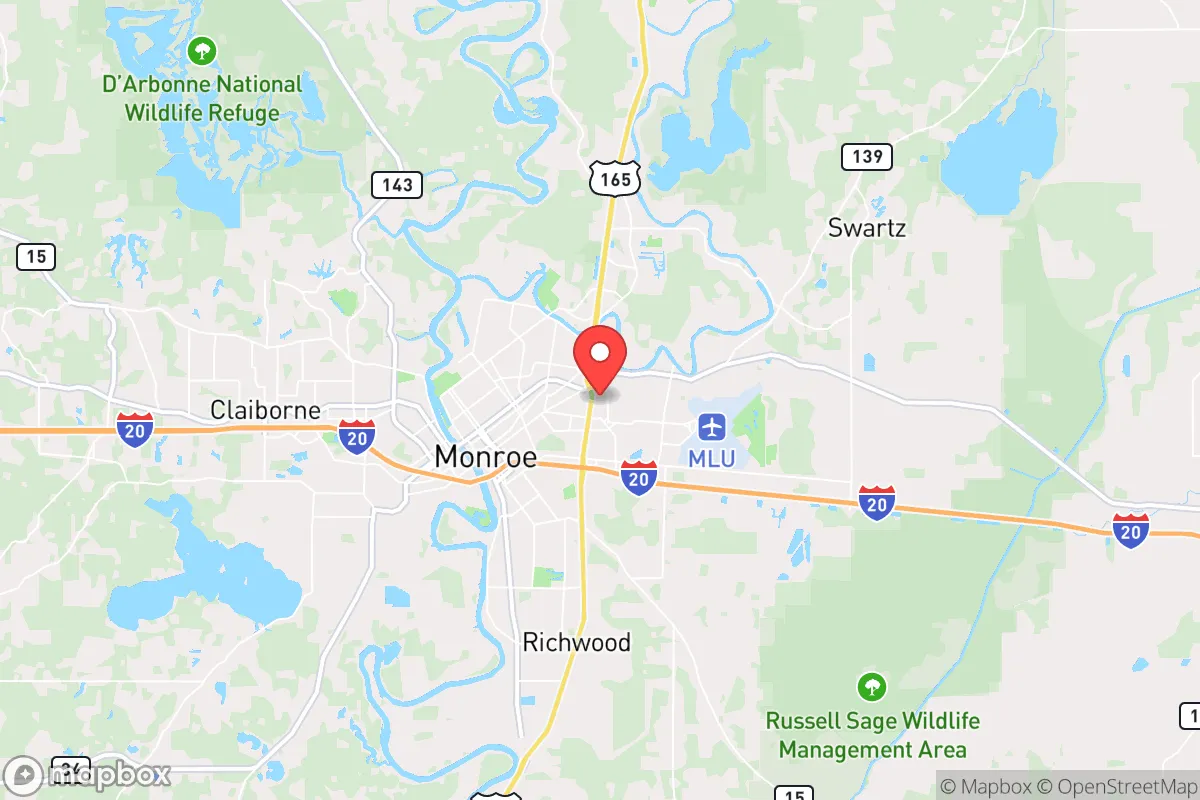
Monroe, Louisiana, offers a strategic relocation option for those prioritizing resilience and distance from major population centers, sitting roughly 100 miles from the Mississippi River and 250 miles from the Gulf Coast. Its position in the northeastern corner of the state provides a buffer from the densest corridors of the I-10 and I-20 corridors, while still maintaining access to regional infrastructure. For a prepper or survivalist-minded individual, Monroe’s combination of low population density, agricultural self-sufficiency, and relative isolation from primary fallout zones makes it a location worth serious consideration, though it is not without its own vulnerabilities.
Geographic position and natural advantages for long-term security
Monroe’s location in the Ouachita Parish region places it within the Mississippi Alluvial Plain, a fertile area that historically supported robust local food production. The city sits on the Ouachita River, a navigable waterway that connects to the Red River and eventually the Mississippi, offering a potential transportation route for trade or movement if road networks become compromised. The surrounding landscape is predominantly rural, with vast tracts of timberland, farmland, and wetlands that create natural barriers against rapid urban sprawl. This geography means that a relocator can secure acreage with relative affordability—land prices in the region are among the lowest in the South, often under $3,000 per acre for undeveloped parcels. The climate is humid subtropical, with a growing season of roughly 230 days, allowing for year-round gardening and livestock grazing. For those concerned with food security, the ability to produce a significant portion of one’s own calories is a tangible advantage. Additionally, the region’s elevation is modest, averaging around 80 feet above sea level, which reduces risks from storm surges or flooding compared to coastal areas, though localized flash flooding from the Ouachita River remains a periodic concern.
Risks, exposures, and proximity to fallout-relevant landmarks
While Monroe is far from the primary targets of a major conflict—such as Washington D.C., New York, or Los Angeles—it is not entirely removed from potential fallout zones. The city lies approximately 150 miles from the Louisiana Chemical Corridor along the Mississippi River between Baton Rouge and New Orleans, which includes numerous refineries and chemical plants that could be secondary targets or sources of industrial accidents during civil unrest. The Barksdale Air Force Base in Bossier City, about 90 miles west, is a strategic military installation that could become a target in a broader conflict, potentially drawing fallout or military activity into the region. Monroe itself has no major military bases or high-value infrastructure, which is a double-edged sword: it reduces the likelihood of being a direct target but also means limited local emergency response capabilities. The city’s population of roughly 48,000 (metro area around 170,000) is small enough to avoid the chaos of a major metropolitan collapse but large enough to have a functioning hospital system and law enforcement presence. However, the region’s poverty rate hovers around 25%, and the local economy is heavily dependent on healthcare, education, and retail—sectors that could falter quickly during a prolonged crisis. For a relocator, the primary risk is not a direct strike but the cascading effects of supply chain disruptions, refugee flows from larger cities like Shreveport or Jackson, and potential civil unrest in the more impoverished neighborhoods of the city itself.
Practical resilience for a relocator: food, water, energy, and defensibility
For those serious about self-sufficiency, Monroe’s practical resilience metrics are mixed but workable. Water access is strong: the Ouachita River provides a reliable surface water source, and the underlying Sparta Aquifer offers deep groundwater that is generally clean and accessible with a well. The city’s municipal water system draws from the river, but a prepper should plan for a private well or rainwater catchment, as the treatment plant could be compromised during a disaster. Food production is feasible due to the long growing season and fertile soil, but the region’s high humidity and pest pressure require diligent management—raised beds, greenhouses, and integrated pest control are advisable. Local hunting and fishing are viable, with deer, wild hog, and catfish abundant in the surrounding forests and waterways. Energy infrastructure is a vulnerability: Monroe is served by Entergy Louisiana, and the grid is prone to outages during thunderstorms and ice storms. Solar panels with battery storage are a wise investment, as the region averages 215 sunny days per year, though cloud cover from Gulf moisture can reduce efficiency in winter. Defensibility is moderate—the flat terrain offers few natural chokepoints, but the rural layout allows for a property to be secured with fencing, natural barriers, and a clear line of sight. The local gun culture is strong, with a high rate of firearm ownership and a supportive legal environment for self-defense, including Louisiana’s stand-your-ground law. For a relocator, the key is to choose a property outside the city limits, ideally in a small community like West Monroe or Sterlington, where neighbors are more likely to be self-reliant and suspicious of outsiders.
The overall strategic picture for Monroe is one of cautious viability. It is not a hardened bunker location, but it offers a realistic balance of affordability, agricultural potential, and distance from the most volatile zones of the country. The region’s economic struggles and dependence on a fragile healthcare system are real concerns, but for a prepared individual willing to invest in off-grid infrastructure and build local connections, Monroe provides a foundation that is far more sustainable than a suburban subdivision near a major city. The key is to arrive with a plan—secure land with water access, establish food production early, and integrate into the local community without drawing attention. In a world where the next crisis could be economic collapse, civil unrest, or a broader conflict, Monroe offers a quiet corner where a determined relocator can build a life that is both independent and resilient, provided they are willing to work for it.

* Values derived from national, state, county, city and local statistics and may differ in a specific area. Last updated: 2026-05-01T22:53:41.000Z
Narrative content on this page is AI-generated and may contain mistakes. Verify any details that matter before acting on them.
ReloMaps may earn a commission from affiliate links at no extra cost to you.

