
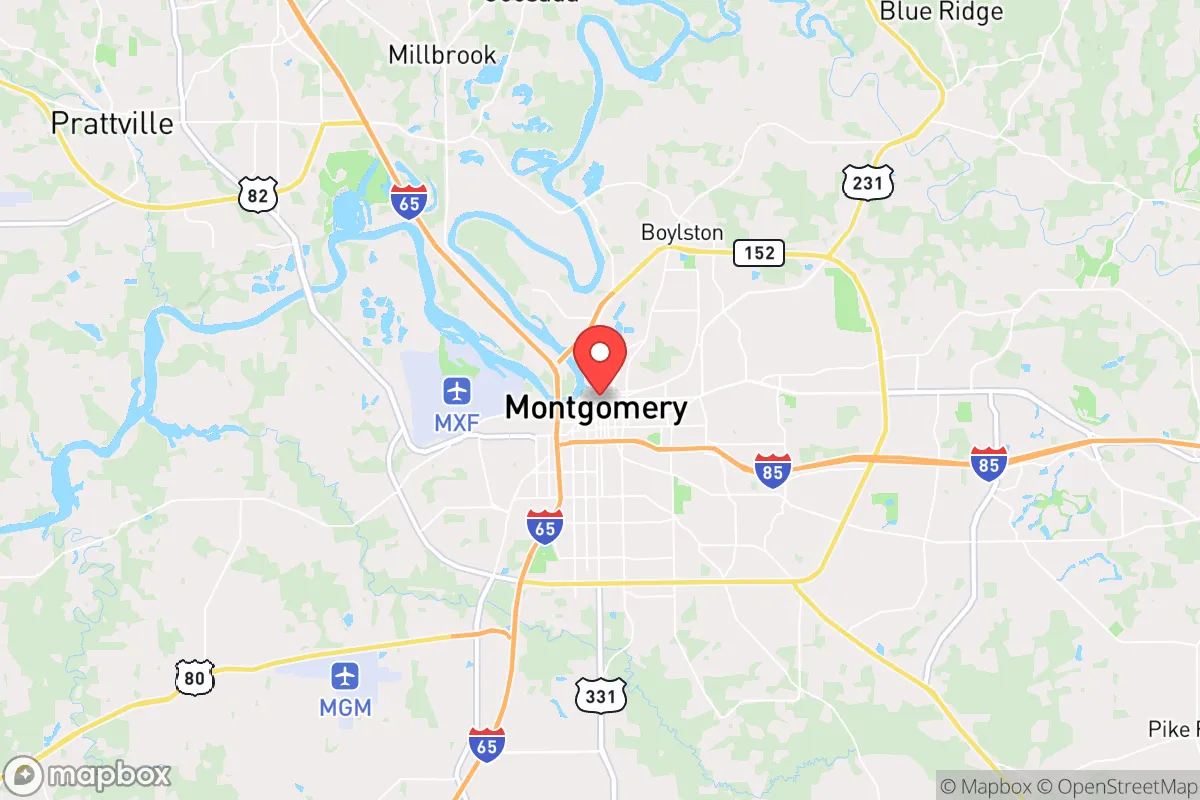
Photo: Wikipedia
Personal Sovereignty in Montgomery, AL
Viable for self-reliance. Generally workable, though some barriers may limit total independence.
What does Personal Sovereignty tell us?
Personal Sovereignty measures your capacity for self-reliance and independence with minimal government friction. Higher scores mean fewer barriers between you and the way you want to live... but it assumes you have the space you need and good neighbors.
What does this tell us?
Personal Sovereignty measures your capacity for self-reliance and independence with minimal government friction. Higher scores mean fewer barriers between you and the way you want to live... but it assumes you have the space you need and good neighbors.
State Policy
Energy independence: Importer (45% of energy produced in-state)
Personal Liberty
Homesteading

Personal Liberty Analysis
Montgomery, Alabama, offers a notably high degree of personal sovereignty compared to many other state capitals, largely due to Alabama’s constitutional and statutory framework that prioritizes limited government and individual autonomy. For a conservative-leaning individual or family concerned with government overreach, the city provides a legal environment where the state generally stays out of your personal decisions, your property, and your means of self-defense. While Montgomery itself is a Democratic-leaning city, the state-level preemption laws and the broader political culture of Alabama create a buffer against many of the local ordinances that erode freedom in other parts of the country. This analysis examines the specific pillars of sovereignty—tax burden, self-defense, self-reliance, and personal liberties—that make Montgomery a strategic relocation option for those seeking to live with minimal interference from the state.
Tax burden and regulatory posture: how Alabama’s low-tax, light-touch framework protects your income and property
Alabama’s tax structure is among the most favorable in the nation for individuals and small businesses, directly supporting personal sovereignty by leaving more money in your pocket and fewer strings attached. The state has a flat income tax rate of 5%, which is simple and predictable, and there is no state-level tax on Social Security benefits, a significant advantage for retirees or those planning for long-term self-reliance. Property taxes in Montgomery County are exceptionally low, typically ranging from 0.4% to 0.6% of assessed value, meaning a $200,000 home carries an annual tax bill of roughly $800 to $1,200. This low property tax burden reduces the risk of being taxed out of your home, a growing concern in high-tax states. On the regulatory side, Alabama is a right-to-work state with minimal business licensing requirements, and Montgomery’s local government generally follows the state’s light-touch approach. There are no county-level income taxes, no onerous environmental regulations on residential property, and no state-level estate or inheritance taxes. For a prepper or survivalist, this means you can allocate more resources toward land, supplies, and infrastructure rather than sending a significant portion of your income to the government.
Self-defense and gun law specifics: constitutional carry, stand your ground, and the legal shield for armed citizens
Alabama is one of the strongest states in the union for the right to keep and bear arms, and Montgomery residents benefit from a legal framework that places few restrictions on firearm ownership and use. The state enacted constitutional carry (permitless carry) in 2022, meaning any law-abiding adult 18 or older can carry a concealed handgun without a permit, though a permit is still available for reciprocity purposes. There is no state-level registry, no waiting period for most purchases, and no magazine capacity restrictions. The "Stand Your Ground" law, codified in Alabama Code § 13A-3-23, removes any duty to retreat before using deadly force in any place you have a legal right to be, including your home, vehicle, or public space. This is critical for a survivalist mindset: if you are forced to defend yourself or your family, the law is on your side, provided the threat is imminent and unlawful. Montgomery’s local government cannot override these state preemptions—Alabama law explicitly prohibits cities from enacting their own gun ordinances, so you won’t face the patchwork of local bans seen in states like California or New York. For those concerned about societal collapse or civil unrest, the ability to legally own, carry, and use firearms without bureaucratic hurdles is a foundational element of personal sovereignty.
Self-reliance and homesteading viability: lot sizes, zoning, and off-grid feasibility in Montgomery and surrounding areas
Montgomery offers a realistic path to self-reliance, particularly if you are willing to look at the unincorporated areas of Montgomery County or the nearby rural counties like Autauga, Elmore, or Lowndes. Within the city limits, standard residential lots are typically 0.25 to 0.5 acres, which is enough for a substantial garden, a few chickens, and rainwater collection, but not for larger livestock or extensive homesteading. However, zoning in Montgomery is relatively permissive for urban agriculture—backyard chickens are allowed without a permit in most residential zones, and beekeeping is permitted with registration. For those seeking true off-grid living, the rural areas within a 20- to 30-minute drive from downtown offer 1- to 5-acre parcels at prices ranging from $5,000 to $15,000 per acre, significantly cheaper than comparable land in the Southeast. There are no state-level restrictions on rainwater harvesting, and Alabama law explicitly protects the right to collect rainwater for non-potable uses. Solar panels are legal and encouraged, with no HOA or county restrictions that would prevent grid independence. The main limitation is that Montgomery County does have building codes and permits for new construction, but these are generally straightforward and not designed to block self-built homes. For a prepper, the combination of affordable land, lax zoning, and legal support for off-grid systems makes the Montgomery area a viable base for a self-sufficient lifestyle.
Personal liberties: parental rights, medical autonomy, free speech, and property rights in Alabama’s legal landscape
Alabama’s legal environment strongly protects parental rights, medical freedom, and property rights, making Montgomery a refuge for those who believe the state should not dictate personal or family decisions. The Alabama Parental Rights Protection Act (2022) explicitly affirms that parents have the fundamental right to direct the upbringing, education, and healthcare of their children, including the right to opt out of any school curriculum or medical treatment they find objectionable. This is a powerful tool against government overreach in education and public health mandates. On medical autonomy, Alabama has no state-level vaccine mandate for adults, and while some employers may require them, the state legislature has repeatedly blocked broad mandates. The state also has a strong conscience clause for medical professionals, allowing them to refuse participation in procedures they find morally objectionable. Free speech is robustly protected under both the U.S. and Alabama constitutions, with no state-level "hate speech" laws that criminalize political or religious expression. Property rights are further secured by Alabama’s strong eminent domain protections—the state constitution requires "just compensation" and limits the use of eminent domain for private economic development, a safeguard against the kind of abuse seen in Kelo v. New London. For a conservative individual, these protections mean you can raise your children, practice your faith, speak your mind, and control your property without fear of state interference.
Overall, Montgomery, Alabama, ranks among the top tier of U.S. cities for personal sovereignty, especially when compared to state capitals like Sacramento, Albany, or Springfield, where state-level preemption is weaker and local governments impose heavy restrictions. The city’s low tax burden, constitutional carry, permissive zoning for self-reliance, and strong legal protections for parental and property rights create an environment where the government is a limited partner in your life, not a dominant one. For a survivalist or prepper, the key trade-off is that Montgomery itself is a Democratic-run city with higher crime rates than the surrounding rural areas, so the optimal strategy is to live just outside the city limits while still having access to its infrastructure. If your priority is maximum autonomy with minimal government interference, Montgomery and its surrounding counties offer a legal and economic foundation that is hard to beat in the modern United States.

* Values derived from national, state, county, city and local statistics and may differ in a specific area. Last updated: 2026-04-19T18:59:06.000Z
Narrative content on this page is AI-generated and may contain mistakes. Verify any details that matter before acting on them.
ReloMaps may earn a commission from affiliate links at no extra cost to you.

