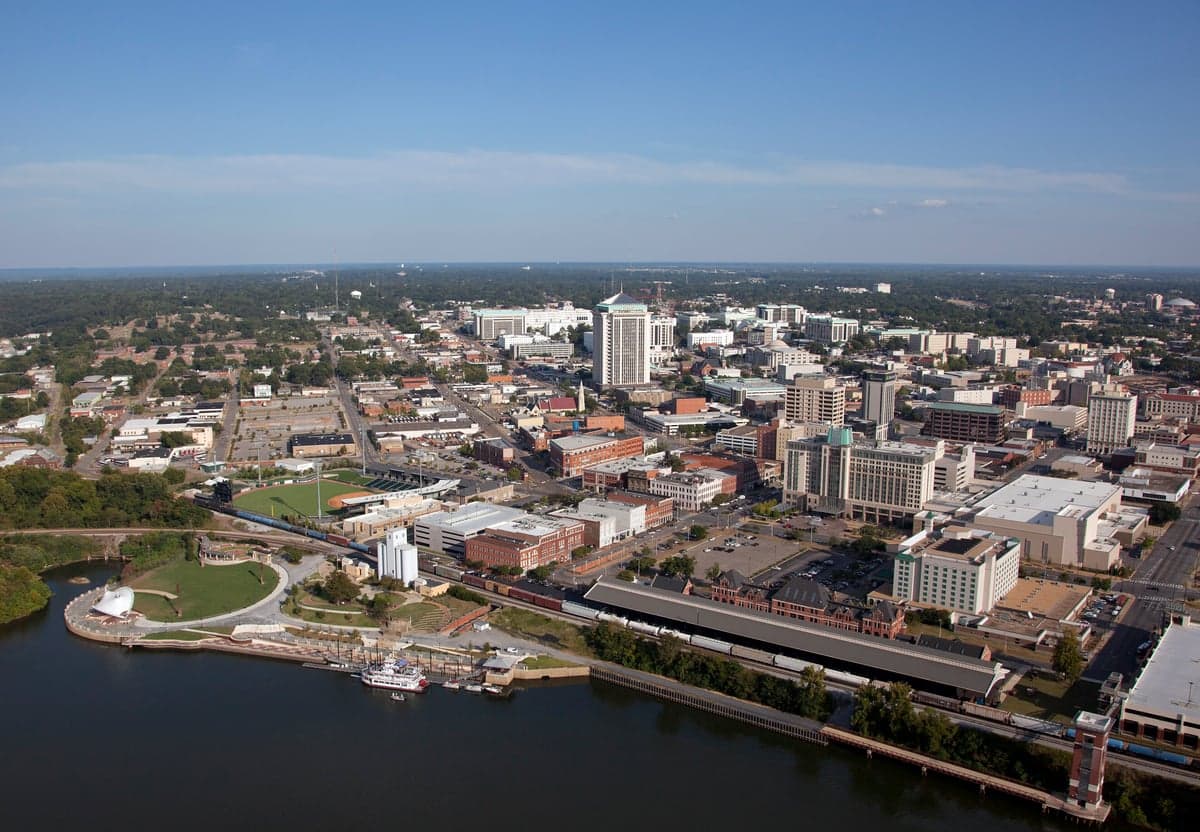
Photo: Wikipedia
Political ClimatePolitical Climate in Montgomery, AL
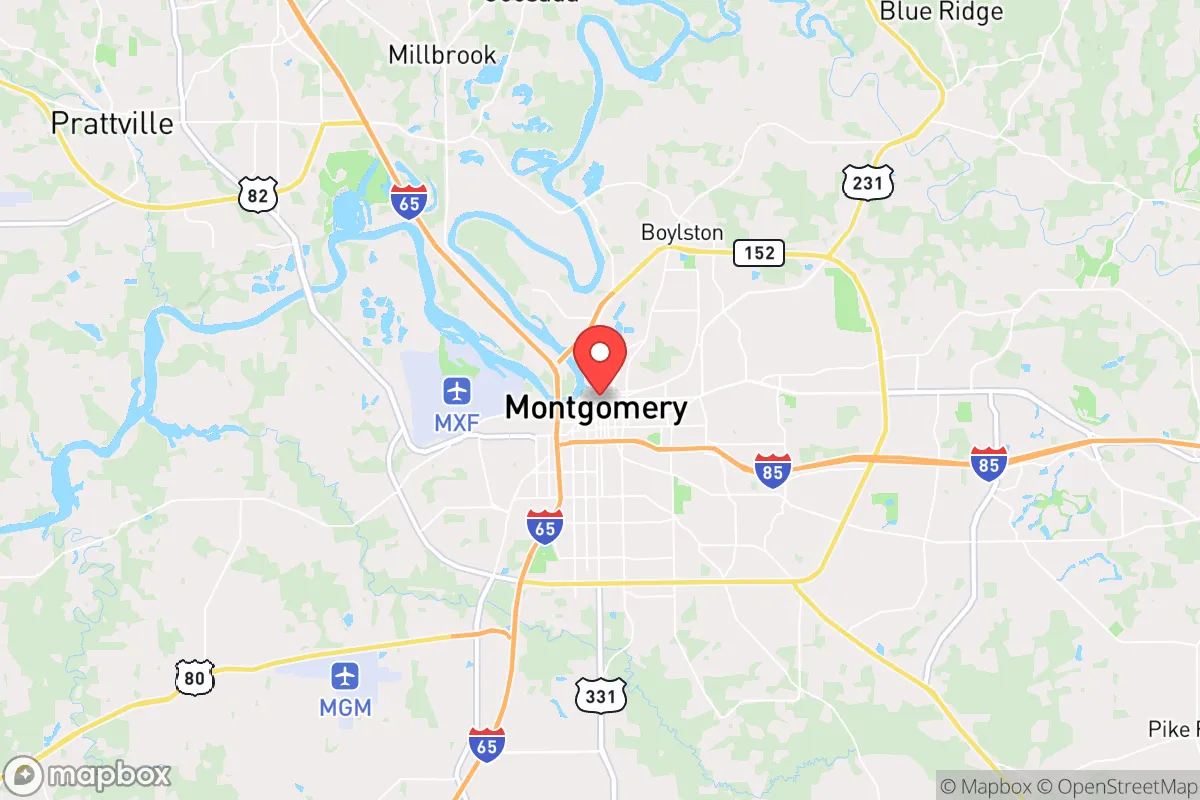
District shown is the primary district for this city’s centroid. Cities may span multiple districts.
Local Political AnalysisPolitical Analysis of Montgomery, AL
Montgomery, Alabama, sits in a political reality that’s shifted noticeably over the last decade. The Cook PVI rating of D+5 tells you the city leans Democrat, but that number doesn’t capture the full story—especially if you’ve lived here long enough to remember when things felt more balanced. Today, the local government and many of the county-level offices are firmly in progressive hands, and that’s brought a wave of policies that feel less about common sense and more about top-down control. For folks who value personal freedoms—whether it’s how you raise your kids, run a small business, or practice your faith—the trajectory here is worth watching closely.
How it compares
Drive just 15 minutes outside the city limits, and the political landscape flips hard. Places like Prattville, Millbrook, and Wetumpka in Autauga and Elmore counties are reliably conservative, with local leaders who push back against the kind of government overreach you see in Montgomery proper. Even nearby Pike Road, a fast-growing suburb, has a distinctly more libertarian-leaning vibe—lower taxes, fewer regulations, and a school board that actually listens to parents. The contrast is stark: inside the city, you’ve got a county commission and school board that have embraced progressive priorities like diversity, equity, and inclusion initiatives and expanded public health mandates. Outside, it’s still the Alabama most of us grew up in, where the default answer from officials is “stay out of my way.” That divide creates a real tension, especially for families who work in Montgomery but choose to live in the surrounding counties to escape the creeping sense of government telling you what to do.
What this means for residents
If you live inside Montgomery city limits, you’re dealing with a local government that’s increasingly comfortable with overreach. Property taxes have crept up to fund pet projects that sound good on paper but rarely deliver results—think expanded public transit programs that barely get used or “equity” offices that seem more focused on messaging than actual outcomes. The school system, which was once a point of pride for many families, has seen a steady exodus to private and charter options as the district doubles down on progressive curriculum changes and discipline policies that leave teachers and parents frustrated. For small business owners, the permitting process has gotten slower and more bureaucratic, with new layers of regulation that feel designed to favor big developers over mom-and-pop shops. The long-term trend is concerning: as the city gets bluer, the cost of living in terms of both taxes and lost freedoms keeps rising, while the quality of basic services—roads, public safety, school performance—stagnates or declines.
One cultural distinction that stands out is how Montgomery’s progressive leadership has leaned into historical narratives and social justice initiatives in a way that feels performative rather than practical. You’ll see city-funded murals and monuments dedicated to various causes, but the same officials rarely address the real issues that affect daily life—like the rising crime rate in certain neighborhoods or the lack of affordable housing that isn’t tied to government programs. Meanwhile, the surrounding conservative communities focus on keeping things simple: low taxes, responsive police, and schools that teach the basics without the political baggage. For anyone who values personal liberty and wants to be left alone to live their life, the smart move is to keep a close eye on city council elections and consider whether the trade-offs of living inside Montgomery are worth it. The way things are going, that answer is getting harder to justify with each passing year.

State Political ClimatePolitical Climate in Alabama
State Political AnalysisPolitical Environment in the State
Alabama is a deeply conservative state, with a Republican lean that has only intensified over the past two decades. The GOP holds supermajorities in both chambers of the state legislature, all statewide elected offices, and both U.S. Senate seats. In the 2024 presidential election, Donald Trump carried the state by roughly 30 points, a margin that has been consistent since 2012. The shift from a reliably Democratic “Solid South” to a Republican stronghold was largely cemented by the 2010 midterms, when the GOP took control of the legislature for the first time since Reconstruction. Today, the dominant coalition is a mix of rural traditionalists, evangelical Christians, and suburban conservatives, with the state’s few urban centers—Birmingham, Montgomery, and Mobile—providing the only real pockets of Democratic resistance.
Urban vs. rural divide
The political map of Alabama is starkly divided between its rural, small-town interior and its handful of urbanized counties. Jefferson County (Birmingham) and Montgomery County are the two main Democratic strongholds, driven by large Black populations and younger, more progressive voters in the cities proper. In 2024, Jefferson County voted for Joe Biden by about 12 points, while the surrounding suburbs—like Hoover, Vestavia Hills, and Mountain Brook—are reliably Republican, often by 20-30 point margins. Mobile County, home to the port city of Mobile, is a classic swing county that has trended redder over the last decade, now voting about 15 points Republican. The real engine of GOP dominance is the “Black Belt” region (named for its rich soil, not politics) and the northern half of the state. Counties like Shelby (suburban Birmingham), Madison (Huntsville), and Baldwin (Gulf Shores) are growing fast and voting increasingly Republican. Huntsville, in particular, is a fascinating case: a tech-heavy, educated workforce that still leans conservative, thanks to a strong military and aerospace presence. The rural counties—like Winston, Blount, and DeKalb—are among the most Republican in the nation, often voting 80%+ for GOP candidates.
Policy environment
Alabama’s policy environment is among the most conservative in the country, with a strong emphasis on low taxes, limited regulation, and traditional social values. The state has no income tax on retirement income, a flat 5% corporate income tax, and a state sales tax of 4% (though local add-ons can push it to 10%+ in some cities). Property taxes are among the lowest in the nation, averaging about 0.4% of assessed value. The regulatory climate is business-friendly, with a right-to-work law and no state-level minimum wage (the federal $7.25 applies). Education policy is a flashpoint: the state has a robust school choice movement, with a new Education Savings Account (ESA) program passed in 2024 that allows parents to use public funds for private school tuition, homeschooling, or tutoring. This is a major win for parental rights advocates. Healthcare is a mixed bag—Alabama did not expand Medicaid under the Affordable Care Act, leaving a coverage gap for about 300,000 low-income adults. The state has some of the strictest abortion laws in the nation, with a near-total ban (the Human Life Protection Act) that took effect after the Dobbs decision. Election laws are moderately restrictive: voter ID is required, and the state has closed primaries. There is no early voting, but absentee voting is available with an excuse.
Trajectory & freedom
Alabama is on a trajectory of expanding personal freedom in several key areas, particularly around gun rights, parental rights, and tax relief. In 2022, the state passed constitutional carry (permitless carry of a concealed firearm), making it the 22nd state to do so. This was a major victory for Second Amendment advocates. In 2024, the legislature passed the “Parents’ Bill of Rights,” which requires schools to notify parents about curriculum changes and medical services, and prohibits instruction on sexual orientation or gender identity in K-5 classrooms. This aligns with a broader national trend of pushing back against progressive education policies. On the tax front, the state has gradually reduced the state sales tax on groceries (from 4% to 2% as of 2025) and eliminated the state income tax on overtime pay for hourly workers. However, there are concerning signs of government overreach. The state’s medical marijuana program, approved in 2021, has been mired in legal challenges and bureaucratic delays, effectively denying patients access. Additionally, the state’s strict abortion ban has led to legal uncertainty for doctors and has been criticized for lacking exceptions for rape and incest. The state’s approach to COVID-19 was notably hands-off—no mask mandates, no vaccine passports—which was a net positive for personal liberty.
Civil unrest & political movements
Alabama has seen relatively little civil unrest compared to other states, but there are active political movements on both sides. The state was a flashpoint in the 2020 election integrity debate, with then-Secretary of State John Merrill (a Republican) repeatedly stating that Alabama’s election was “safe and secure” despite national claims of fraud. There have been no major protests or riots in recent years, though the Black Lives Matter movement did see some demonstrations in Birmingham and Montgomery in 2020. The state’s immigration politics are relatively quiet—Alabama passed a strict immigration law (HB 56) in 2011, which was largely gutted by federal courts, but the issue remains dormant compared to border states. There is a small but vocal secessionist movement, primarily online, but it has no real political traction. The most visible political flashpoint in recent years has been the debate over Confederate monuments, particularly in Montgomery and Birmingham, where statues were removed in 2020 amid protests. This has energized both the conservative base (who see it as an attack on heritage) and progressive activists (who see it as a necessary reckoning). For a new resident, the political climate is generally calm and orderly, with most people keeping their politics to themselves in daily life.
Projection
Over the next 5-10 years, Alabama is likely to become even more conservative, driven by two demographic trends: the continued growth of the Huntsville metro area (which is attracting conservative-leaning tech workers from California and Texas) and the out-migration of younger, more liberal residents from Birmingham and Montgomery to other states. The state’s population is projected to grow by about 5% by 2030, with most of that growth in the suburbs of Huntsville, Birmingham, and the Gulf Coast. This will likely reinforce the GOP’s supermajorities in the legislature and keep the state solidly red in presidential elections. However, there are potential fault lines. The state’s reliance on federal funding (about 40% of the state budget) could become a point of tension if Congress cuts spending. The ongoing debate over Medicaid expansion could resurface, especially if rural hospitals continue to close. And the state’s strict abortion ban could face legal challenges or ballot initiatives in the future. For someone moving in now, expect a state that is stable, predictable, and increasingly aligned with conservative values—but with the same cultural and economic challenges that come with being a low-tax, low-service state.
For a new resident, the bottom line is this: Alabama offers a high degree of personal freedom in areas like gun rights, school choice, and low taxes, but it comes with trade-offs. The state’s healthcare system is strained, its public schools are underfunded (though the ESA program is a game-changer for parents), and its infrastructure is aging. If you value a hands-off government, a strong sense of community, and a slower pace of life, Alabama is a solid choice. Just be prepared for the heat—both political and meteorological.
* Values derived from national, state, county, city and local statistics and may differ in a specific area. Last updated: 2026-04-19T18:59:06.000Z
Narrative content on this page is AI-generated and may contain mistakes. Verify any details that matter before acting on them.
ReloMaps may earn a commission from affiliate links at no extra cost to you.

