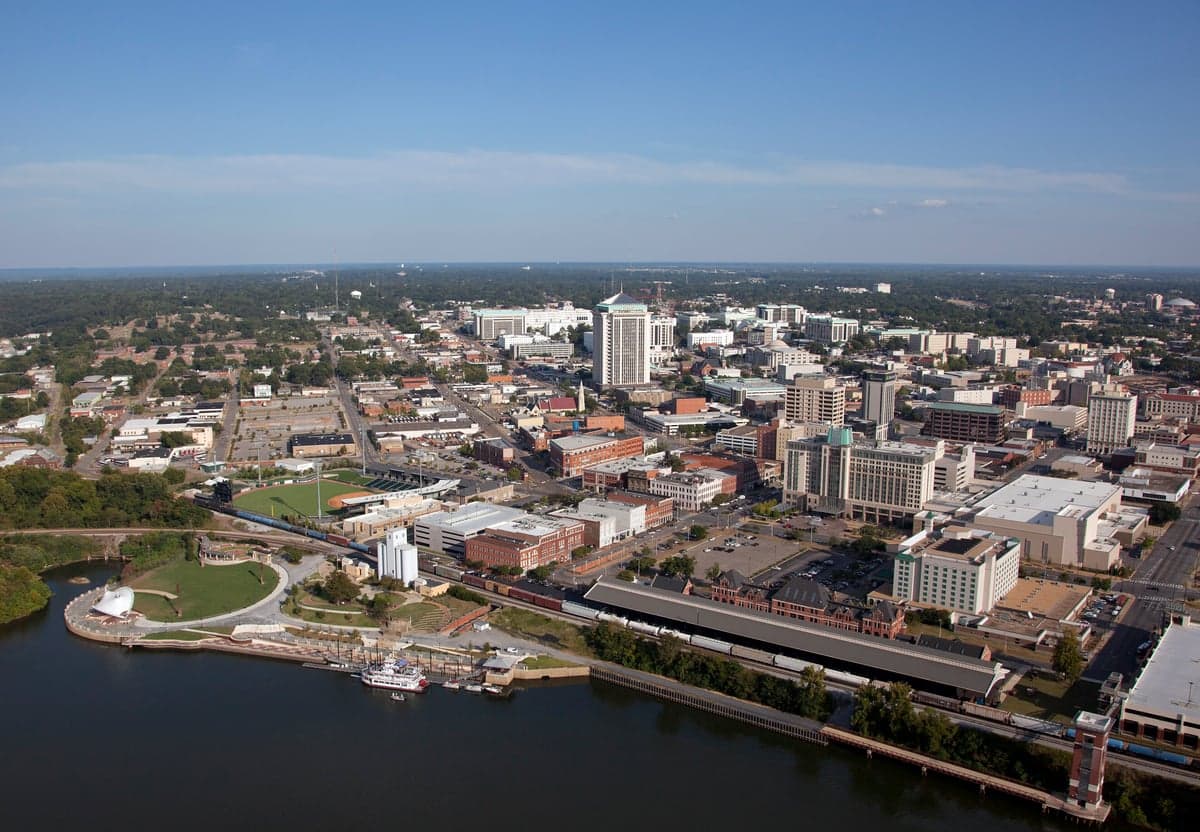
Photo: Wikipedia
Strategic Assessment of Montgomery, AL
Meaningful friction. Expect exposure to either population pressure, blast zones, or natural disaster risk. Consider buying a retreat property.
What does the Strategic Assessment tell us?
Our Strategic Assessment grades tactical survivability of an area. Major population centers, military targets, fallout zones, natural disasters, and border exposure all drive risk — lower exposure means a more defensible position in a crisis.
This is heavily inspired by Joel Skousen's Strategic Relocation book. Highly recommended you checkout the book ($)What does this tell us?
Our Strategic Assessment grades tactical survivability of an area. Major population centers, military targets, fallout zones, natural disasters, and border exposure all drive risk — lower exposure means a more defensible position in a crisis.
This is heavily inspired by Joel Skousen's Strategic Relocation book. Highly recommended you checkout the book ($)Strategic Pillars

Key Distances
Regional Safe Places
Below is our recommended "safe zones" in Alabama and the surrounding area based on our strategic heuristics. For most people, it's unrealistic to live in a “safe zone” full-time due to work, family or other personal reasons. They tend to be more rural. However, many of these areas are perfect for second homes and retreat properties that double as a vacation home or even a short-term rental.
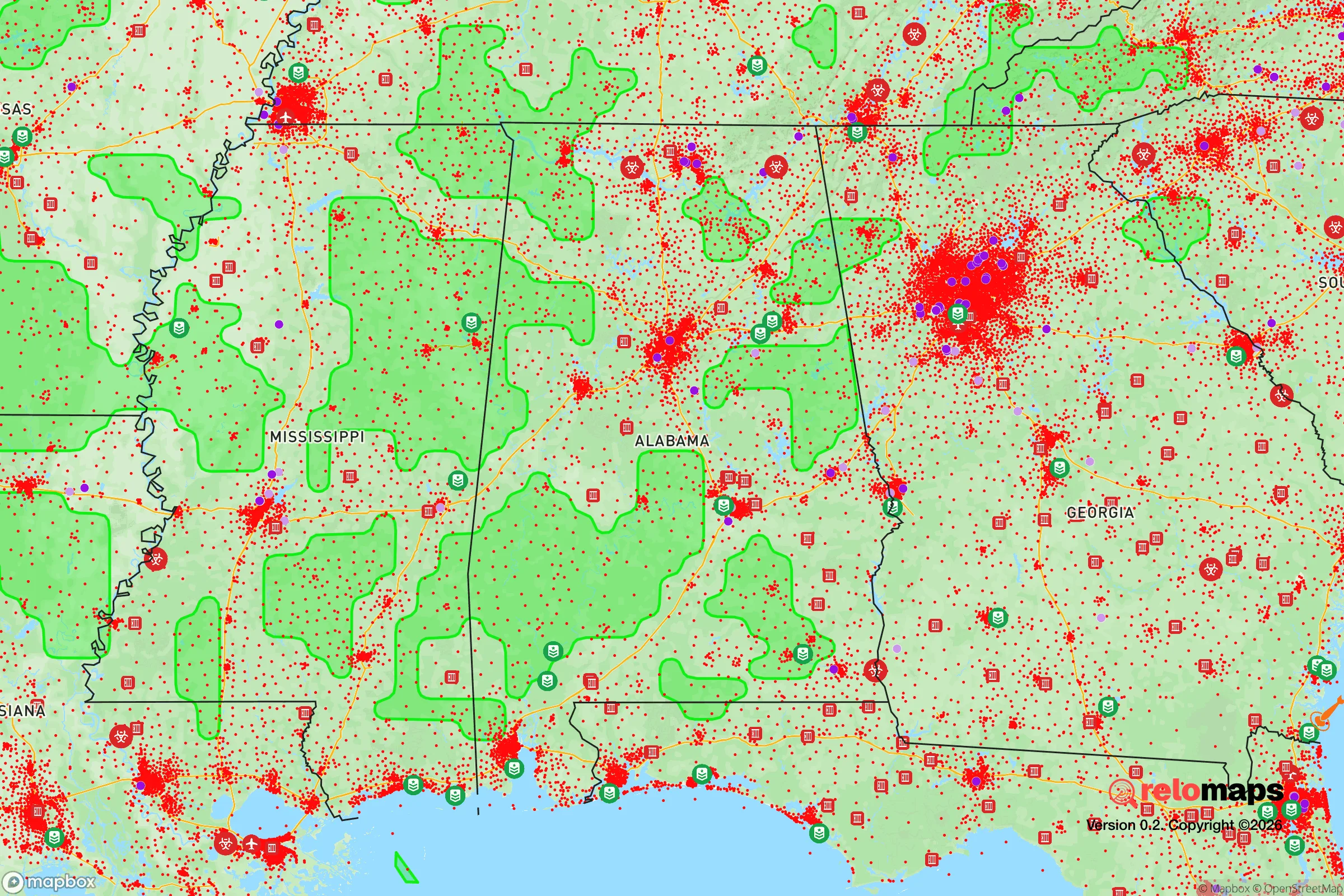
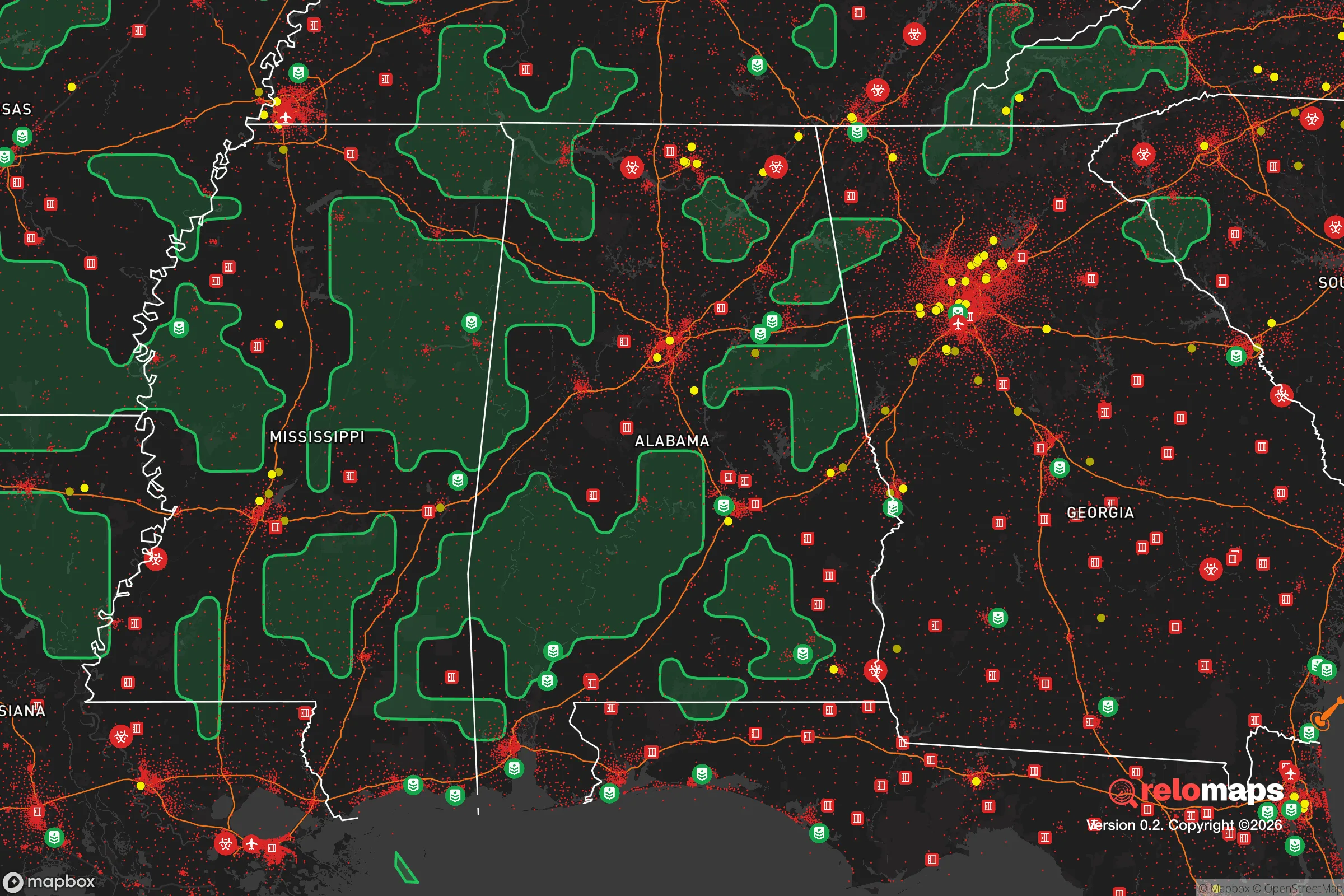


Important Note: For informational purposes only. This does not mean nothing bad ever happens in the green zones. Please use common sense. This is based on public data and modeled with AI. We tried to take a conservative approach but mistakes happen. We update this regularly as new information becomes available.
Solar Generator Recommendations
Backup power matters more here than in safer locations. We've picked three solar generators across budgets and capacity tiers — start with the budget unit if you only need a few essentials, or step up if you want to run a fridge and HVAC for days at a time.

Jackery Portable Power Station Explorer 300
Budget OptionPower on the Go: Weighing only 11 lbs, it's convenient to set up and store with book-sized foldable solar panels

BLUETTI Portable Power Station AC180
Designed for both indoor and outdoor scenarios, AC180 is highly capable as it has a robost capacity and continuous output power.

EF ECOFLOW DELTA Pro Ultra Power Station
Upgraded PickEcoFlow DELTA Pro Ultra is a whole-home energy system designed to grow with your family. Integrated with the Smart Home Panel 2, it scales to meet your evolving energy needs — keeping your home powered, intelligent, and secure through every stage of life.
We earn a commission, at no additional cost to you.
Strategic Assessment Analysis
Montgomery, Alabama, offers a strategic balance of geographic resilience and practical self-sufficiency that appeals to those preparing for civic unrest or large-scale disruptions. Situated roughly 90 miles south of Birmingham and 160 miles west of Atlanta, the city sits outside the immediate blast radius and fallout zones of major population centers while still providing access to critical infrastructure. Its position along the Alabama River, combined with a relatively low population density in the surrounding counties, makes it a viable hub for those seeking to maintain a low profile while staying connected to regional supply chains and medical facilities.
Geographic position and natural advantages for long-term stability
Montgomery’s location in the central part of the state places it in a region with moderate climate risks compared to coastal areas—hurricane storm surge is not a direct threat, though inland flooding from tropical systems can occur. The city sits on the fall line, where the Piedmont plateau meets the Coastal Plain, providing a mix of rolling hills and flatlands that support diverse agriculture and water access. The Alabama River, which runs through the city, offers a reliable freshwater source for those with filtration systems, and the surrounding counties—Autauga, Elmore, and Lowndes—contain substantial undeveloped land suitable for off-grid homesteading or bug-out locations. The area’s growing season lasts roughly 230 days, allowing for year-round food production with proper planning. For a relocator concerned with long-term stability, Montgomery’s distance from major fault lines, nuclear power plants (the nearest is Farley Nuclear Plant in Alabama, about 100 miles southeast), and coastal hurricane zones reduces the likelihood of being caught in a cascading disaster scenario.
Risks, exposures, and proximity to fallout-relevant landmarks
While Montgomery avoids the worst of coastal and seismic threats, it is not without vulnerabilities. The city lies within 150 miles of Maxwell Air Force Base and the Alabama National Guard headquarters, which could become a target in a conflict scenario—though this is a lower-tier risk compared to bases near Washington, D.C., or Norfolk. The nearby Hyundai Motor Manufacturing plant and the Mercedes-Benz U.S. International plant in Vance (about 30 miles west) are industrial assets that could draw attention during economic collapse or supply chain disruptions, but they are not high-value military targets. More concerning for the prepper mindset is Montgomery’s proximity to the Tennessee Valley Authority’s nuclear facilities—Browns Ferry Nuclear Plant is about 120 miles north, and the Farley plant is 100 miles southeast. In a worst-case event, prevailing winds from the Gulf typically blow north-northeast, meaning fallout from Farley would likely move away from Montgomery, but Browns Ferry fallout could drift southward depending on weather patterns. The city’s own industrial base includes chemical plants along the river, which could pose localized hazards if infrastructure fails during unrest. For a relocator, the key takeaway is that Montgomery’s risk profile is moderate—better than living near a major port or capital city, but not as insulated as rural areas in the Appalachian foothills.
Practical resilience for a relocator: food, water, energy, and defensibility
For someone serious about self-reliance, Montgomery’s practical resilience hinges on a few critical factors. Water access is strong: the Alabama River provides a year-round surface water source, and the city’s municipal water comes from the Tallapoosa River via the Montgomery Water Works system. However, in a grid-down scenario, river water requires robust filtration—sediment, agricultural runoff, and industrial discharge are real concerns. Food production is feasible with the long growing season, and local farmers’ markets (like the Montgomery Curb Market) offer a network for sourcing seeds, livestock, and tools. The surrounding counties have a strong agricultural base—soybeans, corn, cotton, and poultry are common—so barter and trade networks could emerge quickly. Energy resilience is mixed: Alabama Power’s grid is reliable under normal conditions, but the region is prone to summer thunderstorms and occasional ice storms that knock out power for days. Solar panel adoption is growing but not yet widespread; a prepper should plan for backup generation or off-grid solar with battery storage. Defensibility is a double-edged sword: Montgomery’s urban core is dense and could become chaotic during civil unrest, but the outer suburbs and rural areas—like Pike Road, Wetumpka, or Prattville—offer more defensible properties with acreage, natural barriers (creeks, wooded lots), and lower crime rates. The city’s crime index is above the national average, with property crime being the primary concern, but violent crime is concentrated in specific neighborhoods; a relocator can avoid these areas by choosing properties north or east of the city center. For daily life, Montgomery has two major hospitals (Baptist Medical Center South and Jackson Hospital) and a Level I trauma center at UAB in Birmingham (90 minutes north), which is adequate for most medical needs but not ideal for a mass casualty event.
Overall, Montgomery presents a workable strategic option for those prioritizing a middle-ground location—close enough to regional resources (Birmingham, Atlanta, Mobile) to access supplies and medical care, but far enough to avoid the worst fallout from urban collapse or nuclear events. The city’s river access, agricultural surroundings, and moderate climate support long-term self-sufficiency, while its industrial and military proximity introduces manageable risks that can be mitigated through careful property selection and prepping. For a conservative-leaning relocator concerned with national instability, Montgomery offers a realistic base of operations—not a fortress, but a defensible position with room to grow food, store water, and maintain a low profile. The key is to avoid the urban core, secure a property with well water and solar potential, and build relationships with the local farming community before a crisis hits. In a world where major cities are increasingly fragile, Montgomery’s blend of accessibility and resilience makes it a serious contender for those planning ahead.

* Values derived from national, state, county, city and local statistics and may differ in a specific area. Last updated: 2026-04-19T18:59:06.000Z
Narrative content on this page is AI-generated and may contain mistakes. Verify any details that matter before acting on them.
ReloMaps may earn a commission from affiliate links at no extra cost to you.

