Photo: Wikipedia
Demographics of Mooresville, NC
Affluence Level in Mooresville, NC
A middle-class area roughly in line with national averages across income, home values, education, and employment.
People of Mooresville, NC
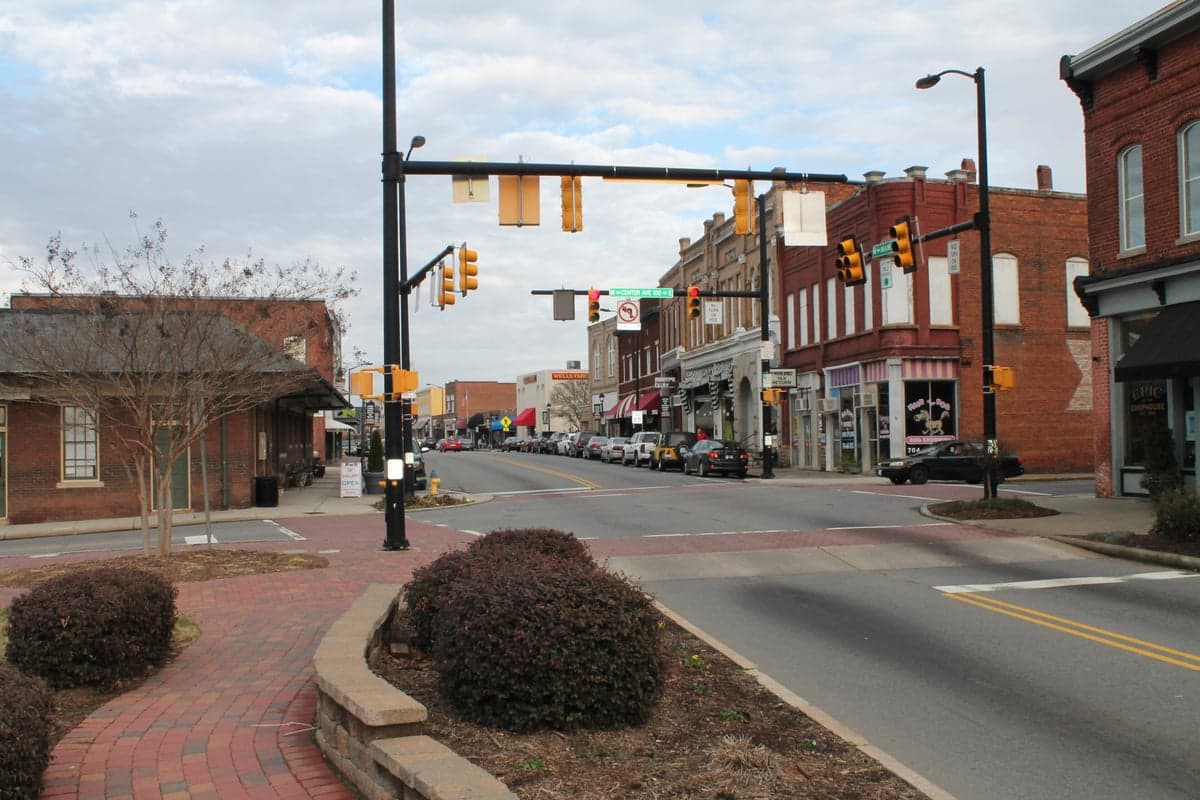
Today, Mooresville, North Carolina, is a rapidly growing town of 51,447 residents defined by its dual identity as a NASCAR hub and a Charlotte exurb. The population is predominantly White (72.5%), with a notable Black community (10.7%) and a growing Hispanic presence (7.3%), while the foreign-born share sits at a modest 5.0%. The town’s character is shaped by a high proportion of college-educated residents (45.3%) and a strong sense of place rooted in Lake Norman living, motorsports culture, and family-oriented subdivisions. Mooresville feels less transient than many Charlotte suburbs, with deep generational roots among both its White and Black populations.
How the city was settled and grew
Mooresville’s population history begins with Scots-Irish and German settlers who arrived in the 1700s, drawn by the fertile Piedmont land and the promise of small-scale farming. The town was officially incorporated in 1873, named after a railroad official, and its early growth was tied to the Atlantic, Tennessee & Ohio Railroad line. The first major population wave came with the post-Civil War textile boom. Cotton mills—most notably the Mooresville Cotton Mills (founded 1891) and the Mooresville Spinning Company—drew rural White families from the surrounding countryside and Black families from the Deep South seeking industrial work. These mill workers settled in distinct neighborhoods: Mill Village (the area around the original mills, now largely redeveloped) housed White mill families, while Black workers concentrated in Southside, a historically African American neighborhood near the railroad tracks that remains a cultural anchor today. A second wave arrived during the early 20th century as the town became a regional trading center, with German and Irish immigrants opening shops and businesses along Main Street. By 1950, Mooresville’s population hovered around 5,000, a stable, biracial community built on textiles and agriculture.
Modern era (post-1965)
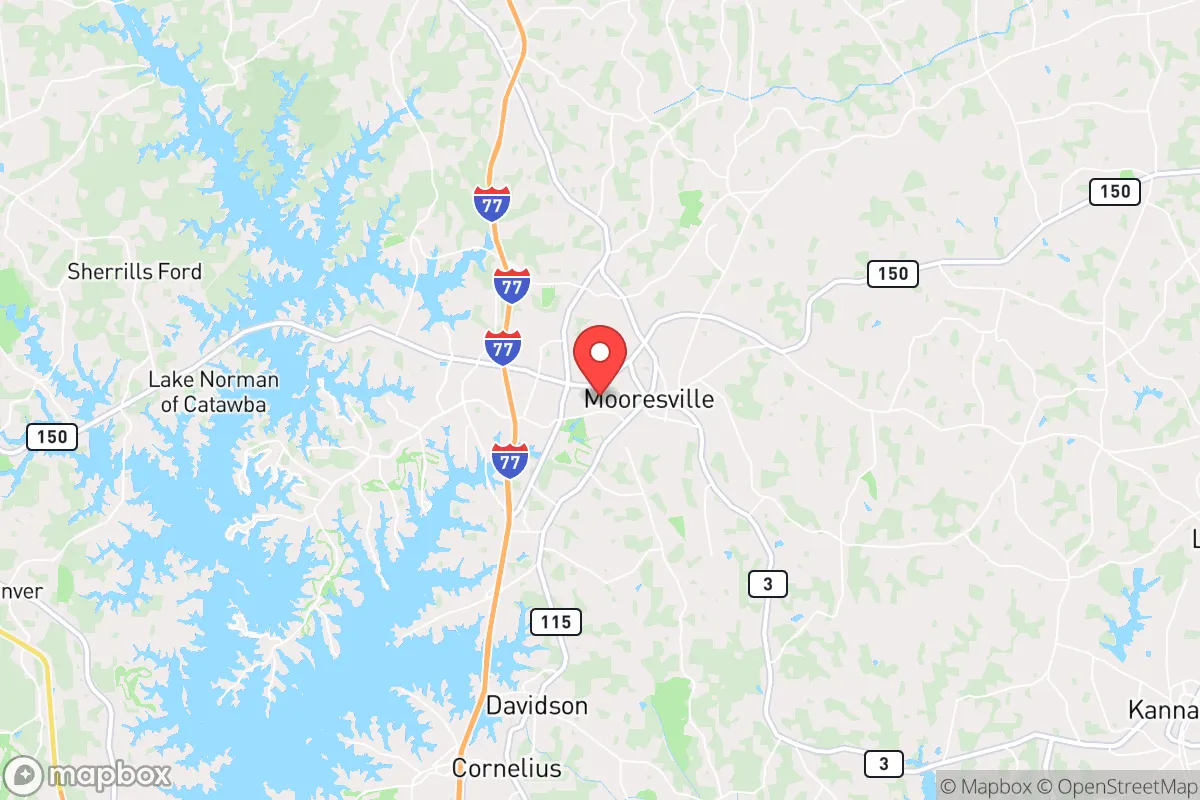
The modern transformation of Mooresville’s population began in the 1990s with two catalysts: the completion of Interstate 77 and the explosive growth of NASCAR. The racing industry—headquartered in Mooresville with teams like Hendrick Motorsports, Joe Gibbs Racing, and Penske Racing—drew a wave of engineers, mechanics, and executives, predominantly White, from across the Midwest and Northeast. These newcomers settled in lakefront subdivisions like The Point and Brawley Farms, creating an affluent, car-culture enclave. Simultaneously, Charlotte’s suburban sprawl pushed middle-class families—both White and Black—into Mooresville, filling developments like Langtree at the Lake and Shepherds Vineyard. The Black population, which had historically lived in Southside and the East Mooresville area, began to spread into newer subdivisions, though Southside remains a core community. The Hispanic population grew from near-zero in 1990 to 7.3% today, driven by construction and landscaping jobs tied to the building boom; they are concentrated in the West Mooresville corridor near Highway 150. The Indian subcontinent population (2.8%) and East/Southeast Asian population (1.8%) are smaller but visible, largely professionals in tech and motorsports engineering who live in newer subdivisions like Birkdale Village and the Lake Forest area. The foreign-born share of 5.0% is low for a Charlotte suburb, indicating that Mooresville’s growth has been overwhelmingly domestic.
The future
Mooresville’s population is projected to continue growing, likely reaching 65,000–70,000 by 2040, driven by Charlotte’s outward expansion and the town’s reputation for good schools and lake access. The population is homogenizing in terms of income—new arrivals are overwhelmingly middle-to-upper-middle-class—but tribalizing by lifestyle: NASCAR families, lake recreationists, and Charlotte commuters form distinct social circles that rarely overlap. The Hispanic and Indian communities are growing steadily but remain small; they are assimilating residentially, with no strong ethnic enclaves forming. The Black population share has held steady at around 10-11% for two decades, suggesting a stable, integrated community rather than resegregation. The biggest demographic shift ahead is the aging of the White lakefront population, which may lead to turnover as retirees sell to younger families. Mooresville is becoming more educated and more affluent, but its racial and ethnic diversity is increasing only slowly.
For a conservative-leaning mover, Mooresville offers a stable, family-oriented community with strong institutions and a clear sense of identity. The town is not becoming a melting pot in the Charlotte mold; rather, it is a place where traditional Southern roots, motorsports culture, and suburban comfort coexist. New arrivals will find a population that is welcoming but not rapidly diversifying, and neighborhoods that are defined more by income and lifestyle than by ethnicity.

* Values derived from national, state, county, city and local statistics and may differ in a specific area. Last updated: 2026-04-21T17:04:35.000Z
Narrative content on this page is AI-generated and may contain mistakes. Verify any details that matter before acting on them.
ReloMaps may earn a commission from affiliate links at no extra cost to you.

