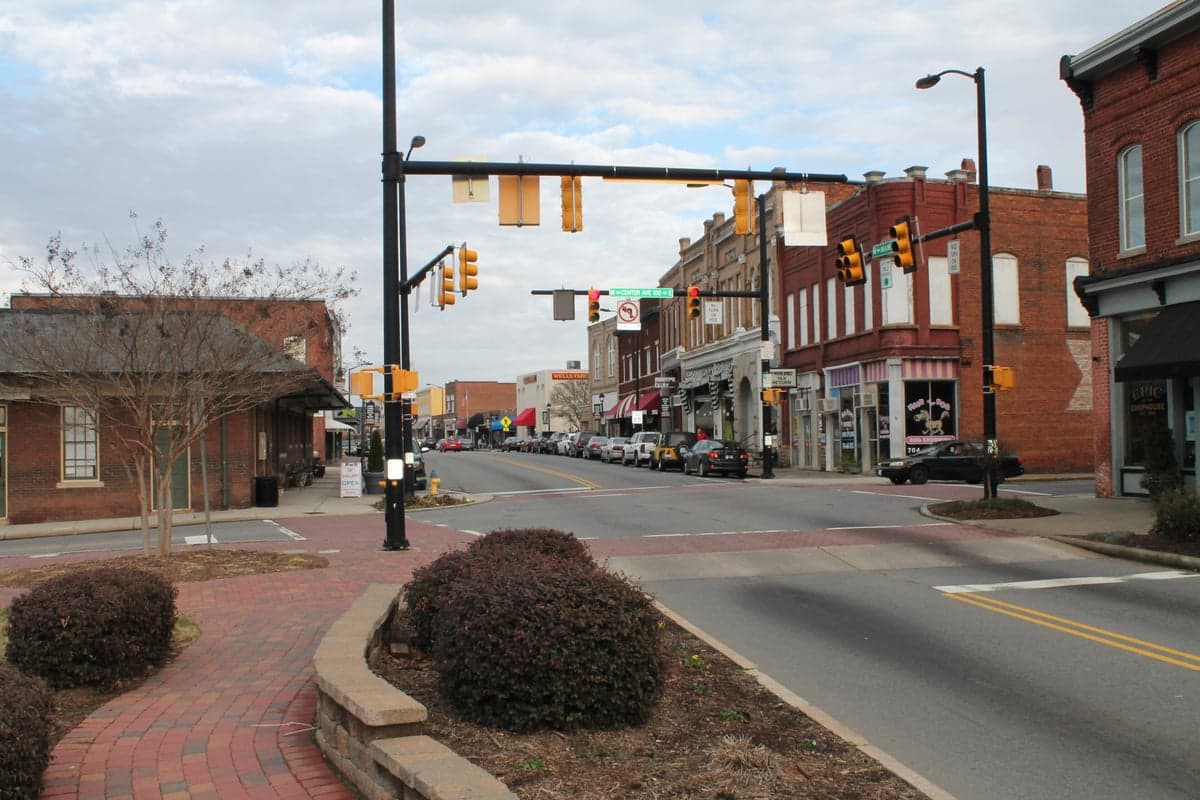
Photo: Wikipedia
Political ClimatePolitical Climate in Mooresville, NC
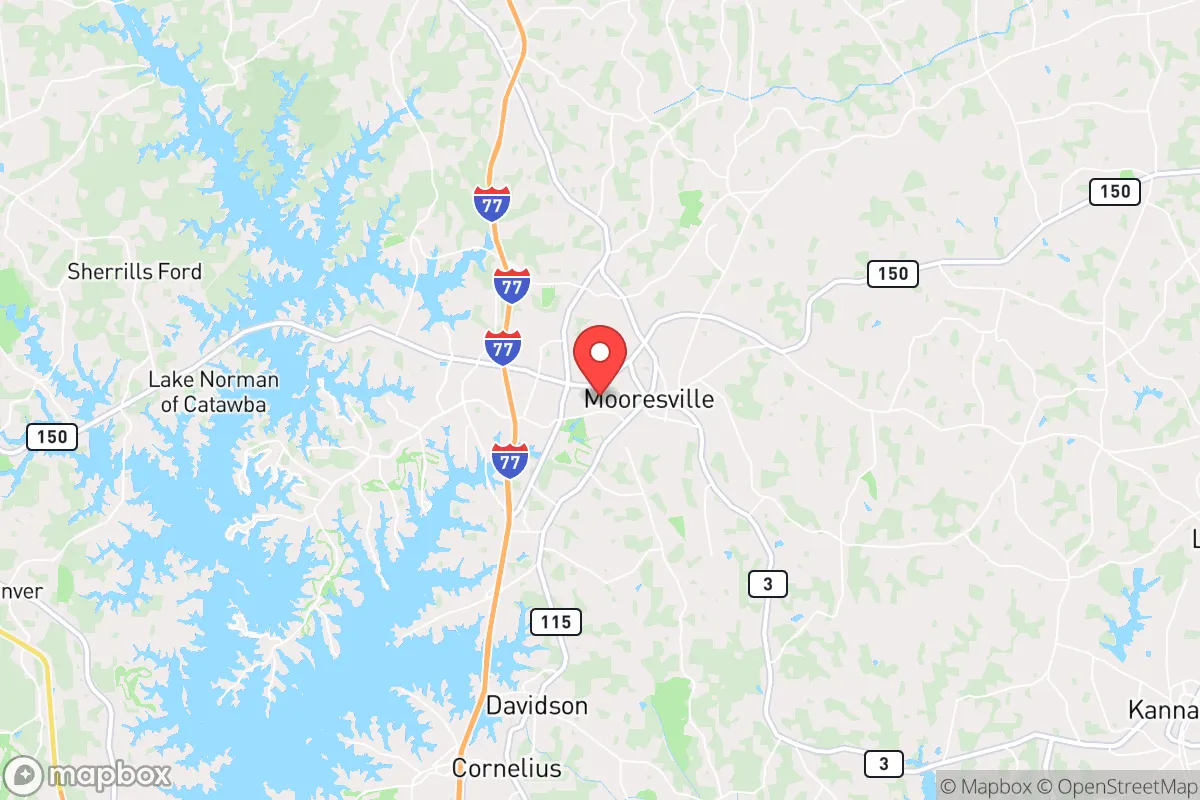
District shown is the primary district for this city’s centroid. Cities may span multiple districts.
Local Political AnalysisPolitical Analysis of Mooresville, NC
Mooresville has long been a solidly conservative community, and that hasn’t changed much even as the area has grown. The Cook PVI rating of R+9 tells you the baseline: this isn’t a swing town, it’s a place where Republican candidates can generally count on winning by comfortable margins. But if you’ve been here a while, you’ve noticed the political winds shifting, especially as folks from Charlotte and other more liberal areas move in for the lake life and lower taxes. The trajectory is still red, but there’s a growing undercurrent of progressive activism that wasn’t here a decade ago, and it’s worth keeping an eye on.
How it compares
Drive 20 minutes south to Charlotte’s Mecklenburg County, and you’re in a completely different world politically—solidly blue, with a Cook PVI of D+14. That contrast is stark. Mooresville, in Iredell County, is a conservative island compared to its big-city neighbor. Even within Iredell, the northern part of the county around Statesville leans more traditional, while Mooresville’s growth has brought in a younger, more diverse crowd that sometimes votes differently. Towns like Davidson, just across the lake, are noticeably more liberal, with a college-town vibe from Davidson College that pushes local politics left. So if you’re looking for a place where your values on limited government and personal freedom are the norm, Mooresville still fits, but the buffer zone is shrinking.
What this means for residents
For folks who value keeping government out of their lives, Mooresville’s political climate is generally a relief. You won’t see the kind of overreach you get in Mecklenburg County—no heavy-handed business mandates, no aggressive zoning that tells you what you can do with your own property. The local school board and town council have historically been conservative, which means lower taxes and fewer regulations. But the influx of new residents has brought pressure for more progressive policies, like higher density development and expanded public transit. If you’re concerned about government creeping into your personal freedoms—whether that’s how you run your small business, what you teach your kids, or how you use your land—you’ll want to stay engaged in local elections. The shift isn’t here yet, but the seeds are being planted.
One thing that sets Mooresville apart is its strong sense of community self-reliance. People here don’t look to the government to solve every problem; they handle things through churches, civic groups, and neighbor-to-neighbor help. That’s a cultural distinction that’s worth protecting. The town’s rapid growth has brought some tension between long-time residents who want to keep things small and newcomers who want more amenities and services. So far, the conservative majority has held the line on most issues, but the 2024 election showed that the margin is tightening in some precincts. If you’re thinking about moving here, know that you’re getting a place where your rights are respected, but you’ll need to be part of the conversation to keep it that way.

State Political ClimatePolitical Climate in North Carolina
State Political AnalysisPolitical Environment in the State
North Carolina has long been considered a quintessential swing state, but over the past decade, its political center of gravity has shifted noticeably rightward, driven by a powerful coalition of suburban conservatives, rural traditionalists, and a growing population of retirees and remote workers fleeing high-tax states. While the state still votes narrowly in presidential elections—Trump won it by just 1.3 points in 2024—the state legislature has maintained a veto-proof Republican supermajority since 2022, and the governor’s office remains the only statewide Democratic stronghold. The 10-20 year arc shows a state that was once a classic purple battleground now trending red at the local and legislative level, even as its major metros become more progressive.
Urban vs. rural divide
The political map of North Carolina is a textbook study in geographic polarization. The three major urban centers—Charlotte, Raleigh-Durham, and Greensboro-Winston-Salem—are solidly Democratic, with Mecklenburg and Wake counties delivering margins of 20-30 points for Democratic candidates. But the real story is the rural and exurban explosion of Republican strength. Counties like Union (southeast of Charlotte), Johnston (southeast of Raleigh), and Cabarrus (north of Charlotte) have flipped from purple to deep red over the last two cycles, driven by explosive population growth and an influx of conservative-leaning migrants from the Northeast and Midwest. Meanwhile, the eastern part of the state—places like Pitt County (Greenville) and Cumberland County (Fayetteville)—remain competitive but are trending redder as military families and rural voters consolidate. The Appalachian counties in the west, such as Watauga (Boone) and Buncombe (Asheville), are notable outliers: Watauga is a college-town blue island, while Buncombe has become a progressive stronghold, but the surrounding mountain counties are overwhelmingly Republican. The net effect is a state where roughly 70% of the landmass votes Republican, but the population centers keep statewide races close.
Policy environment
North Carolina’s policy environment is a mixed bag that leans conservative on most economic and cultural fronts, but with some notable exceptions that frustrate conservatives. The state has a flat income tax rate of 4.5%, which is scheduled to drop to 3.99% by 2027 under legislation passed in 2023—a clear win for fiscal conservatives. There is no state-level estate tax, and the corporate income tax is being phased down to zero by 2030. However, the sales tax is relatively high at 4.75% (plus local add-ons), and property taxes vary widely by county, with Wake and Mecklenburg counties imposing rates above the state median. On education, the state has a robust school choice landscape: the Opportunity Scholarship Program, expanded in 2023, now provides vouchers of up to $7,000 per student for private school tuition, with no income cap—making it one of the most expansive school choice programs in the country. Higher education is dominated by the UNC system, which has seen conservative board appointments under the Republican legislature, leading to debates over DEI programs and academic freedom. Healthcare is a flashpoint: the state expanded Medicaid in 2023 under a bipartisan deal, a move that many conservatives opposed as a step toward government-run healthcare, but which also brought coverage to 600,000 low-income adults. Election laws have been tightened: voter ID is now required (implemented in 2023 after years of litigation), and same-day registration during early voting was eliminated in 2024. The state also passed a 12-week abortion ban in 2023, with exceptions for rape, incest, and fetal anomalies—a significant shift from the previous 20-week limit.
Trajectory & freedom
On the freedom front, North Carolina is a state of contradictions that is trending in a conservative direction on most fronts, but with some worrying signs. The Second Amendment is well-protected: permitless carry became law in 2023, allowing any law-abiding adult to carry a concealed handgun without a permit. This was a major victory for gun rights advocates. On parental rights, the state passed the Parents’ Bill of Rights in 2023, which requires schools to notify parents of any changes to a child’s health or well-being and prohibits instruction on gender identity and sexual orientation in K-4 classrooms. This was a direct response to progressive school board policies in places like Wake County and Mecklenburg County. However, the state has seen an erosion of medical freedom: the 2023 Medicaid expansion came with work requirements that were later struck down by a federal court, and vaccine mandates for state employees were lifted in 2022, but the state still maintains a centralized vaccine registry that privacy-conscious residents view with suspicion. Property rights are generally strong, with no statewide rent control and a relatively straightforward eminent domain process, but local zoning battles in fast-growing suburbs like Holly Springs and Mooresville have seen homeowners push back against high-density development. The biggest freedom concern for conservatives is the governor’s veto power: Democratic Governor Roy Cooper has used his veto to block conservative legislation on abortion, election integrity, and transgender sports, but the Republican supermajority has overridden him repeatedly since 2022. The trajectory is clear: the legislature is pulling the state rightward, and the governor’s office is the last check on that momentum.
Civil unrest & political movements
North Carolina has seen its share of political flashpoints, but the level of civil unrest is relatively low compared to states like Oregon or Washington. The most visible movement in recent years has been the pro-life activism around the 2023 abortion ban, which drew large but peaceful protests at the state capitol in Raleigh. On the left, the Moral Monday movement, led by the NAACP and progressive clergy, has been a fixture since 2013, organizing regular protests against Republican policies on voting rights, education funding, and criminal justice reform. These protests are largely confined to Raleigh and have not resulted in significant property damage or violence. Immigration politics are relatively quiet: North Carolina is not a sanctuary state, and several counties, including Cabarrus and Union, have passed resolutions opposing sanctuary policies. However, the state has seen a surge in Hispanic population growth, particularly in the Piedmont Triad region (Greensboro, High Point), which has led to localized tensions over housing and schools. Election integrity remains a hot-button issue: the 2020 election saw widespread allegations of irregularities in Mecklenburg County, leading to a GOP-led audit that found no evidence of widespread fraud but did recommend tighter chain-of-custody procedures. The 2024 election was smoother, with the voter ID law in effect and no major controversies. The most visible political movement on the right is the Moms for Liberty chapter in Wake County, which has been highly effective in school board elections, flipping several seats in 2022 and 2024. Overall, the state is politically engaged but not volatile—a new resident would find a healthy, if heated, democratic process.
Projection
Looking ahead 5-10 years, North Carolina is likely to become more conservative at the state level, even as its major metros continue to trend left. The key demographic driver is in-migration: the state is adding roughly 100,000 new residents per year, and the majority are coming from high-tax, high-regulation states like New York, New Jersey, and California. While many of these newcomers are progressive-leaning professionals settling in Charlotte and Raleigh, a significant portion are conservative-leaning retirees and remote workers who are drawn by the low taxes and gun-friendly laws. This is already reshaping the political map: exurban counties like Johnston and Union are growing at 3-4% annually and voting more Republican each cycle. The state legislature is likely to remain under Republican control for the foreseeable future, thanks to aggressive gerrymandering that was upheld by the state supreme court in 2023 after a conservative majority was elected. The governor’s race in 2024 will be critical: if a Republican wins, the last Democratic check on the legislature disappears, and we could see further restrictions on abortion, a school choice expansion, and a right-to-work law. If a Democrat wins, the gridlock continues. The wild card is the Charlotte and Raleigh suburbs: if they continue to shift left as they have in the past decade, the state could become more competitive at the presidential level, but the legislative map is likely to remain red for at least another decade due to geographic clustering of Democratic voters. For a conservative moving in now, the state is a safe bet for continued conservative governance, but the culture war battles will intensify in the growing suburbs.
For a conservative individual or family considering relocation, North Carolina offers a compelling package: low and falling taxes, strong gun rights, school choice, and a legislature that is actively pushing back against progressive overreach. The main trade-offs are the growing progressive influence in the major metros—which means you’ll want to choose your county carefully—and the lingering risk of a Democratic governor who can veto conservative legislation until 2028. If you’re looking for a state where your values are reflected in state law and your tax dollars aren’t funding policies you oppose, North Carolina is one of the best bets in the Southeast. Just avoid Orange County (Chapel Hill) and Buncombe County (Asheville) unless you enjoy being the conservative minority at the PTA meeting.
* Values derived from national, state, county, city and local statistics and may differ in a specific area. Last updated: 2026-04-21T17:04:35.000Z
Narrative content on this page is AI-generated and may contain mistakes. Verify any details that matter before acting on them.
ReloMaps may earn a commission from affiliate links at no extra cost to you.

