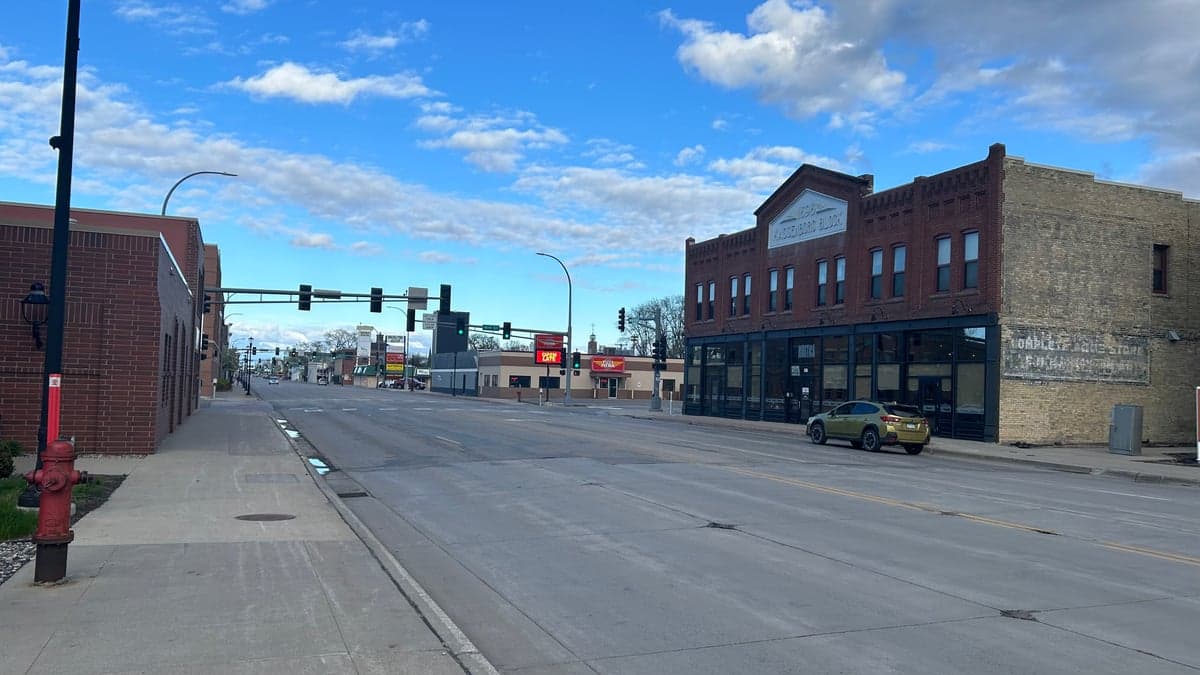
Photo: Wikipedia
Demographics of Moorhead, MN
Affluence Level in Moorhead, MN
A below-average socioeconomic profile. Incomes, home values, and educational attainment trail the U.S., with higher poverty and unemployment.
People of Moorhead, MN
Moorhead, Minnesota, is a city of 44,706 residents that blends small-town Midwestern character with the cross-border energy of Fargo-Moorhead’s metropolitan area. Its population is predominantly white (81.2%) and relatively well-educated, with 42.3% holding a college degree, reflecting the influence of nearby Minnesota State University Moorhead and Concordia College. The city’s identity is shaped by its history as a railroad and agricultural hub, a destination for Scandinavian immigrants, and more recently, a stable, family-oriented community with modest but growing diversity.
How the city was settled and grew
Moorhead’s founding population was drawn by the promise of land and transportation. The city was established in 1871 as a stop on the Northern Pacific Railway, which connected the Red River Valley’s fertile wheat fields to eastern markets. The first major wave of settlers were Yankees from New England and New York, who arrived to farm and run grain elevators. They were quickly followed by Norwegian and Swedish immigrants, who formed the backbone of the agricultural workforce. These Scandinavian groups concentrated in the north side neighborhoods around Main Avenue and the railroad corridor, building the Lutheran churches and cooperative creameries that still define the area’s character. By 1900, Moorhead was a bustling rail town of about 3,000, nearly all of Northern European stock. A smaller wave of German and Irish immigrants settled in the south-central area near the Red River, working in the flour mills and brickyards that supplemented the rail economy. The city’s growth remained steady but slow through the mid-20th century, reaching 22,000 by 1970, with the population overwhelmingly white and native-born.
Modern era (post-1965)
After the 1965 Immigration and Nationality Act, Moorhead saw only modest diversification compared to larger Minnesota cities. The foreign-born population today is just 2.5%, well below the national average. The most notable post-1965 shift was domestic: the expansion of Minnesota State University Moorhead and Concordia College drew students and faculty from across the Upper Midwest, increasing the college-educated share and creating a more transient, younger demographic in the campus-adjacent neighborhoods near 8th Street and 11th Street. These areas, sometimes called the “College District,” have a higher concentration of renters and a more liberal-leaning character than the rest of the city. The Hispanic population (5.3%) began growing in the 1990s, driven by agricultural and food-processing jobs in the Red River Valley. Many Hispanic families settled in the southwest side near 34th Street, where newer housing developments and apartment complexes offered affordable entry points. The Black population (6.1%) is largely composed of African immigrants—particularly Somali and Ethiopian families—who arrived in the 2000s via refugee resettlement programs. They concentrated in the east side near the Minnesota State University campus and along 8th Street, where social services and mosques were established. East and Southeast Asian communities (1.7%) are smaller, mostly Hmong and Vietnamese families who came as secondary migrants from the Twin Cities, settling in the north-central area near the Moorhead Center Mall. The Indian subcontinent population (0.4%) is tiny and largely tied to professional jobs at Sanford Health and the universities, living scattered across the city without a distinct ethnic enclave.
The future
Moorhead’s population is projected to grow slowly, reaching roughly 48,000 by 2040, driven by natural increase and continued domestic in-migration from rural Minnesota and North Dakota. The city is not homogenizing; rather, it is slowly tribalizing into distinct enclaves. The white, Scandinavian-descended population remains dominant in the north side historic districts and the rural fringe west of I-94, where single-family homes and conservative values prevail. The Hispanic and Black communities are growing at a faster rate than the white population, but from a small base; their share of the city’s population is expected to rise to about 8% and 9% respectively by 2040. These groups are likely to remain concentrated in the southwest and east side neighborhoods, respectively, as chain migration and affordable housing patterns reinforce existing clusters. The East/Southeast Asian and Indian populations are expected to plateau, as they are largely tied to university and healthcare employment that does not show strong growth. The college-educated, transient population in the College District will continue to cycle through, keeping that area younger and more diverse than the rest of the city. Overall, Moorhead is becoming a slightly more diverse, but still predominantly white, family-oriented community where distinct neighborhoods retain their ethnic and cultural identities.
For someone moving in now, Moorhead offers a stable, safe environment with good schools and a strong sense of local identity. The city is not experiencing rapid demographic upheaval, but rather a gradual, manageable diversification that is concentrated in specific neighborhoods. New residents should expect a community where the Scandinavian heritage is still visible in local festivals and church life, while newer immigrant groups are carving out their own spaces in the southwest and east sides. The bottom line: Moorhead is a quietly evolving Midwestern city where tradition and incremental change coexist, making it a predictable and welcoming choice for families and individuals seeking a low-drama relocation.

* Values derived from national, state, county, city and local statistics and may differ in a specific area. Last updated: 2026-04-19T10:03:14.000Z
Narrative content on this page is AI-generated and may contain mistakes. Verify any details that matter before acting on them.
ReloMaps may earn a commission from affiliate links at no extra cost to you.

