Photo: Wikipedia
Demographics of Moscow, ID
Affluence Level in Moscow, ID
A middle-class area roughly in line with national averages across income, home values, education, and employment.
People of Moscow, ID
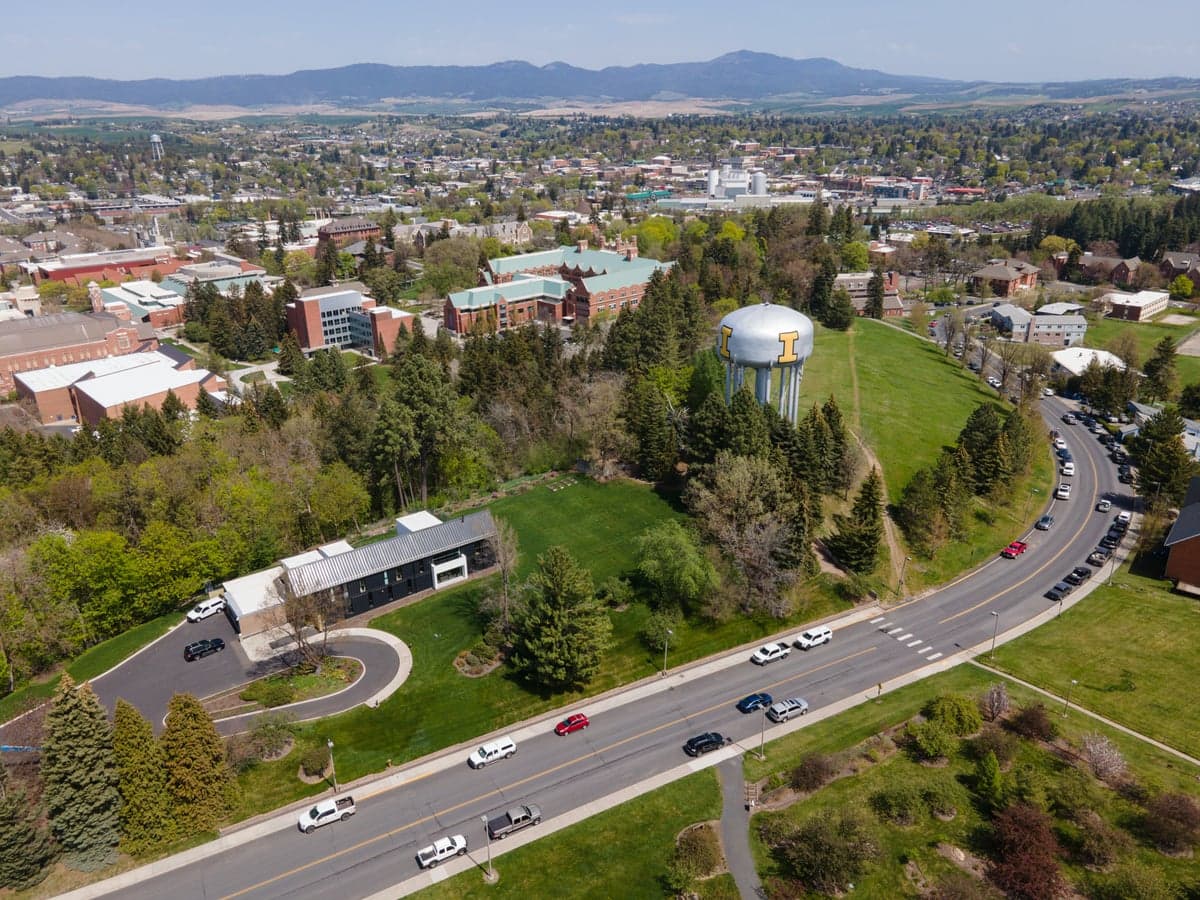
The people of Moscow, Idaho today form a compact, highly educated community of 25,868, with a character shaped by the University of Idaho’s academic presence and the surrounding agricultural economy. The population is predominantly white (83.4%), with a modest Hispanic share of 5.6% and small but distinct East/Southeast Asian (2.3%) and Indian subcontinent (0.6%) communities. With 54.3% of adults holding a college degree, Moscow stands out as a knowledge-economy hub in the Palouse region, blending a stable, family-oriented core with a transient student population that gives the city a younger, more progressive edge than the surrounding Latah County.
How the city was settled and grew
Moscow’s founding population arrived in the 1870s, drawn by the fertile loess soils of the Palouse and the promise of wheat farming. The original settlers were predominantly white Protestants of Northern European descent—English, German, and Scandinavian families—who established homesteads along the Paradise Creek drainage. The arrival of the railroad in 1885 and the establishment of the University of Idaho in 1889 triggered the first major population wave. The historic Downtown Moscow district, centered on Main Street, was built by these early merchants and farmers, with Victorian-era homes still lining East Third Street and Adams Street. A second wave came in the 1910s-1920s as the university expanded, drawing faculty and staff who settled in the College Hill neighborhood, a leafy enclave of Craftsman bungalows and early 20th-century homes just south of campus. By 1950, Moscow’s population had reached roughly 10,000, remaining overwhelmingly white and native-born, with the university and agriculture as the twin economic pillars.
Modern era (post-1965)
The post-1965 era brought gradual diversification, though Moscow remained far more homogeneous than the national average. The 1965 Hart-Cellar Act opened immigration channels, but Moscow’s remote inland location meant that foreign-born residents reached only 3.8% by the 2020s—well below the national figure of 13.6%. The university became the primary magnet for new groups. East/Southeast Asian students and faculty—particularly from China, South Korea, and Vietnam—began arriving in the 1980s and 1990s, often settling in rental-heavy areas near campus such as the University Heights district, a mix of apartment complexes and older single-family homes east of the university. Indian subcontinent professionals, many in tech and academic roles, followed in the 2000s, clustering in newer subdivisions like Mountain View Estates in the city’s southwest. Hispanic residents, now 5.6% of the population, grew steadily from the 1990s onward, drawn by agricultural work in the surrounding wheat and pea fields and by service-sector jobs in town; they are most concentrated in the West Moscow area, near the industrial corridor along Highway 95. The white population, while still dominant, has seen a slight relative decline as these groups have grown, but Moscow has not experienced the rapid ethnic turnover seen in larger Idaho cities like Boise or Nampa.
The future
Moscow’s population is heading toward modest, slow diversification rather than rapid change. The foreign-born share (3.8%) is likely to rise incrementally as the university continues recruiting international students and faculty, but the city’s high housing costs and limited job market outside academia and agriculture will cap growth. The East/Southeast Asian and Indian subcontinent communities are expected to grow slowly, primarily through university-related migration, and are likely to remain concentrated in the College Hill and University Heights neighborhoods. The Hispanic population, driven by family reunification and agricultural labor demand, may see the fastest growth rate, potentially reaching 7-8% by 2035, with continued settlement in West Moscow. The white population will remain the overwhelming majority, but the city is not homogenizing—rather, it is developing distinct enclaves: a transient, diverse student corridor near campus; a stable, white, family-oriented core in neighborhoods like Sunset Park; and a working-class Hispanic area in the west. The city’s political culture, historically moderate for Idaho, may see a slight leftward tilt as the university’s influence grows, but the surrounding Latah County electorate remains reliably conservative.
For someone moving to Moscow now, the city offers a stable, safe, and highly educated environment with a clear demographic trajectory: slow growth, gradual diversification, and a persistent divide between the university-driven population and the longer-term agricultural community. The neighborhoods are distinct enough that a newcomer can choose between the academic bustle of College Hill, the quiet family streets of Sunset Park, or the more affordable, working-class West Moscow area. The bottom line is that Moscow is becoming slightly more diverse and slightly more urban, but it remains a predominantly white, college-town community where the university sets the cultural and economic tone.

* Values derived from national, state, county, city and local statistics and may differ in a specific area. Last updated: 2026-04-21T12:29:23.000Z
Narrative content on this page is AI-generated and may contain mistakes. Verify any details that matter before acting on them.
ReloMaps may earn a commission from affiliate links at no extra cost to you.

