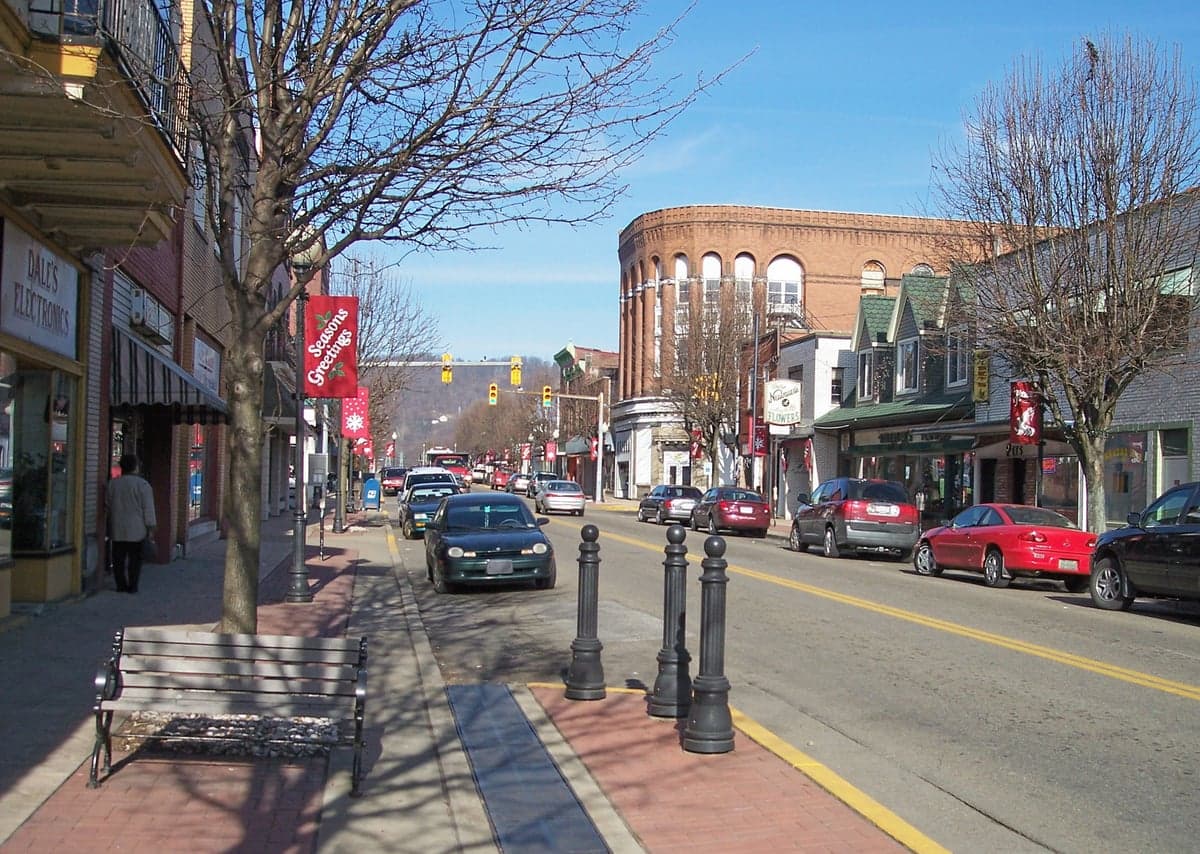
Photo: Wikipedia
Political ClimatePolitical Climate in Moundsville, WV
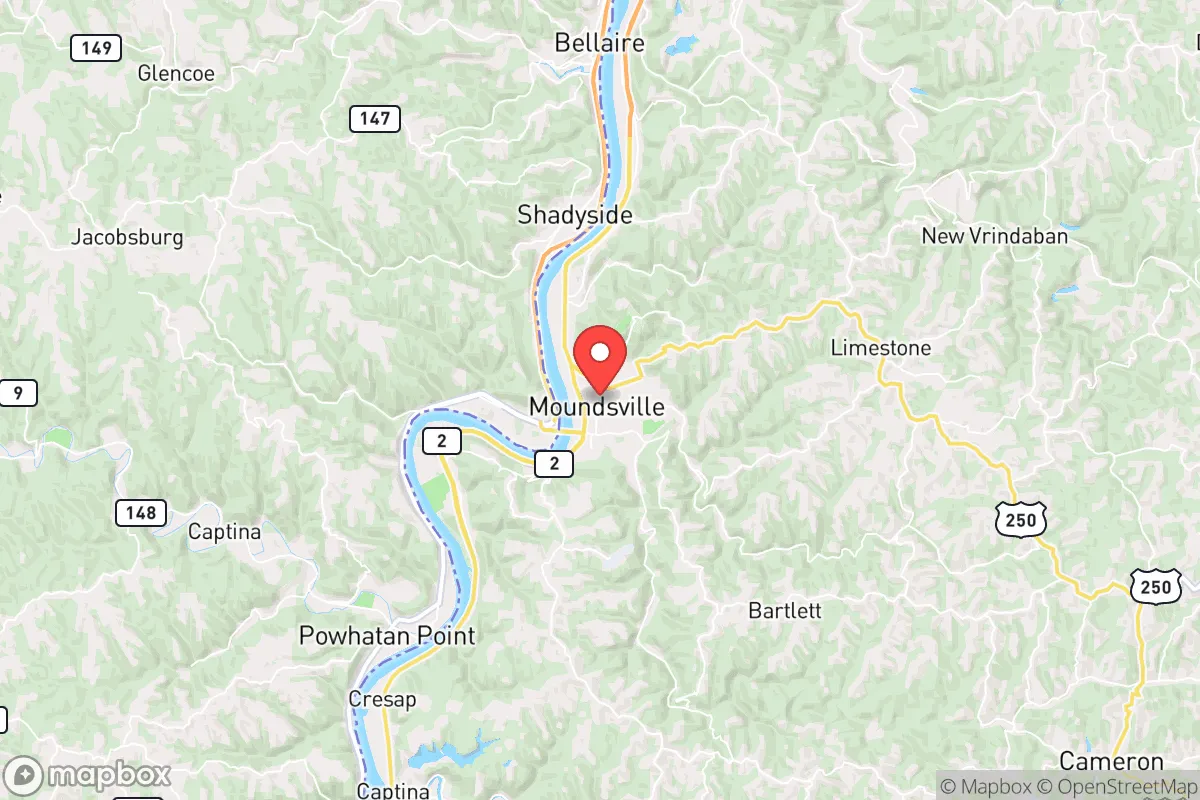
District shown is the primary district for this city’s centroid. Cities may span multiple districts.
Local Political AnalysisPolitical Analysis of Moundsville, WV
Moundsville, West Virginia, is about as solidly conservative as it gets, with a Cook PVI of R+20 that tells you everything you need to know about the local voting patterns. This isn't a place that's been trending blue or flirting with progressive ideas—it's a community that has held the line for generations, and you can feel it in the way folks talk about taxes, gun rights, and local control. The political lean here is deeply Republican, and the trajectory has been steady: if anything, the area has only gotten more conservative as national politics have polarized, with most residents seeing the Democratic Party's shift left as a direct threat to their way of life.
How it compares
When you look at the surrounding region, Moundsville stands out as a conservative anchor compared to some of the more moderate or even left-leaning pockets nearby. Drive 15 minutes south to Wheeling, and you'll find a city that's still red but with a noticeable purple streak—especially in the downtown and university areas, where younger voters and transplants have nudged things a bit left. Head east toward Morgantown, and the contrast is stark: that's a college town where progressive activism is loud and local government has embraced policies that would make most Moundsville residents cringe, like mask mandates that lingered long after they were needed. In Marshall County, where Moundsville sits, the politics are more in line with the rural parts of the Ohio Valley—think gun-friendly, pro-life, and skeptical of any federal overreach. The difference is night and day compared to places like Pittsburgh, just an hour north, where city council has been pushing defund-the-police rhetoric and sanctuary city status. Moundsville hasn't budged an inch, and that's a point of pride for the locals I've talked to.
What this means for residents
For the people living here, the conservative climate translates into a daily life that feels free from the kind of government meddling you hear about in other parts of the country. Property taxes are low, there's no income tax on the state level, and the local sheriff's office isn't interested in enforcing federal gun laws that don't align with the Second Amendment. You won't see the kind of zoning fights or housing mandates that have turned places like Austin or Portland into bureaucratic nightmares. That said, there's a growing concern among long-time residents about outside influence creeping in—especially from state-level pushes for things like renewable energy mandates or diversity initiatives in schools. The fear is that if the progressive wave ever reaches Moundsville, it'll come through Charleston or Washington, not from the neighbors. For now, though, the community remains a place where personal responsibility is valued over government programs, and where most folks would rather solve problems at the kitchen table than through a city ordinance.
Culturally, Moundsville has a few distinctions that set it apart even within conservative West Virginia. The town is famously home to the West Virginia Penitentiary, which has become a tourist attraction and a symbol of the area's tough-on-crime ethos—there's no sympathy here for soft-on-crime policies that have wrecked other cities. The local schools still start the day with the Pledge of Allegiance, and the county fair is a bigger deal than any political rally. Policy-wise, the biggest fights in recent years have been over land use and property rights, especially with the fracking boom bringing in out-of-state workers and companies. Some residents worry that corporate interests could erode the small-town feel, but so far, the conservative majority has kept things from sliding into the kind of overregulation that chokes off freedom. If you're looking for a place where the government stays out of your business and your neighbors share your values, Moundsville is still holding strong—but keep an eye on those state-level elections, because that's where the real battles are coming.

State Political ClimatePolitical Climate in West Virginia
State Political AnalysisPolitical Environment in the State
West Virginia has long been one of the most reliably Republican states in the nation, but that wasn't always the case. As recently as the 1990s, the Mountain State was a Democratic stronghold at the state and local level, but a seismic shift began in the 2000s and accelerated through the 2010s. Today, the state is deeply red: Donald Trump won West Virginia by nearly 39 points in 2020 and by over 42 points in 2024. The dominant coalition is a mix of rural, working-class voters, coal country families, and evangelical Christians who have abandoned the national Democratic Party over cultural and energy issues. Over the past 20 years, the state has moved from a purple-blue swing state to a solidly Republican one, with every statewide office held by a Republican and a supermajority in the legislature.
Urban vs. rural divide
The political map of West Virginia is starkly divided between a few small urban centers and the vast rural expanse. The largest city, Charleston, and its surrounding Kanawha County lean more moderate, but even there, Republicans have made gains—Trump won Kanawha by 12 points in 2024, a far cry from the days when Democrats dominated. Huntington (Cabell County) and Morgantown (Monongalia County) are the other notable blue-ish pockets, driven by university populations and some union influence. Morgantown, home to West Virginia University, is the most liberal-leaning area in the state, but it's still not reliably Democratic—Trump won Monongalia by 6 points in 2024. The real story is the rural counties: places like Mingo, Logan, and McDowell in the southern coalfields, which were once Democratic bastions, now vote 70-80% Republican. Berkeley County in the Eastern Panhandle, part of the DC exurbs, has become a Republican stronghold as well, with Trump winning by 36 points. The divide isn't really urban vs. rural in the traditional sense—it's more about which areas have held onto their Democratic roots (mostly college towns and a few union-heavy spots) versus the rest of the state that has flipped hard red.
Policy environment
West Virginia's policy environment is aggressively conservative, and it's been shaped by the state's Republican supermajority since 2014. The tax structure is one of the most business-friendly in the region: there is no personal property tax on vehicles or business inventory, and the corporate net income tax was cut from 6.5% to 6% in 2023, with further reductions planned. The state also has no inheritance tax and a relatively low 6.5% sales tax. On education, the state passed a robust school choice law in 2021, creating the Hope Scholarship program that allows parents to use state education funds for private school, homeschooling, or tutoring—a major win for parental rights. Healthcare is a mixed bag: West Virginia expanded Medicaid under the ACA, but the state has also passed strict abortion laws, banning the procedure after 15 weeks with very limited exceptions. Election laws have been tightened: voter ID is required, and the state purged inactive voters from rolls in 2024. The regulatory posture is light, especially for energy extraction, with the state actively courting natural gas and coal companies. There's no state-level rent control, no universal background checks for gun purchases, and no red flag law—a stark contrast to neighboring Virginia.
Trajectory & freedom
West Virginia is becoming more free in several key areas, particularly when it comes to gun rights, parental rights, and economic liberty. In 2023, the legislature passed a constitutional carry law, allowing any adult who can legally possess a firearm to carry it openly or concealed without a permit. The same year, the state passed the "Parental Bill of Rights," which requires schools to notify parents of any medical or mental health services offered to their child and prohibits instruction on sexual orientation or gender identity in K-5 classrooms. On the medical autonomy front, West Virginia banned nearly all abortions in 2022 after the Dobbs decision, and in 2024, the legislature passed a law prohibiting gender transition procedures for minors. Property rights have been strengthened with a 2023 law limiting the ability of local governments to impose zoning restrictions that could devalue property. However, there are concerning trends: the state's heavy reliance on federal funding (over 40% of the state budget comes from Washington) creates a vulnerability to federal overreach. The state also has one of the highest sales tax rates in the region at 6.5%, and while there's no income tax on Social Security benefits, the state still taxes most other retirement income, which is a sore point for many retirees.
Civil unrest & political movements
West Virginia has a history of labor unrest, but the modern political movements are more focused on cultural and constitutional issues. The 2018 teachers' strike was a massive, statewide protest that shut down schools for nine days and resulted in a 5% pay raise—a rare moment of cross-party unity. More recently, the state has seen organized opposition to vaccine mandates and COVID-19 restrictions, with large rallies at the state capitol in Charleston in 2021 and 2022. The "Mountain State" has also been a hotspot for Second Amendment activism, with the West Virginia Citizens Defense League holding regular events. There's a growing "constitutional sheriff" movement in rural counties like Hampshire and Hardy, where sheriffs have publicly stated they will not enforce federal gun laws they deem unconstitutional. Immigration politics are less visible here than in border states, but the state has passed laws prohibiting sanctuary cities and requiring local law enforcement to cooperate with ICE. Election integrity has been a flashpoint: in 2020, the state's Republican Secretary of State Mac Warner conducted a post-election audit that found no widespread fraud, but some activists remain skeptical of mail-in voting. A new resident would notice that political signs and flags are ubiquitous, especially in rural areas, and that political conversations are common in diners and hardware stores.
Projection
Over the next 5-10 years, West Virginia is likely to become even more conservative, but with some important caveats. The state's population is aging and shrinking—it lost over 3% of its population between 2020 and 2024—and the people leaving tend to be younger and more moderate. The in-migration is mostly from neighboring states like Virginia, Maryland, and Pennsylvania, and these newcomers are often retirees or remote workers looking for lower taxes and more freedom. This demographic shift will likely reinforce the state's conservative bent, as these migrants are typically fleeing blue states. However, the Eastern Panhandle, particularly Jefferson County and Berkeley County, is seeing an influx of DC-area commuters who may bring more moderate or even liberal views over time. The state's economy is slowly diversifying away from coal toward natural gas, tourism, and remote work, but the cultural identity remains deeply tied to energy extraction. Expect more school choice expansion, further tax cuts (especially on retirement income), and continued battles over federal overreach, particularly on environmental regulations that threaten the coal and gas industries. The biggest wildcard is the state's health: with one of the highest rates of drug overdose and obesity in the nation, any major federal healthcare policy changes could dramatically affect the state's budget and population.
For a conservative-leaning individual or family considering a move, West Virginia offers a rare combination of low taxes, strong gun rights, parental control in education, and a culture that values self-reliance and community. The trade-offs are real: the economy is still fragile, healthcare access is limited in rural areas, and the state's infrastructure (roads, broadband, water systems) lags behind much of the country. But if you're looking for a place where your vote actually counts, where your kids won't be exposed to radical gender ideology in school, and where you can buy a house for under $200,000 in a place like Martinsburg or Beckley, West Virginia is hard to beat. Just know that you're moving to a state that is still fighting its way out of decades of economic decline, and that fight is deeply political. You'll be part of a community that values freedom and tradition, but you'll also need to be prepared for the challenges that come with living in a place that the coastal elites have largely forgotten.
* Values derived from national, state, county, city and local statistics and may differ in a specific area. Last updated: 2026-04-23T06:08:29.000Z
Narrative content on this page is AI-generated and may contain mistakes. Verify any details that matter before acting on them.
ReloMaps may earn a commission from affiliate links at no extra cost to you.

