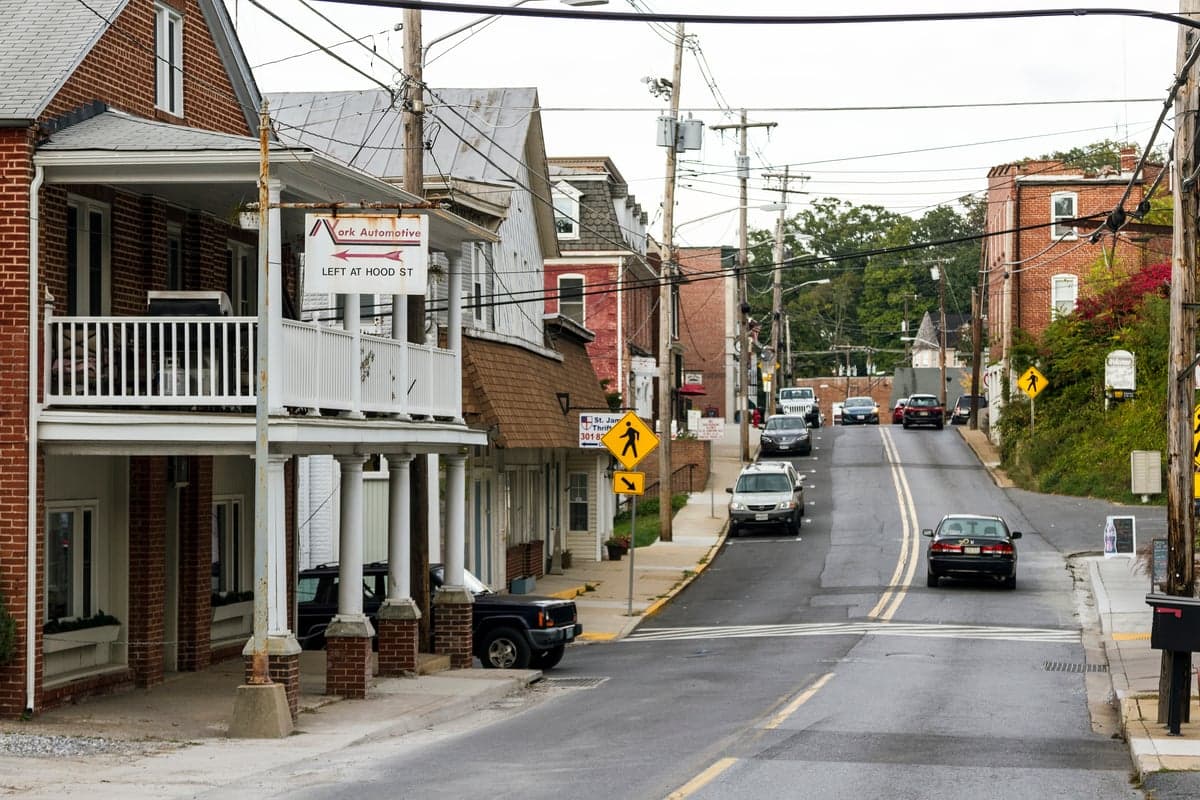
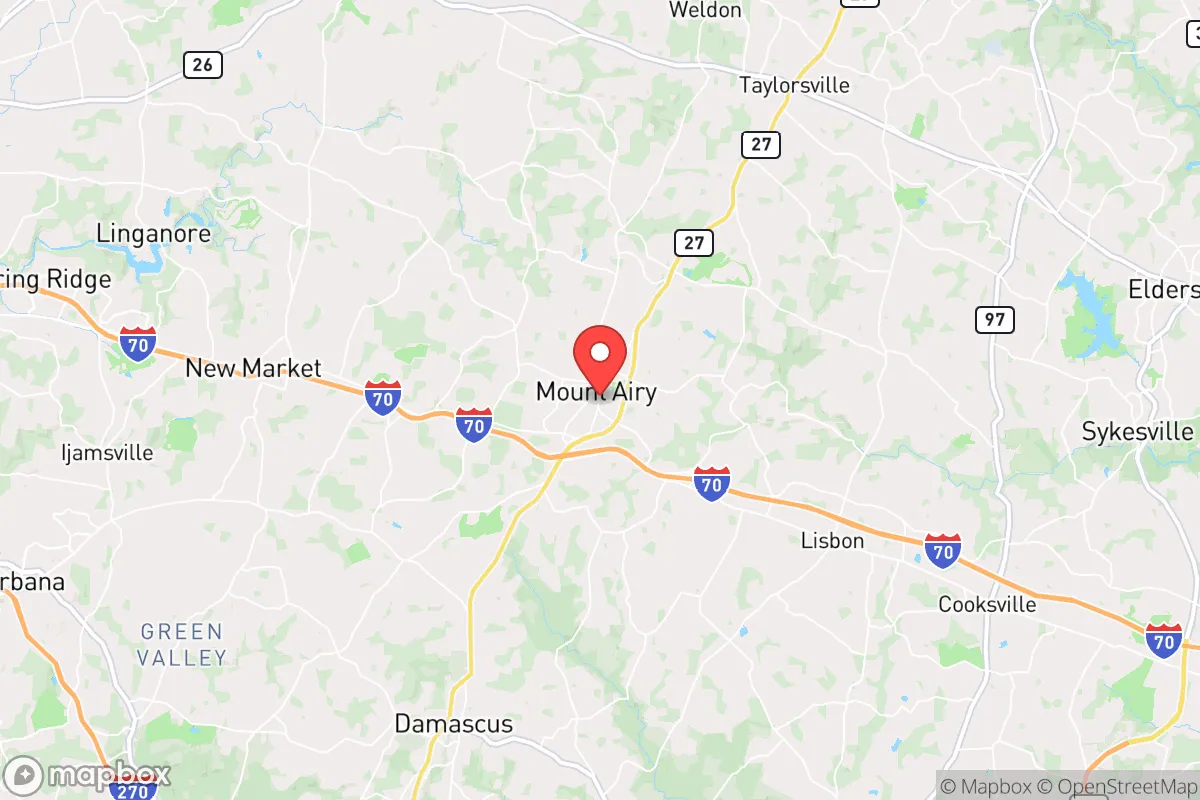
Photo: Wikipedia
Demographics of Mount Airy, MD
Affluence Level in Mount Airy, MD
An upper-middle-class area. Household wealth, education levels, and homeownership run ahead of national benchmarks.
People of Mount Airy, MD
Mount Airy, Maryland, is a small, predominantly white town of 9,746 residents, characterized by a high proportion of college-educated professionals (56.2%) and a notably low foreign-born population (2.5%). The city’s identity is shaped by its historic role as a railroad and agricultural crossroads, now evolving into a commuter suburb for Washington, D.C., and Baltimore. Its population is overwhelmingly native-born and politically moderate-to-conservative, with a growing Hispanic minority (8.2%) and small but distinct East/Southeast Asian (1.9%) and Black (2.6%) communities. The city feels more like a tight-knit, family-oriented town than a diverse urban hub, with most residents tracing their roots to earlier waves of European-American settlement.
How the city was settled and grew
Mount Airy’s original population was drawn by the Baltimore and Ohio Railroad in the 1830s, which made the area a stop for goods and passengers traveling between Baltimore and the Ohio River. The first settlers were primarily English and German farmers, who established homesteads along what is now Main Street and Ridge Road. The town was formally incorporated in 1894, and its early growth centered on the Historic District around Main Street, where merchants, blacksmiths, and railroad workers built wood-frame houses and storefronts. A second wave of Irish immigrants arrived in the late 19th century to work on railroad expansion and in local quarries, settling in the Pleasant Ridge area, a hillside neighborhood just north of downtown. By the early 20th century, the population was almost entirely white, native-born, and Protestant, with a small Catholic minority from the Irish influx. The town remained a quiet farming and railroad hub through the 1950s, with fewer than 2,000 residents.
Modern era (post-1965)
Mount Airy’s modern demographic shift began in the 1970s and accelerated after 1990, driven by the expansion of Interstate 70 and the town’s location roughly halfway between Washington and Baltimore. This made it attractive to white-collar commuters seeking larger lots and lower taxes than closer-in suburbs. The Birch Tree subdivision, developed in the 1980s, absorbed many of these new arrivals—mostly white families from Montgomery and Howard counties. The Woodville neighborhood, built in the 1990s and 2000s, became a landing pad for younger families, again predominantly white and college-educated. The Hispanic population began to grow noticeably after 2000, rising from under 3% to 8.2% by 2020, with many families settling in the Parr’s Ridge area near the high school, drawn by construction and service jobs. The East/Southeast Asian community (1.9%) is small but concentrated in newer developments like Spring Ridge, where tech and government workers from the D.C. metro area have bought homes. The Black population (2.6%) and Indian-subcontinent population (0.4%) remain very small, with no distinct neighborhood concentration. The foreign-born share (2.5%) is far below the national average, reflecting the town’s limited appeal to recent immigrants compared to larger cities.
The future
Mount Airy’s population is likely to continue growing slowly, with the town’s master plan projecting an increase to roughly 12,000 by 2040. The white share will probably decline gradually as the Hispanic and East/Southeast Asian populations grow, but the town is not expected to become a majority-minority community within the next two decades. The Hispanic population is the fastest-growing group, driven by natural increase and continued in-migration for construction and landscaping work, but it remains a small minority. The East/Southeast Asian community is likely to grow modestly as more professionals seek affordable housing in the corridor. The Indian-subcontinent population is too small to project meaningful change. The town is not tribalizing into distinct ethnic enclaves; rather, newer subdivisions like Parr’s Ridge and Spring Ridge are attracting a mix of white and Hispanic families, while older neighborhoods like the Historic District and Pleasant Ridge remain overwhelmingly white. The biggest demographic trend is the aging of the white population, with many long-time residents retiring in place, while younger families—still mostly white—move into new developments.
For a conservative-leaning individual or family considering a move, Mount Airy offers a stable, low-crime, and predominantly white community with strong schools and a small-town feel. The population is homogenizing in terms of socioeconomic status—more college-educated and professional—but remains ethnically homogeneous by national standards. The city is not becoming a diverse melting pot; it is a comfortable, family-oriented suburb where the biggest change is the gradual arrival of a modest Hispanic minority. Newcomers should expect a community that values tradition, local governance, and a slower pace of life, with little of the cultural or ethnic friction seen in larger cities.

* Values derived from national, state, county, city and local statistics and may differ in a specific area. Last updated: 2026-04-22T03:04:36.000Z
Narrative content on this page is AI-generated and may contain mistakes. Verify any details that matter before acting on them.
ReloMaps may earn a commission from affiliate links at no extra cost to you.

