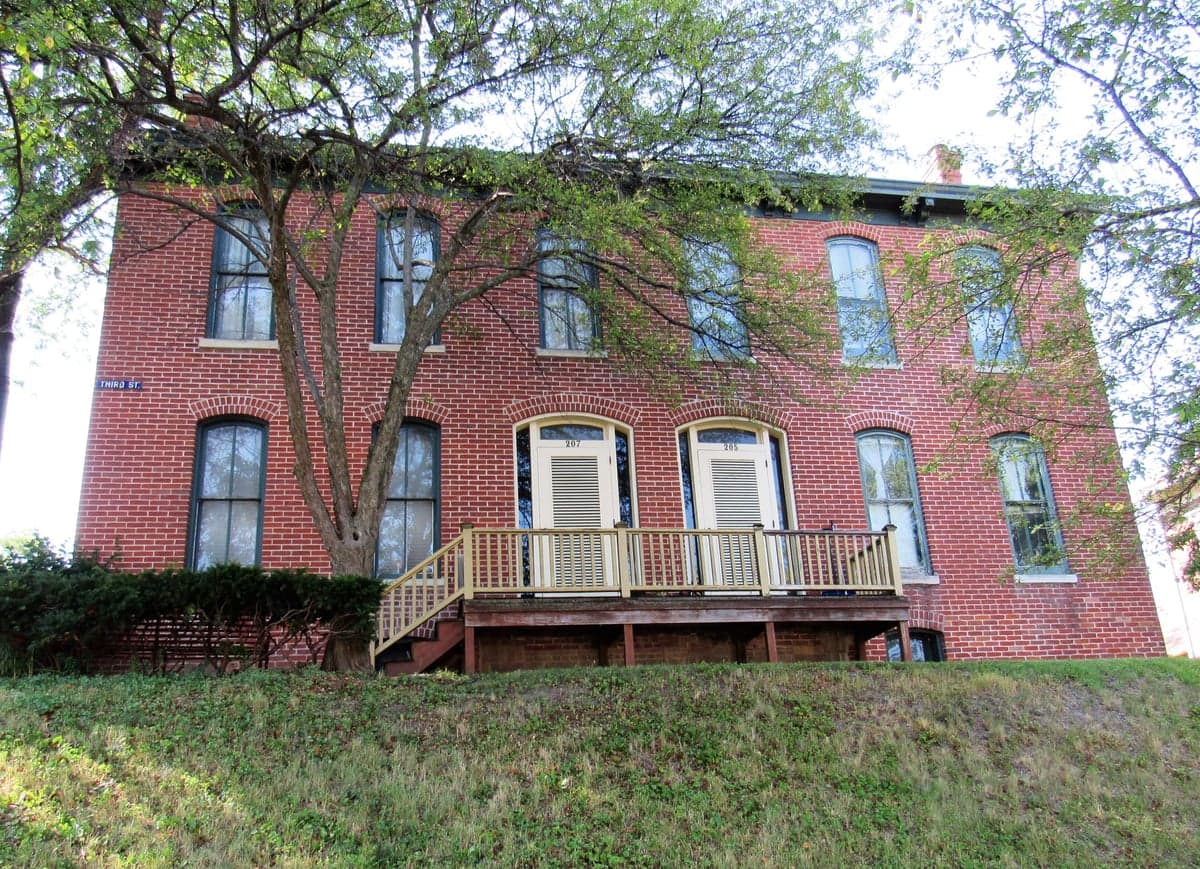


Photo: Wikipedia
Demographics of Muscatine, IA
Affluence Level in Muscatine, IA
A below-average socioeconomic profile. Incomes, home values, and educational attainment trail the U.S., with higher poverty and unemployment.
People of Muscatine, IA
Muscatine, Iowa, is a Mississippi River town of 23,567 residents with a distinctly blue-collar, family-oriented character. The population is predominantly White (72.0%), with a significant and growing Hispanic community (19.3%) and smaller Black (4.5%) and Indian-subcontinent (0.5%) populations. The city’s identity is rooted in its industrial past—pearl button manufacturing and agriculture—and its present as a manufacturing and logistics hub, giving it a pragmatic, hardworking ethos that appeals to conservative-leaning families seeking affordable housing and community stability.
How the city was settled and grew
Muscatine’s original population was drawn by the Mississippi River and the promise of fertile farmland. The city was platted in 1836, and the first major wave of settlers were Yankee and German immigrants who arrived in the 1840s and 1850s. These groups built the early neighborhoods along the riverfront, particularly in the West Hill district, where many of the original frame houses still stand. The German community established churches, breweries, and social clubs, and their descendants remain a visible presence in the city’s older core. A second wave came with the pearl button industry, which boomed from the 1890s to the 1920s. This drew Italian and Eastern European immigrants (Poles, Czechs, and Slovaks) who settled in the East End neighborhood, near the button factories along the river. The industry’s decline in the 1930s left a working-class population that shifted to manufacturing at companies like H.J. Heinz and Grain Processing Corporation (GPC). By the mid-20th century, Muscatine was a solidly White, union-leaning town with a strong German and Eastern European cultural base.
Modern era (post-1965)
The post-1965 era brought two major demographic shifts. First, the Hispanic population began growing in the 1970s and 1980s, driven by recruitment for agricultural and food-processing jobs at Heinz and local farms. This wave initially concentrated in the South End neighborhood, near the Heinz plant and along Grandview Avenue. Today, the Hispanic community is the fastest-growing group in the city, with a 19.3% share that is heavily Mexican-American and largely working-class. Second, a small but steady influx of Indian-subcontinent professionals arrived from the 1990s onward, drawn by engineering and management roles at GPC and other industrial employers. This group, now 0.5% of the population, tends to settle in the North Hill area, a newer subdivision with larger homes near the Muscatine Community College campus. The Black population (4.5%) has a longer history, dating to the Great Migration of the 1940s and 1950s, when African Americans came for factory jobs; they are concentrated in the Greenwood neighborhood, near the old rail yards and industrial corridor. The East/Southeast Asian population remains negligible at 0.1%, with no distinct neighborhood cluster. Suburbanization since the 1980s has pushed many White families to the Fairport area, a rural-adjacent subdivision east of the city limits, leaving the older core neighborhoods more diverse.
The future
Muscatine’s population is slowly diversifying, but the trend is toward ethnic enclaves rather than full integration. The Hispanic share is projected to grow to 25-30% by 2040, driven by continued recruitment for food processing and construction, with the South End likely becoming a majority-Hispanic corridor. The White population is aging and declining slightly, as younger families move to larger metros like Iowa City or the Quad Cities for white-collar jobs. The Indian-subcontinent community is small but stable, with professionals likely to remain in North Hill. The Black population is plateauing, with limited new in-migration. The city’s low college attainment rate (21.2%) and reliance on manufacturing mean that future growth will depend on retaining industrial employers. If GPC and Heinz remain stable, the population will likely hold steady or grow modestly, with the Hispanic share absorbing most of the increase. The city is not homogenizing; instead, it is becoming a patchwork of distinct ethnic neighborhoods, with the older White population concentrated in West Hill and Fairport, and newer immigrant groups in the South End and East End.
For a conservative-leaning family or individual moving to Muscatine today, the city offers a stable, affordable, and industrially rooted community. The demographic future is one of gradual diversification, with the Hispanic population growing into a larger share of the workforce and civic life. The city remains a place where manufacturing jobs anchor the economy, neighborhoods are defined by ethnic history, and the pace of change is slow enough to feel manageable for newcomers seeking a traditional Midwestern lifestyle.

* Values derived from national, state, county, city and local statistics and may differ in a specific area. Last updated: 2026-05-03T11:41:11.000Z
Narrative content on this page is AI-generated and may contain mistakes. Verify any details that matter before acting on them.
ReloMaps may earn a commission from affiliate links at no extra cost to you.

