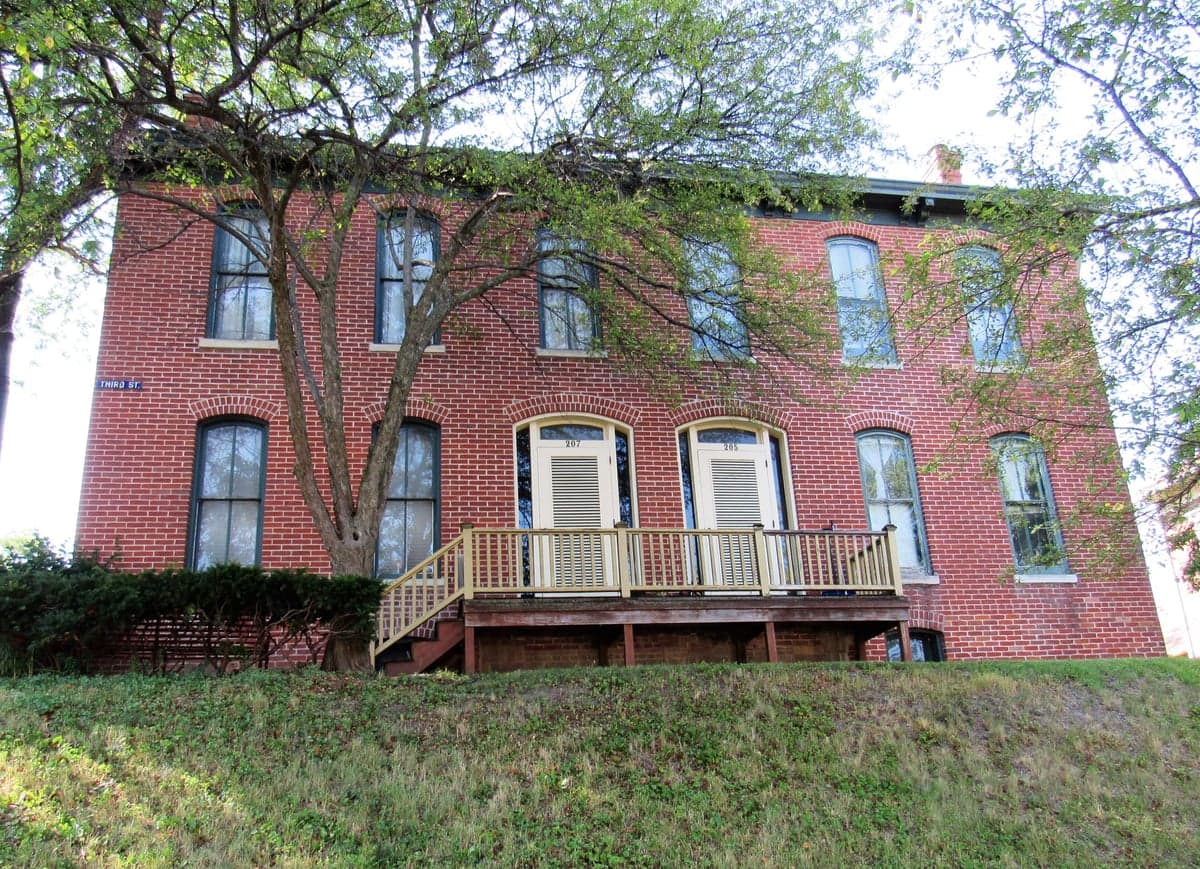
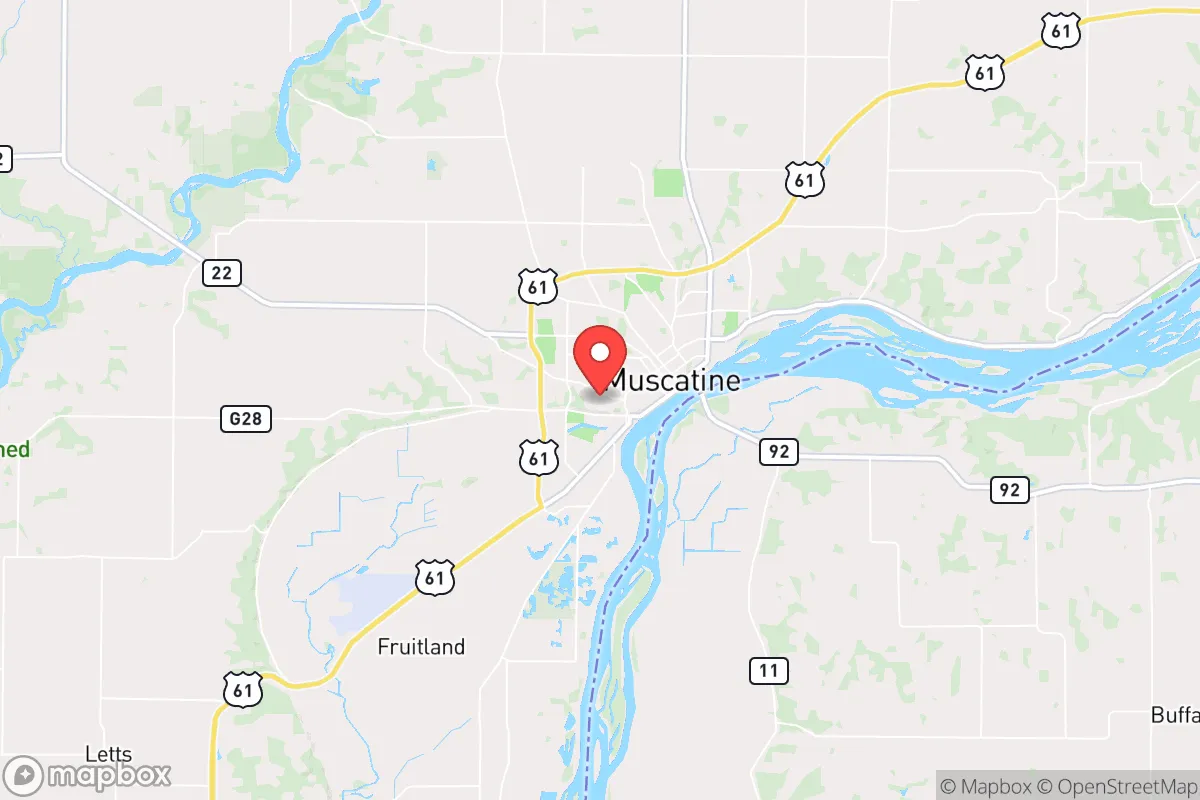
Photo: Wikipedia
Political ClimatePolitical Climate in Muscatine, IA
District shown is the primary district for this city’s centroid. Cities may span multiple districts.
Local Political AnalysisPolitical Analysis of Muscatine, IA
Muscatine, Iowa, sits in a county that leans reliably conservative, with a Cook PVI of R+4, but don't let that number fool you into thinking it's a straight red stronghold. The city itself has a long history of pragmatic, blue-collar politics, and while the surrounding rural areas vote solidly Republican, Muscatine proper has seen a slow but noticeable drift toward more progressive policies in recent years, especially on local boards and school committees. If you've been here a while, you remember when the town felt more unified around traditional values and limited government; now, there's a growing tension between that old-school mindset and a newer wave of activism that's pushing for bigger government involvement in daily life.
How it compares
To get a real feel for Muscatine's political climate, you have to look at the contrast with nearby towns. Head west to West Liberty, and you'll find a community that's become a hub for progressive immigration and housing policies, with city council meetings that often feel like a social experiment. Drive east to Wilton or Durant, and you're back in solidly conservative territory where folks still believe in low taxes and personal responsibility. Muscatine sits right in the middle—it's not as far left as Iowa City, which is a whole different universe of progressive politics, but it's definitely more purple than the deep-red counties to the north and west. The shift is subtle but real: a few years ago, you wouldn't have seen debates over things like "sanctuary city" policies or diversity, equity, and inclusion initiatives in local schools, but now those conversations are happening, and they're dividing neighbors.
What this means for residents
For a long-time resident, the biggest concern is that government overreach is creeping in under the radar. The city council has shown a willingness to take on more control over property rights and local business regulations, and there's been a push for higher taxes to fund programs that sound good on paper but often miss the mark in practice. The school board, in particular, has become a battleground, with some members pushing for curriculum changes that prioritize social activism over core academics. If you value your Second Amendment rights or want to keep your property taxes from skyrocketing, you need to stay engaged—because the progressive minority is organized and vocal, and they're not shy about using city resources to advance their agenda. The good news is that the majority of residents still lean conservative on fiscal issues and personal freedoms, but that majority is getting quieter every year.
One cultural distinction that sets Muscatine apart is its strong sense of community rooted in manufacturing and agriculture—places like the H.J. Heinz plant and the local grain elevators are still the backbone of the economy. That working-class identity tends to favor practical, hands-off governance, but the influx of remote workers and retirees from more liberal areas is slowly changing the local conversation. If you're considering a move here, know that you'll find plenty of folks who share your values, but you'll also need to be ready to speak up at town hall meetings if you want to keep Muscatine from drifting too far from its conservative roots. The next few election cycles will be telling—if the current trend continues, we could see a very different political landscape in just five years.

State Political ClimatePolitical Climate in Iowa
State Political AnalysisPolitical Environment in the State
Iowa has been a reliably Republican state in presidential elections since 2016, but its political identity is more complex than a simple red-state label. The state’s overall partisan lean is roughly R+6 to R+8, driven by a strong rural and small-town conservative base, though it was a classic swing state for decades. Over the past 10-20 years, the trajectory has been a steady rightward shift, accelerated by the 2020 and 2024 cycles, as suburban and rural voters consolidated behind the GOP while Democratic strength became concentrated in a handful of urban counties.
Urban vs. rural divide
The political map of Iowa is a textbook case of the urban-rural split. The Democratic strongholds are the state’s three major metro areas: Des Moines (Polk County), Iowa City (Johnson County), and Davenport (Scott County). Polk County, home to the state capital, has trended blue but not overwhelmingly so—Biden won it by about 9 points in 2020, down from Obama’s 14-point margin in 2012. Johnson County, anchored by the University of Iowa, is the bluest county in the state, routinely voting 2-to-1 Democratic. Scott County (Quad Cities) is a perennial swing county that has leaned slightly Democratic but is drifting right. Outside these islands, the rest of the state is deeply red. Sioux County in northwest Iowa is one of the most Republican counties in the nation, routinely giving GOP candidates 80%+ of the vote. Dallas County, a fast-growing suburban ring west of Des Moines, flipped from blue-leaning to solidly red in the last two cycles, mirroring national suburban shifts. Linn County (Cedar Rapids) is a notable battleground—it voted for Obama twice, then Trump in 2016 and 2020, before flipping back to Biden narrowly in 2024. The rural counties of north-central and southern Iowa, like Kossuth and Decatur, are now reliably Republican by 20-30 points, a shift that has solidified the state’s overall lean.
Policy environment
Iowa’s policy environment is broadly conservative, with a strong emphasis on limited government and individual freedom. The state has a flat income tax rate of 3.8% (down from 8.98% a decade ago), with a scheduled phase-down to 3.5% by 2027. There is no estate tax, and property taxes are among the lowest in the Midwest. The regulatory posture is business-friendly, with a right-to-work law on the books and no state-level minimum wage above the federal $7.25. Education policy has been a flashpoint: in 2023, Governor Kim Reynolds signed a universal school choice bill (HF 68) that allows any family to use state funds for private or homeschool expenses, a major win for parental rights. Healthcare is mixed—Iowa expanded Medicaid under the Affordable Care Act but has since imposed work requirements for able-bodied adults. Election laws were tightened in 2021 (SF 413), requiring voter ID, reducing early voting days, and closing polls earlier, which critics call suppression but supporters say ensures integrity. The state also passed a six-week abortion ban (the “fetal heartbeat” law) in 2023, which was upheld by the Iowa Supreme Court in 2024, making Iowa one of the most restrictive states on abortion access.
Trajectory & freedom
Iowa is clearly trending toward more personal freedom in several key areas, but with some concerning caveats. On gun rights, Iowa became a permitless carry state in 2021 (SF 2098), allowing any legal adult to carry a concealed firearm without a permit—a significant expansion of Second Amendment rights. On parental rights, the school choice law and a 2023 law banning instruction on sexual orientation and gender identity in K-6 classrooms (HF 802) have strengthened family autonomy. However, the state has also seen government overreach in other areas. The 2023 ban on gender-affirming care for minors (SF 538) was framed as protecting children, but it represents a heavy-handed state intervention into medical decisions. Similarly, the state’s aggressive use of emergency powers during COVID—including business closures and mask mandates in 2020—left a bitter taste for many conservatives, though the legislature has since curbed gubernatorial emergency authority. On taxation, the income tax cuts are a clear win for economic freedom, but property taxes continue to rise in fast-growing areas like Ankeny and Waukee, driven by local school bond referendums. Overall, the trajectory is toward more liberty in education and gun rights, but with ongoing battles over medical freedom and local control.
Civil unrest & political movements
Iowa has seen relatively little civil unrest compared to coastal states, but there have been notable flashpoints. The Black Lives Matter protests in Des Moines in 2020 were largely peaceful, though a few nights of property damage occurred near the state capitol. More recently, the state has become a battleground for immigration politics. In 2024, Governor Reynolds deployed the Iowa National Guard to the Texas border as part of a multi-state operation, and the legislature passed a bill (SF 2340) allowing state law enforcement to arrest and deport illegal immigrants—a direct challenge to federal authority that has sparked lawsuits. There is no sanctuary city policy anywhere in Iowa; in fact, Iowa City is the only municipality that has resisted cooperation with ICE, and it faces constant political pressure. Election integrity controversies have been minimal—Iowa’s voter ID law has been implemented without major issues, though Democrats continue to challenge it in court. A visible flashpoint for new residents is the annual Iowa State Fair in Des Moines, which has become a stage for political activism, with both pro-life and pro-choice groups setting up booths, and presidential candidates making pilgrimages. The state also has a small but vocal secessionist movement in northwest Iowa, where some residents have floated joining South Dakota over cultural and political differences, though it remains fringe.
Projection
Over the next 5-10 years, Iowa is likely to become more Republican and more conservative, driven by two demographic trends. First, the state is seeing an influx of conservative-leaning migrants from Illinois, Minnesota, and California, drawn by lower taxes and housing costs. Second, the rural population is aging and shrinking, but the remaining rural voters are becoming even more Republican, while the urban counties are not growing fast enough to offset the rural shift. The suburbs of Des Moines—places like Johnston, Grimes, and Adel—are growing rapidly and trending red, which will solidify the GOP’s hold on the state legislature and congressional delegation. The wild card is the University of Iowa’s influence in Johnson County, which could keep Iowa City as a blue island, but that won’t change the statewide math. Expect further tax cuts, continued school choice expansion, and more restrictive abortion laws. A new resident moving in now should expect a state that is culturally and politically aligned with the Midwest’s conservative heartland, with a government that is generally friendly to business, family, and gun rights, but with ongoing fights over medical freedom and local control.
Bottom line for a new resident: If you’re looking for a state where your tax dollars are respected, your kids’ education is in your hands, and your Second Amendment rights are protected, Iowa is a solid bet. Just be prepared for cold winters and a political landscape that is increasingly red, with the occasional blue pocket in Iowa City and Des Moines. The state is moving in a direction that favors personal responsibility and limited government, but keep an eye on property taxes and local school board races—those are where the real battles for freedom are being fought.
* Values derived from national, state, county, city and local statistics and may differ in a specific area. Last updated: 2026-05-03T11:41:11.000Z
Narrative content on this page is AI-generated and may contain mistakes. Verify any details that matter before acting on them.
ReloMaps may earn a commission from affiliate links at no extra cost to you.

