Photo: Wikipedia
Political ClimatePolitical Climate in Muskogee, OK
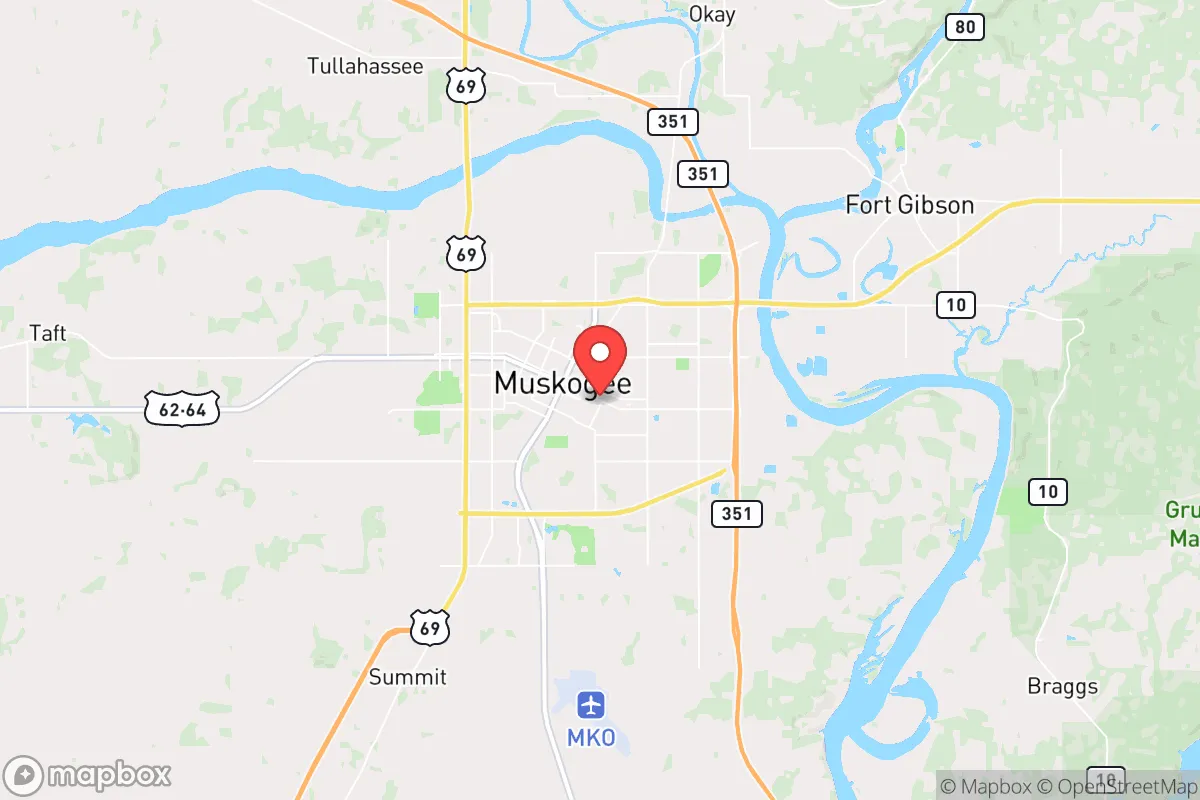
District shown is the primary district for this city’s centroid. Cities may span multiple districts.
Local Political AnalysisPolitical Analysis of Muskogee, OK
Muskogee is about as solidly conservative as it gets in Oklahoma, with a Cook PVI of R+28 that puts it deep in the red column. That number isn't just a statistic—it reflects a community where traditional values and limited government are the default, not the exception. For as long as I can remember, folks here have voted their conscience, and that conscience leans hard toward personal responsibility and keeping government out of your business. The trajectory hasn't budged much in recent cycles, and I don't see it changing anytime soon, even as some nearby towns start to wobble a bit.
How it compares
Drive thirty minutes north to Tulsa, and you'll feel the difference immediately. Tulsa's got a Cook PVI of R+17, which is still conservative, but it's a full 11 points less red than Muskogee. That gap matters because Tulsa's city council has been flirting with progressive pet projects—like zoning changes that prioritize density over property rights and a push for sanctuary city policies that make law-abiding residents uneasy. Down south, McAlester sits at R+27, so it's closer to Muskogee's lean, but it's a smaller town with less political muscle. The real contrast is with places like Norman (D+10) or Oklahoma City (R+10), where you see the kind of urban drift that Muskogee has largely avoided. We're the kind of place where a county commissioner can still get elected on a platform of cutting taxes and defending the Second Amendment without apology.
What this means for residents
For the people living here, that R+28 rating translates into a government that mostly stays out of the way. Property taxes are low, business regulations are minimal, and you won't find the kind of overreach you hear about in blue states—like mask mandates that drag on for years or housing policies that tell you what you can do with your own land. The local school board hasn't gone down the rabbit hole of critical race theory or gender ideology, and the city council hasn't tried to impose a plastic bag ban or a living wage ordinance. That's the kind of freedom that keeps Muskogee attractive to families and retirees who want to live their lives without a bureaucrat looking over their shoulder. There's a reason people move here from places like California or Colorado—they're tired of being told how to live.
That said, there are some cultural distinctions worth noting. Muskogee has a strong Native American presence, with the Cherokee Nation and Muscogee (Creek) Nation both having a significant footprint here. That influences local politics in ways you don't see in, say, Enid or Stillwater—tribal sovereignty and jurisdictional issues are real topics at the dinner table. But even with that complexity, the overall vibe remains conservative. The annual Azalea Festival and the Oklahoma Music Hall of Fame draw crowds, but you won't find any drag queen story hours or socialist book clubs. The biggest political fights lately have been over property rights and water usage, not the culture war nonsense that dominates coastal news. If you're looking for a place where your vote actually means something and your freedoms aren't up for debate, Muskogee is still that place. Just keep an eye on the school board elections—that's where the progressive foot-in-the-door usually starts.

State Political ClimatePolitical Climate in Oklahoma
State Political AnalysisPolitical Environment in the State
Oklahoma has long been one of the most reliably Republican states in the nation, with a partisan lean that has only deepened over the past two decades. The state hasn’t voted for a Democratic presidential candidate since 1964, and in 2024, Donald Trump carried it by over 34 points. The dominant coalition is a mix of rural conservatives, evangelical Christians, and energy-sector workers, with a growing libertarian streak that pushes back on federal overreach. Over the last 10-20 years, the trajectory has been steadily rightward, driven by in-migration from blue states and a backlash against progressive policies in neighboring states like Colorado and California.
Urban vs. rural divide
The political map of Oklahoma is a textbook case of the urban-rural split. The two major metros — Oklahoma City and Tulsa — are Republican strongholds, but with distinct flavors. Oklahoma City’s core is more moderate, with pockets of Democratic lean in areas like the Plaza District and Midtown, but the suburbs — Edmond, Yukon, and Moore — are deeply red. Tulsa County has trended slightly more competitive, but the city’s suburbs like Broken Arrow and Jenks are reliably conservative. The rural expanse is where the GOP’s base truly lives: counties like Texas County in the Panhandle and Sequoyah County in the east routinely deliver 80%+ margins for Republicans. The only reliably blue counties are Oklahoma County (OKC) and Tulsa County (Tulsa), and even those have shifted right in recent cycles. The Lawton area, home to Fort Sill, leans conservative but with a military influence that keeps it pragmatic.
Policy environment
Oklahoma’s policy environment is aggressively pro-business and low-tax, with a flat state income tax of 4.75% that is being phased down toward 3.99% by 2027. There is no state estate tax, and property taxes are among the lowest in the nation — typically under 1% of assessed value. The regulatory posture is light, especially in energy and agriculture, which are the backbone of the economy. Education policy has been a flashpoint: in 2023, the state passed a universal school voucher program (the Oklahoma Parental Choice Tax Credit Act), allowing families up to $7,500 per child for private school expenses. This was a major win for school choice advocates. Healthcare is more mixed — the state did expand Medicaid under a 2020 ballot initiative (State Question 802), but the legislature has since added work requirements and premiums for able-bodied adults. Election laws are strict: voter ID is required, and in 2022, the state passed a law limiting absentee ballot drop boxes and requiring proof of citizenship for voter registration. Overall, the policy environment is designed to maximize personal freedom in economic and educational matters, while maintaining traditional social values.
Trajectory & freedom
Oklahoma has been moving decisively toward greater personal freedom in several key areas, particularly since 2020. The most notable expansion is in gun rights: in 2019, the state passed constitutional carry (permitless carry for both open and concealed), and in 2023, it passed a law prohibiting state and local enforcement of federal gun laws that don’t exist in state statute — a clear nullification stance. Parental rights have been strengthened: the 2022 “Parental Bill of Rights” (HB 4456) gives parents explicit authority over their children’s education, medical decisions, and records. Medical autonomy took a hit with the near-total abortion ban (SB 612, 2022), which prohibits the procedure from conception with narrow exceptions — a move that expanded government control over reproductive decisions, which some conservatives support as protecting life. Property rights were bolstered by the 2021 “Right to Farm” amendment (State Question 777), which protects agricultural practices from nuisance lawsuits. Taxation has been trending downward, with the income tax rate dropping from 5.25% in 2018 to 4.75% in 2024. However, the state has also seen some concerning expansions of government power: the 2023 “Gender Transition Ban” (SB 613) prohibits gender-affirming care for minors, which libertarians see as government overreach into medical decisions. The trajectory is toward more freedom in economic, educational, and Second Amendment areas, but with a strong social conservative bent that limits personal autonomy in medical and identity matters.
Civil unrest & political movements
Oklahoma has seen relatively little civil unrest compared to coastal states, but there have been notable flashpoints. The 2020 Black Lives Matter protests in Oklahoma City and Tulsa were large but mostly peaceful, with some property damage in Tulsa’s downtown. The state’s response was firm: Governor Kevin Stitt deployed the National Guard in Tulsa, and the legislature passed a “riot boosting” law in 2021 that increased penalties for participating in violent protests. On the right, the “Oklahoma Freedom Caucus” has been a powerful force in the legislature, pushing for school choice, gun rights, and election integrity. Immigration politics are heated: in 2024, the state passed HB 4156, which makes it a state crime to be in Oklahoma illegally and requires law enforcement to cooperate with federal immigration authorities. There is no sanctuary city movement — Oklahoma City and Tulsa both cooperate with ICE. Election integrity has been a major issue: the 2020 election saw no major fraud in Oklahoma, but the legislature passed a series of laws in 2021-2022 tightening voter ID, limiting mail-in ballots, and requiring citizenship verification. Secessionist rhetoric is rare but not absent — some rural counties have floated “county secession” proposals to break away from urban-dominated state government, but none have gained traction. The most visible political movement is the “Take Our Border Back” convoy that passed through Oklahoma City in early 2024, drawing thousands of supporters. Overall, the state is politically stable but with a growing activist base on both sides, particularly around education and immigration.
Projection
Over the next 5-10 years, Oklahoma is likely to become even more conservative, but with a libertarian twist. In-migration from California, Colorado, and Texas is accelerating — many newcomers are fleeing high taxes and progressive policies in those states, and they’re bringing a “leave me alone” ethos that reinforces the state’s existing freedom-oriented policies. The demographic shift is toward more suburban and exurban growth, particularly along the I-35 corridor from Oklahoma City to Ardmore, and the Tulsa suburbs. This will likely push the state further on school choice, tax cuts, and deregulation. However, there are risks: the state’s heavy reliance on oil and gas revenue makes it vulnerable to energy transitions, and the ongoing teacher shortage could force a reckoning with education funding. The social conservative wing will continue to push for restrictions on abortion, gender identity, and LGBTQ+ rights, which could create friction with the libertarian faction that wants less government involvement in personal lives. The most likely outcome is a state that remains deeply red, with a growing emphasis on economic freedom and school choice, but with ongoing battles over the scope of government in social matters. For a new resident, expect a state that is stable, affordable, and generally respectful of personal liberty, but with a clear conservative cultural norm that may feel restrictive to those accustomed to more permissive environments.
Bottom line for a new resident: If you value low taxes, strong gun rights, school choice, and a government that mostly stays out of your business, Oklahoma is a solid bet. You’ll find a welcoming community in places like Edmond or Broken Arrow, and a political climate that’s unlikely to shift dramatically leftward anytime soon. Just be prepared for a state that takes its social conservatism seriously — especially on abortion and education — and a political culture that expects you to be involved in your local school board and county commission. It’s a place where freedom is real, but it comes with a clear set of community expectations.
* Values derived from national, state, county, city and local statistics and may differ in a specific area. Last updated: 2026-04-25T13:50:03.000Z
Narrative content on this page is AI-generated and may contain mistakes. Verify any details that matter before acting on them.
ReloMaps may earn a commission from affiliate links at no extra cost to you.

