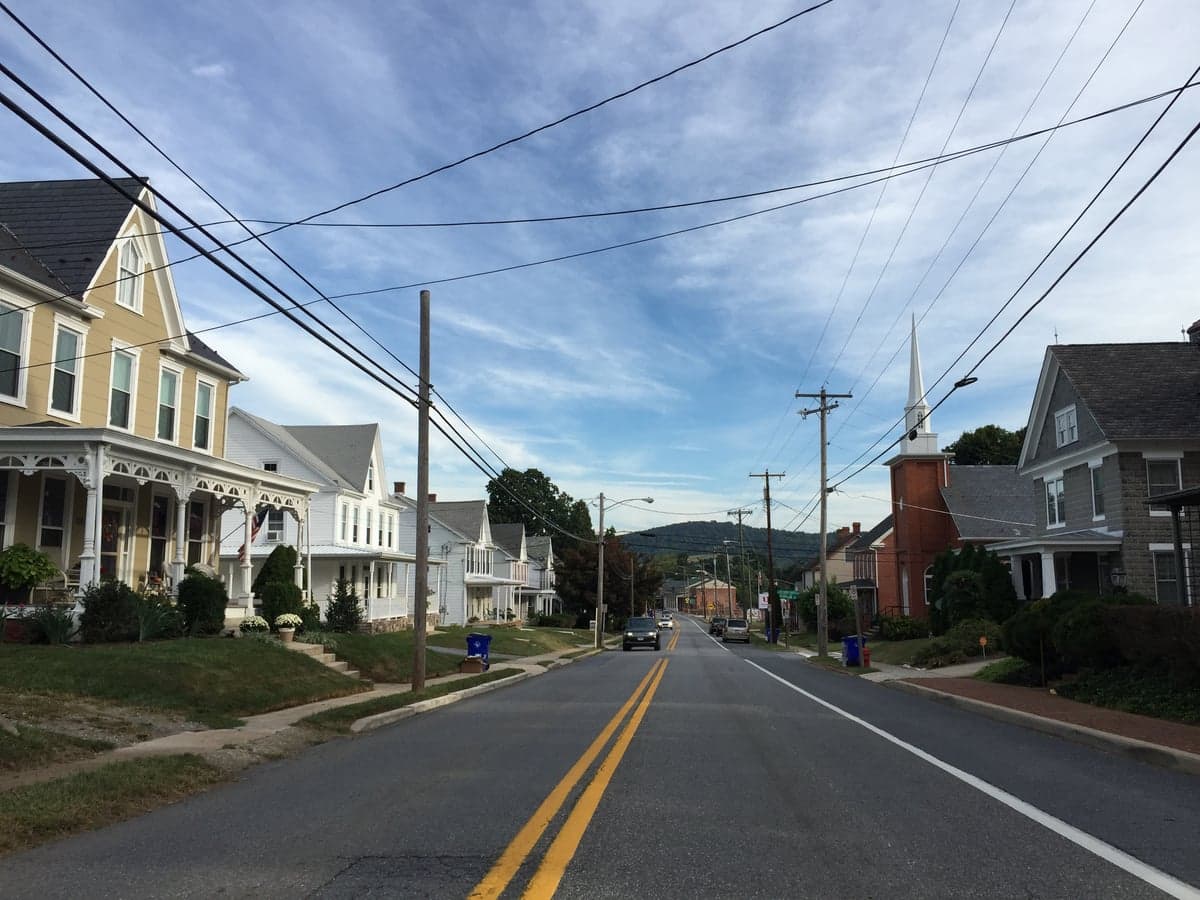
Photo: Wikipedia
Personal Sovereignty in Myersville, MD
Viable for self-reliance. Generally workable, though some barriers may limit total independence.
What does Personal Sovereignty tell us?
Personal Sovereignty measures your capacity for self-reliance and independence with minimal government friction. Higher scores mean fewer barriers between you and the way you want to live... but it assumes you have the space you need and good neighbors.
What does this tell us?
Personal Sovereignty measures your capacity for self-reliance and independence with minimal government friction. Higher scores mean fewer barriers between you and the way you want to live... but it assumes you have the space you need and good neighbors.
State Policy
Energy independence: Importer (8% of energy produced in-state)
Personal Liberty
Homesteading

Personal Liberty Analysis
Myersville, Maryland, offers a nuanced personal sovereignty environment that balances the state’s generally higher regulatory posture with the tangible advantages of small-town, rural living in Frederick County. For those prioritizing autonomy, the town provides a meaningful degree of self-reliance in daily life, particularly in housing and land use, but residents must navigate Maryland’s more restrictive state-level frameworks on taxes, firearms, and certain personal liberties. The net effect is a location where personal freedom is exercised more through local community norms and property rights than through state policy, making it a strategic choice for those who value independence within a structured legal environment.
Tax burden and regulatory posture in Frederick County
Maryland carries a reputation for a relatively high tax burden, and Myersville residents are subject to that reality. The state’s income tax rates range from 2% to 5.75%, and Frederick County adds a local income tax of 2.96%, bringing the combined top marginal rate to roughly 8.71% for higher earners. Property taxes in Myersville are levied at a county rate of approximately $1.06 per $100 of assessed value, plus a small town tax, which is moderate for the region but higher than in many states to the south and west. The regulatory environment in Frederick County is generally business-friendly compared to more urban Maryland jurisdictions, but it is not light-touch. Zoning is enforced, building permits are required, and the county’s Adequate Public Facilities Ordinance (APFO) can slow new development, which protects existing property values but limits rapid expansion. For a resident focused on personal sovereignty, the key takeaway is that the tax burden is real and predictable, but the regulatory posture in Myersville itself is not overly intrusive—most day-to-day activities, from running a home-based business to making property improvements, are manageable within the existing rules. The state’s estate and inheritance tax structure, however, is a notable consideration for long-term wealth transfer planning.
Self-defense and gun law specifics in Maryland
Maryland’s firearm laws are among the most restrictive in the nation, and this directly impacts personal sovereignty in Myersville. The state requires a Handgun Qualification License (HQL) to purchase a handgun, which involves a background check, fingerprinting, and a four-hour training course. A permit to carry a handgun (Wear and Carry Permit) is issued on a “shall-issue” basis after a 2022 Supreme Court decision (NYSRPA v. Bruen), but the application process remains rigorous, including a 16-hour training course and a thorough background investigation. Magazine capacity is limited to 10 rounds, and certain semi-automatic rifles are banned by name under the state’s Firearm Safety Act of 2013. Open carry is generally prohibited without a permit, and even with a permit, it is legally risky in practice. For a resident prioritizing self-defense, the practical reality is that owning firearms for home defense is straightforward (with the HQL process), but carrying a concealed weapon for personal protection requires significant time and financial investment. Stand-your-ground laws do not exist in Maryland; the state follows a duty-to-retreat standard in public spaces, though the Castle Doctrine applies in the home. Myersville’s rural character means that property crime is less frequent than in urban areas, but the legal framework for self-defense is decidedly state-controlled and not permissive. Those moving from more gun-friendly states should budget for the licensing process and understand that the legal landscape is unlikely to change soon.
Self-reliance and homesteading viability: lot sizes, zoning, and off-grid feasibility
Myersville’s zoning and land-use patterns are a strong point for personal sovereignty, particularly for those interested in homesteading or self-reliance. The town is located in an Agricultural-Residential (AR) zone, which allows for a wide range of activities on larger parcels. Minimum lot sizes in the surrounding county area are typically 2 to 5 acres for new subdivisions, and many existing properties in the Myersville area sit on 1 to 10 acres, providing ample space for gardens, small livestock, and outbuildings. Raising chickens, goats, and even a few head of cattle is generally permissible under county zoning, provided the property meets acreage and setback requirements. Off-grid feasibility is limited by state and county building codes—Maryland requires connection to the electrical grid for new construction, and solar panels must be grid-tied unless a special exemption is obtained. Rainwater collection for outdoor use is allowed, but potable rainwater systems are heavily regulated and require permits. Composting toilets and greywater systems are technically possible but face significant permitting hurdles. For the serious homesteader, Myersville offers a workable middle ground: you can grow your own food, keep animals, and reduce reliance on grocery stores, but full off-grid independence is not legally practical. The county’s Right-to-Farm law protects agricultural operations from nuisance complaints, which is a meaningful benefit for those who want to run a small farm or keep livestock without neighbor disputes.
Personal liberties: parental rights, medical autonomy, speech, and property
In the realm of personal liberties, Myersville reflects the broader Maryland context, which is mixed. Parental rights in education are a live issue: Frederick County Public Schools (FCPS) has a policy that allows parents to opt their children out of specific instructional materials related to sexuality and gender, but the district does not have a blanket parental notification requirement for changes in a student’s gender identity. This is a point of tension for families who prioritize parental authority in such matters. Medical autonomy is similarly constrained by state law—Maryland has broad vaccine mandates for school attendance (with medical and religious exemptions, but not personal belief exemptions), and the state’s public health emergency powers are substantial. For those seeking medical freedom, the environment is less permissive than in states like Florida or Texas. Free speech is protected under the First Amendment, and Myersville’s small-town character means that community discourse is generally open, though local government meetings follow standard parliamentary procedure. Property rights are the strongest pillar of personal liberty here: the county’s zoning is stable, eminent domain is rarely used for private development, and property owners have significant latitude in how they use their land, within the bounds of environmental regulations (e.g., Chesapeake Bay buffer requirements for streams). The overall picture is one of constrained but real personal sovereignty—strong on property and land use, moderate on parental rights, and more restrictive on medical and firearm autonomy.
Compared to other areas in the Mid-Atlantic, Myersville offers a notably higher degree of personal sovereignty than suburban enclaves closer to Washington, D.C., such as Montgomery County, where zoning is tighter, taxes are higher, and regulatory oversight is more pervasive. It falls short, however, of the autonomy found in rural parts of West Virginia or Pennsylvania, where property taxes are lower, gun laws are more permissive, and off-grid living is legally simpler. For the relocation researcher with a conservative-leaning priority on independence, Myersville represents a strategic compromise: you gain meaningful self-reliance in land use, a strong sense of community, and a slower pace of life, while accepting that state-level policies on taxes, firearms, and medical choice will require adaptation. The town’s sovereignty profile is best suited for those who value property rights and rural living above all other freedoms, and who are willing to navigate Maryland’s regulatory framework as a cost of doing business in a desirable, scenic location.

* Values derived from national, state, county, city and local statistics and may differ in a specific area. Last updated: 2026-08-26T18:54:43.000Z
Narrative content on this page is AI-generated and may contain mistakes. Verify any details that matter before acting on them.
ReloMaps may earn a commission from affiliate links at no extra cost to you.

