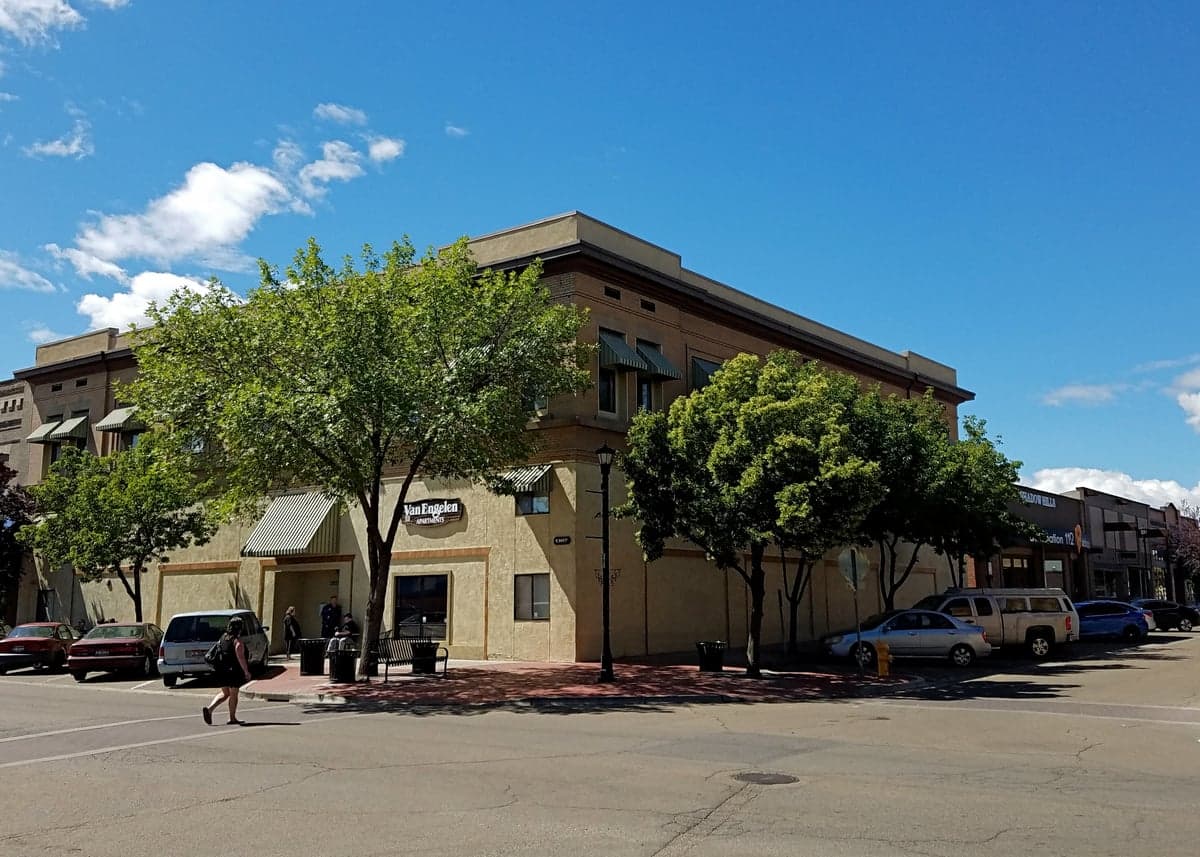
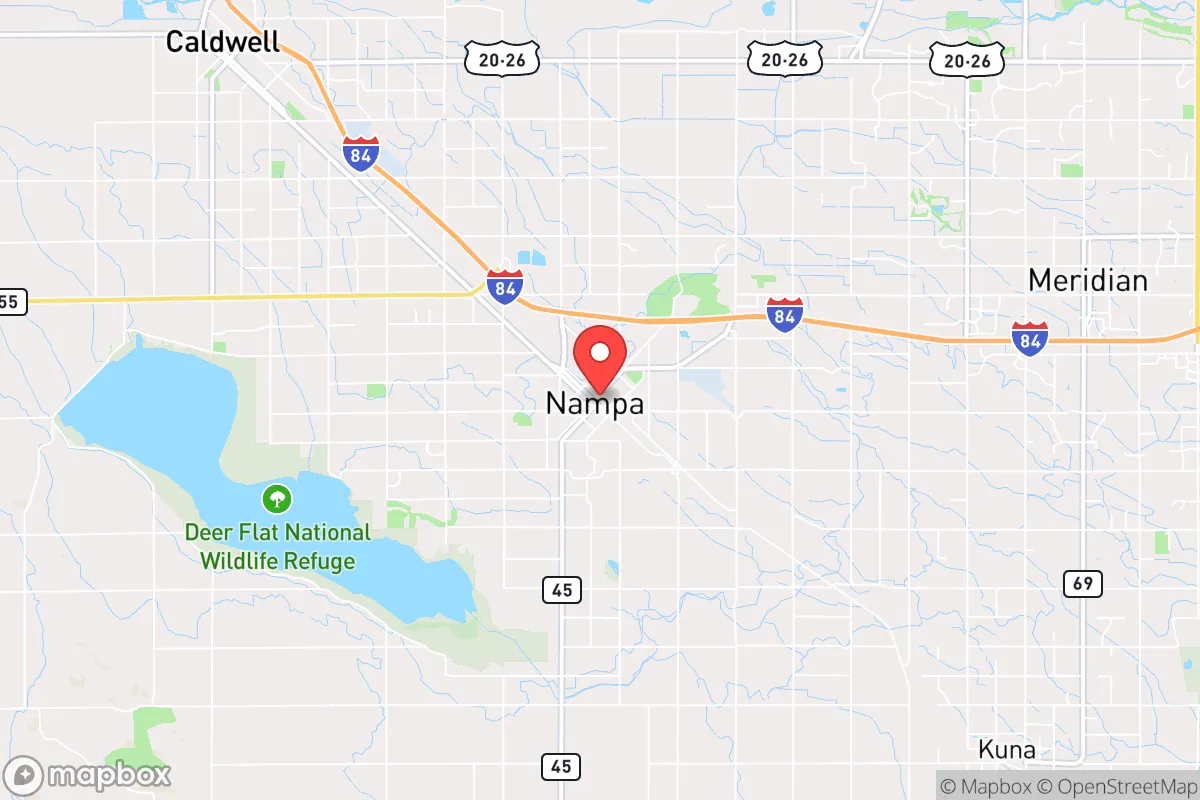
Photo: Wikipedia
Demographics of Nampa, ID
Affluence Level in Nampa, ID
A middle-class area roughly in line with national averages across income, home values, education, and employment.
People of Nampa, ID
The people of Nampa, Idaho today form a predominantly white (68.1%) and increasingly Hispanic (24.5%) community of 106,289 residents, shaped by a century of agricultural settlement and recent suburban expansion. The city’s identity is rooted in its working-class, family-oriented character, with a lower-than-average college attainment rate (23.6%) and a small foreign-born population (4.0%) that reflects limited recent international immigration. Nampa is a place where Mormon pioneer heritage, Basque ranching traditions, and a growing Hispanic workforce coexist within a conservative, churchgoing social fabric.
How the city was settled and grew
Nampa was founded in 1886 as a railroad stop on the Oregon Short Line, drawing its first wave of settlers from Mormon pioneers who had colonized the broader Treasure Valley. The original population was overwhelmingly white and native-born, with families arriving from Utah, the Midwest, and the Pacific Northwest to farm the newly irrigated land. The Lakeview neighborhood, near the original townsite, was built by these early Mormon homesteaders and still contains some of the city’s oldest homes and churches. A second wave arrived in the 1910s and 1920s, when Basque sheepherders and Italian railroad workers settled in the Downtown Nampa district, establishing boarding houses and small businesses along 1st Street South. The city’s population grew steadily through the mid-20th century, reaching roughly 18,000 by 1960, driven by agricultural processing plants (sugar beets, onions, potatoes) and the expansion of the Union Pacific rail yard. The West Nampa area, developed in the 1950s, absorbed many of the post-war white families moving out of Boise for cheaper land and larger lots.
Modern era (post-1965)
After the 1965 Immigration and Nationality Act, Nampa saw a modest but steady influx of Hispanic workers, primarily from Mexico and later Central America, drawn by year-round agricultural jobs in the surrounding onion, sugar beet, and corn fields. These families concentrated in the South Nampa corridor, particularly around Franklin Road and Garrity Boulevard, where older farmworker housing and mobile home parks provided affordable entry points. By 1990, the Hispanic share of the population had risen to roughly 8%, and by 2024 it reached 24.5%. The East Nampa area, near the intersection of Idaho 16 and Karcher Road, became a secondary Hispanic enclave as second-generation families moved into newer subdivisions. Meanwhile, domestic in-migration from California, Oregon, and Washington accelerated after 2000, bringing white, college-educated professionals seeking lower housing costs and conservative governance. These newcomers settled primarily in the North Nampa master-planned communities like the Highlands and the Greens, where home prices are 20-30% higher than the city average. The Black population remains tiny (1.1%), concentrated in scattered rental complexes near the city center, while East/Southeast Asian communities (0.7%) are almost entirely Vietnamese and Filipino families living in the Downtown Nampa area near the Buddhist temple on 3rd Street North. The Indian-subcontinent population is effectively zero, reflecting the absence of tech-sector or medical-research employers that typically draw that group.
The future
Nampa’s population is heading toward a more pronounced white-Hispanic binary, with the Hispanic share projected to reach 30-33% by 2040 based on current birth rates and continued agricultural labor demand. The white population is aging and slowly declining in share, though absolute numbers remain stable due to domestic in-migration from the West Coast. The city is not tribalizing into distinct ethnic enclaves so much as sorting by income: North Nampa is becoming a predominantly white, higher-income zone, while South Nampa and East Nampa are increasingly Hispanic and working-class. The foreign-born share (4.0%) is low and likely to remain so, as most Hispanic growth comes from U.S.-born children rather than new arrivals. The Black, Asian, and Indian populations are too small to form meaningful enclaves and are likely to remain marginal. The next decade will see continued suburban infill, with new subdivisions pushing into the farmland south of the city, absorbing both white and Hispanic families into mixed-income developments.
For a conservative-leaning mover, Nampa is becoming a more Hispanic but still culturally conservative city, where the dominant white population and the growing Hispanic population share traditional family values, religious participation, and a skepticism of progressive urban politics. The city is not diversifying in the cosmopolitan sense—it is becoming a two-group community with clear geographic and economic boundaries. New arrivals should expect a stable, family-oriented environment with low crime in the north and higher poverty in the south, but little of the ethnic friction seen in larger Western cities.

* Values derived from national, state, county, city and local statistics and may differ in a specific area. Last updated: 2026-05-03T20:23:50.000Z
Narrative content on this page is AI-generated and may contain mistakes. Verify any details that matter before acting on them.
ReloMaps may earn a commission from affiliate links at no extra cost to you.

