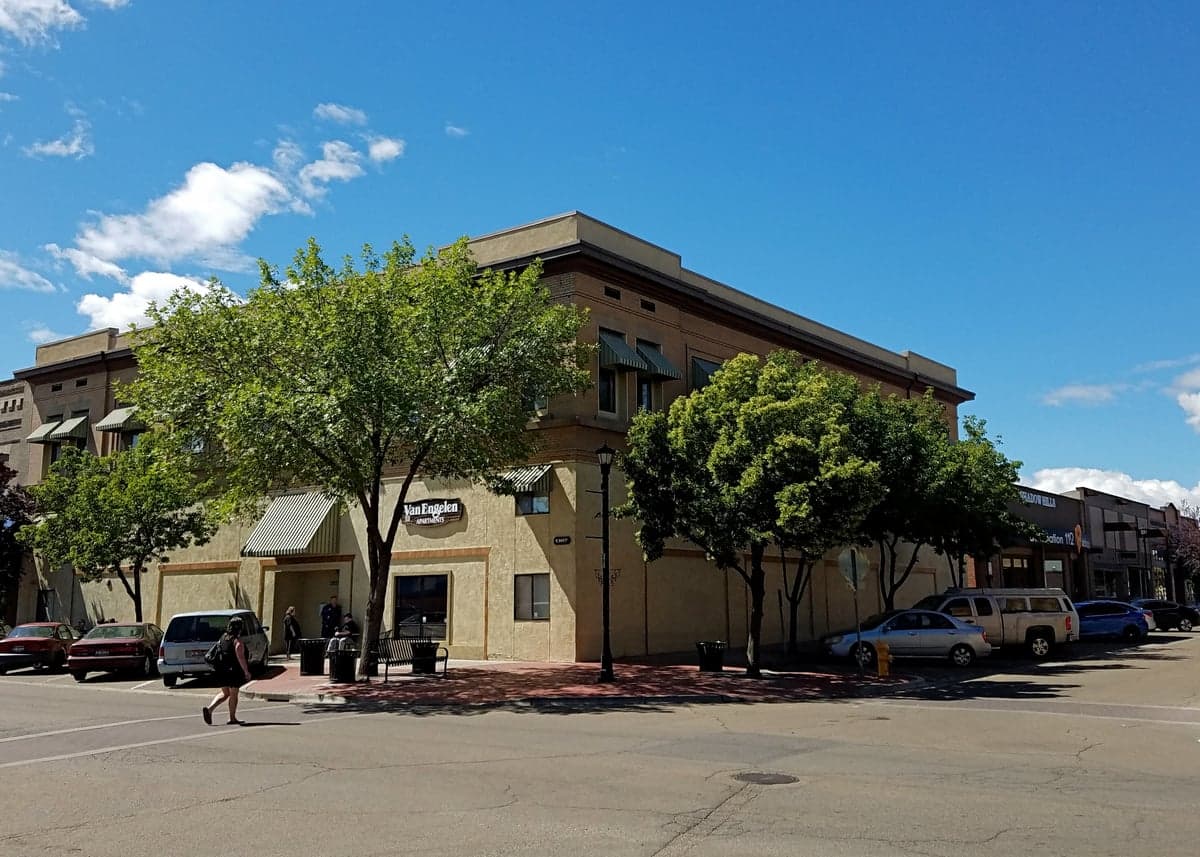
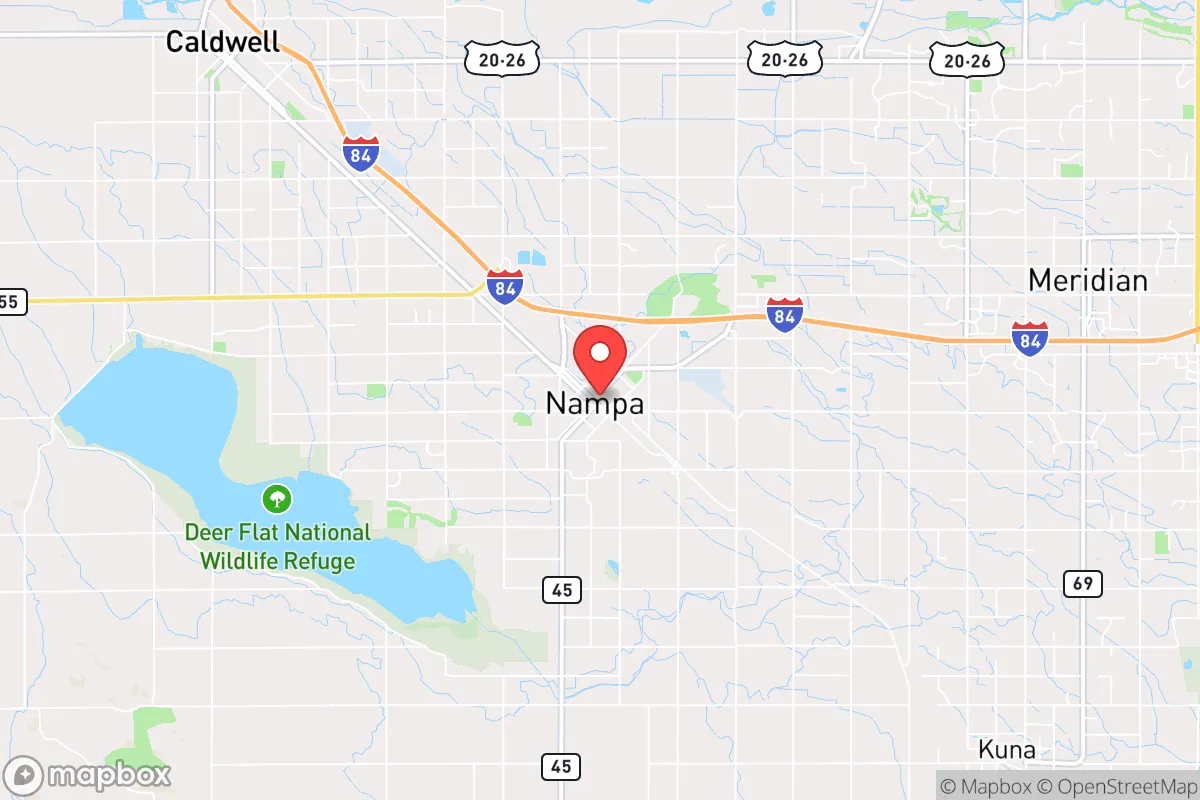
Photo: Wikipedia
Personal Sovereignty in Nampa, ID
Moderate friction. Expect trade-offs in some aspect of personal liberty and independence.
What does Personal Sovereignty tell us?
Personal Sovereignty measures your capacity for self-reliance and independence with minimal government friction. Higher scores mean fewer barriers between you and the way you want to live... but it assumes you have the space you need and good neighbors.
What does this tell us?
Personal Sovereignty measures your capacity for self-reliance and independence with minimal government friction. Higher scores mean fewer barriers between you and the way you want to live... but it assumes you have the space you need and good neighbors.
State Policy
Energy independence: Importer (25% of energy produced in-state)
Personal Liberty
Homesteading

Personal Liberty Analysis
Nampa, Idaho, offers a personal sovereignty environment that is among the strongest in the Pacific Northwest, largely because it sits within a state that has aggressively pushed back against federal overreach and maintains a culture of self-reliance. For those concerned with preserving autonomy in an era of expanding government control, Nampa represents a deliberate choice to live under a legal and political framework that prioritizes individual rights over collective mandates. The city’s growth—from roughly 100,000 residents in 2020 to over 110,000 by 2025—reflects a steady influx of people seeking precisely this kind of liberty, particularly from states with more restrictive governance like California, Oregon, and Washington. However, no place is a perfect fortress; Nampa’s sovereignty is shaped by state-level protections, local zoning realities, and the practical limits of living within a growing metropolitan area that still answers to Boise’s political gravity.
Tax burden and regulatory posture: how Nampa compares to high-control states
Idaho’s tax structure is a major draw for those fleeing high-tax jurisdictions. The state’s flat income tax rate, which dropped to 5.8% in 2024 and is scheduled to decline further to 5.695% by 2026, is a fraction of what you’d pay in California (top marginal rate of 13.3%) or New York (10.9%). Property taxes in Canyon County, where Nampa sits, average around 0.72% of assessed value—roughly half the national average and a fraction of the 1.8%+ rates common in Texas or New Jersey. Sales tax is 6% statewide, with no local add-ons, meaning a $50,000 truck costs you $3,000 in tax versus $4,500+ in many blue states. More importantly, Idaho’s regulatory posture is explicitly pro-business and anti-red tape. The state has a right-to-work law, no state-level occupational licensing for dozens of trades that require it elsewhere, and a regulatory budget that has been shrinking in real terms since 2020. For the prepper-minded, this means fewer bureaucratic hurdles for building a shop, running a home-based business, or storing bulk supplies—though you still need to comply with local building codes and HOA restrictions, which can be a trap for the unwary. The state also passed a law in 2023 requiring agencies to justify any new regulation that costs more than $5,000 annually, effectively chilling most new rulemaking.
Self-defense and gun law specifics: what Nampa allows that other cities don’t
Idaho is a constitutional carry state, meaning no permit is required to carry a concealed firearm for anyone 18 or older who can legally possess a gun. Nampa itself has no local ordinances that restrict this—no magazine capacity limits, no "assault weapon" bans, and no waiting periods beyond the federal background check. The state preempts all local gun laws, so city council can’t pass its own restrictions, a critical protection that cities like Seattle, Portland, and Denver have eroded. Stand-your-ground laws are in full effect, with no duty to retreat in any place you have a legal right to be. Castle doctrine applies to your home, vehicle, and workplace. For the survivalist, the practical upshot is that you can keep an AR-15 in your truck, a shotgun by the back door, and a concealed pistol on your hip without worrying about a patchwork of local ordinances. Nampa’s police department, while professional, is understaffed relative to the city’s growth—response times for non-emergency calls can exceed 30 minutes, making personal defense a necessity, not a hobby. The state also passed a Second Amendment Preservation Act in 2021, which prohibits state resources from enforcing federal gun laws that violate the state constitution—a direct challenge to federal overreach that has not yet been fully tested in court but signals the political climate.
Self-reliance and homesteading viability: lot sizes, zoning, and off-grid feasibility
Nampa’s zoning is a mixed bag for the serious homesteader. Within the city limits, most residential lots are standard suburban parcels of 6,000 to 10,000 square feet, which limits large-scale gardening, livestock, or water independence. Chickens are generally allowed (up to 6 hens, no roosters) in most residential zones, but goats, pigs, or horses require a minimum of one acre and a special permit. The real opportunity lies in the unincorporated areas of Canyon County, just outside Nampa’s city limits, where lot sizes of 1 to 5 acres are still affordable—prices range from $50,000 to $150,000 for raw land, depending on proximity to utilities. Off-grid living is legally feasible here: Idaho has no state law requiring connection to the electrical grid, and rainwater collection is unrestricted (unlike Colorado or Utah). However, you must comply with the county’s septic system regulations, which require a percolation test and a permit, and well drilling is allowed but subject to groundwater rights—you can’t just dig a hole and pump. Solar panels are unregulated, and battery storage is encouraged by net metering policies that credit you at retail rates for excess power. For the prepper, the sweet spot is buying 2-5 acres in the rural fringe east of Nampa toward Kuna or south toward Melba, where you can have a garden, a few animals, and a solar array without city interference. Just be aware that HOAs in newer subdivisions often ban clotheslines, sheds, and visible generators—read the covenants before buying.
Personal liberties: parental rights, medical autonomy, speech, and property
Idaho has become a national battleground for parental rights, and Nampa sits squarely in that fight. The state passed the Parental Rights in Education Act in 2023, which requires schools to notify parents of any curriculum involving gender identity or sexual orientation and prohibits instruction on these topics in grades K-3. In practice, this means Nampa parents have more legal leverage to opt their children out of controversial materials than in most states. Medical autonomy is similarly robust: Idaho has no vaccine mandates for adults (beyond federal requirements for healthcare workers), and the state’s 2022 law prohibiting discrimination based on vaccination status means employers cannot fire you for refusing a COVID-19 or flu shot. The Idaho Freedom Act, passed in 2024, explicitly protects the right to refuse any medical treatment, including experimental therapies, and prohibits the state from mandating any medical procedure as a condition of employment, education, or travel. Speech protections are strong under both the state constitution and a 2023 law that prohibits "viewpoint discrimination" on public university campuses—a direct response to cancel culture concerns. Property rights are protected by a 2021 law requiring just compensation for any regulation that reduces property value by more than 20%, effectively limiting zoning changes that could devalue your land. For the liberty-minded individual, Nampa offers a legal environment where you can homeschool, refuse vaccines, carry a firearm, and speak your mind without fear of government retaliation—at least for now.
Overall, Nampa ranks among the top 15% of U.S. cities for personal sovereignty, particularly when compared to the heavily regulated coastal states that many relocating families are fleeing. The combination of low taxes, constitutional carry, strong parental rights, and a culture that values self-reliance creates a buffer against the creeping federal and state overreach seen elsewhere. But it’s not a libertarian utopia: you still have to deal with county zoning, property taxes that fund a growing school system, and the occasional HOA that bans your backup generator. For the survivalist or prepper who wants a base of operations within striking distance of true wilderness (the Sawtooth National Forest is two hours away) but with access to a Costco and a regional airport, Nampa is a solid, pragmatic choice. Just keep your eye on Boise—the state capital is only 20 miles away, and the political winds can shift faster than a wildfire in August.

* Values derived from national, state, county, city and local statistics and may differ in a specific area. Last updated: 2026-05-03T20:23:50.000Z
Narrative content on this page is AI-generated and may contain mistakes. Verify any details that matter before acting on them.
ReloMaps may earn a commission from affiliate links at no extra cost to you.

