Photo: Wikipedia
Personal Sovereignty in Naperville, IL
Viable for self-reliance. Generally workable, though some barriers may limit total independence.
What does Personal Sovereignty tell us?
Personal Sovereignty measures your capacity for self-reliance and independence with minimal government friction. Higher scores mean fewer barriers between you and the way you want to live... but it assumes you have the space you need and good neighbors.
What does this tell us?
Personal Sovereignty measures your capacity for self-reliance and independence with minimal government friction. Higher scores mean fewer barriers between you and the way you want to live... but it assumes you have the space you need and good neighbors.
State Policy
Energy independence: Importer (45% of energy produced in-state)
Personal Liberty
Homesteading

Personal Liberty Analysis
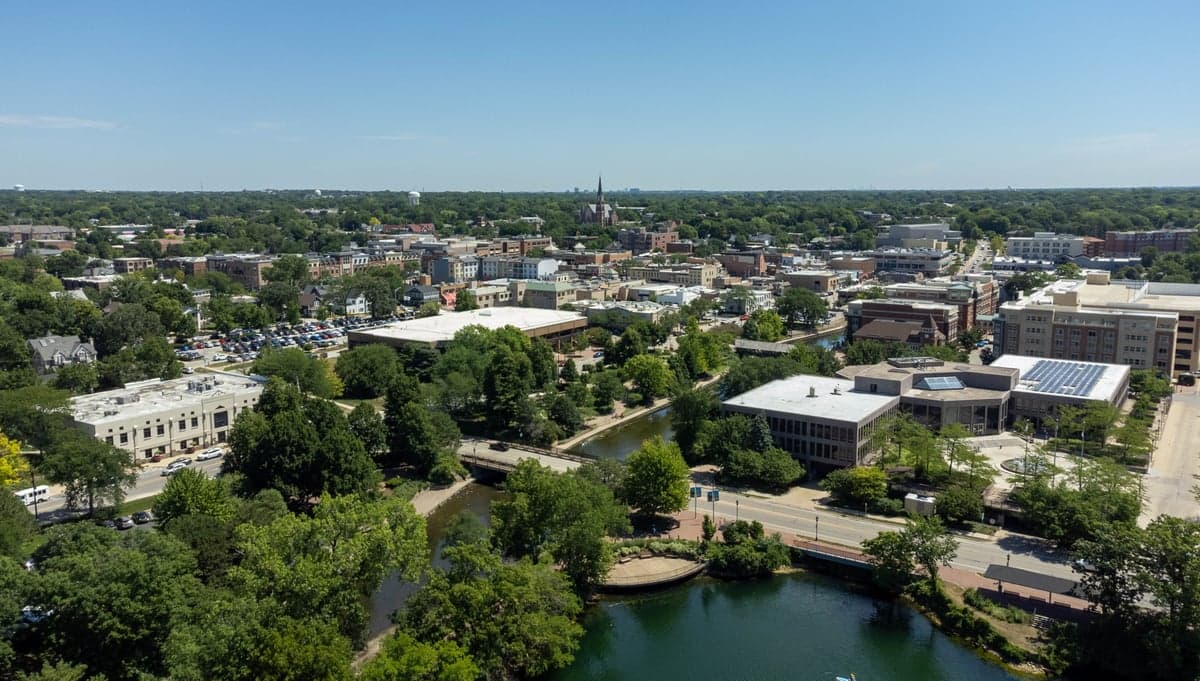
Naperville, Illinois, presents a complex picture for those prioritizing personal sovereignty. While the city offers strong economic stability and high-quality public services, these benefits come with a significant trade-off in the form of a high tax burden and a regulatory environment that leans heavily toward state-level control. For the survivalist or prepper mindset, Naperville is a place where you can build a comfortable life, but only if you are prepared to navigate and absorb the costs of a system that actively limits certain forms of self-reliance and personal autonomy. The overall sovereignty environment here is best described as "managed"—you have considerable freedom within the lines the state has drawn, but stepping outside those lines, particularly regarding self-defense, property use, and medical choice, carries real consequences.
Tax burden and regulatory posture: the cost of living under state control
The most immediate challenge to personal sovereignty in Naperville is the financial one. Illinois has the second-highest property tax burden in the nation, and Naperville, as a high-value suburb, is ground zero for this. A typical home valued at $500,000 can carry an annual property tax bill of $10,000 to $12,000 or more. This is not a tax that funds optional services; it is a mandatory, recurring transfer of wealth that directly reduces your capacity to invest in your own preparedness—whether that means buying land, stockpiling supplies, or building a secure home. The state income tax is a flat 4.95%, and sales taxes in Naperville push past 8% when county and municipal levies are added. The regulatory posture is equally aggressive. Illinois is a state with a strong tradition of home-rule authority, meaning Naperville can and does impose its own building codes, business licensing requirements, and environmental regulations that go beyond state minimums. For someone looking to operate a home-based business, install a backup generator, or modify their property for self-sufficiency, expect to deal with permits, inspections, and fees that can slow or block your plans. The state's regulatory climate is consistently ranked among the worst in the country for business freedom, and that friction extends to individual property owners as well.
Self-defense and gun law specifics: navigating a restrictive state within a safe city
This is the area where Naperville's sovereignty profile is most sharply defined by state law. Illinois is a "may-issue" state for concealed carry, meaning local law enforcement has discretion in granting permits, though in practice, law-abiding residents in DuPage and Will Counties generally receive them after completing the required 16-hour training and background check. However, the state's Firearm Owners Identification (FOID) card system is a mandatory, state-run registry that every gun owner must maintain, creating a centralized database of legal gun owners. In 2023, Illinois passed a ban on the sale and possession of many semi-automatic rifles and magazines over 10 rounds, which directly impacts the types of firearms a prepper might consider essential for home defense or long-term security. Naperville itself is a very low-crime city—violent crime rates are a fraction of the national average—so the immediate need for armed self-defense is statistically low. But the legal framework is hostile to the principle of an uninfringed right to keep and bear arms. For the sovereignty-minded individual, the reality is that you can own firearms in Naperville, but you will do so under a system of state registration, restricted magazine capacities, and a banned weapons list that limits your options. This is not a place for those who view the Second Amendment as an absolute right.
Self-reliance and homesteading viability: lot sizes, zoning, and off-grid feasibility
Naperville is a dense, planned suburb, and the physical environment is not conducive to traditional homesteading or off-grid living. The typical residential lot is a quarter-acre or less, with strict homeowners' association (HOA) covenants in many neighborhoods that prohibit livestock, large gardens, clotheslines, and even the parking of utility trailers or work trucks. Zoning codes are enforced rigorously; building a detached workshop, installing solar panels, or drilling a well requires multiple permits and approvals. Off-grid feasibility is essentially zero—the city requires connection to municipal water and sewer, and any attempt to disconnect from the grid would violate building codes and likely result in fines or legal action. For the prepper who wants to raise chickens, grow a substantial garden, or store bulk supplies, Naperville is a poor fit. The city's density and HOA culture are designed for conformity, not self-reliance. If you want to be able to ride out a disruption without depending on municipal services, you need to look at the exurban or rural townships west of Naperville, where lot sizes of one to five acres are common and zoning is far more permissive. Within Naperville city limits, your best bet for self-reliance is a well-stocked pantry and a backup generator—but even that generator may be subject to noise ordinances and placement restrictions.
Personal liberties: parental rights, medical autonomy, speech, and property
Illinois has a strong record on some personal liberties and a weak one on others. Parental rights are under active pressure—the state has passed laws that allow minors to access certain medical treatments, including reproductive health care and gender transition services, without parental consent. School boards in Naperville have been the site of contentious debates over curriculum transparency and library content, with the state government generally siding with district autonomy over parental opt-out rights. Medical autonomy is similarly constrained: Illinois has a robust vaccine mandate history for school attendance, and during the COVID-19 pandemic, the state imposed some of the strictest and longest-lasting public health orders in the Midwest. For those who prioritize the right to make medical decisions for themselves and their children without government interference, this is a significant red flag. On the positive side, property rights are relatively well-protected from eminent domain abuse, and the state has a strong tradition of contract enforcement. Free speech is protected by the First Amendment, and Naperville has a vibrant public forum culture, though local ordinances on noise, signage, and public assembly can be used to limit expressive activities. The overall picture is one of a state that is comfortable using its police power to regulate personal behavior in the name of public health, safety, and welfare, which directly conflicts with a high-sovereignty worldview.
Compared to other high-opportunity suburbs in the Midwest, Naperville offers a trade-off that many conservative-leaning individuals will find unacceptable. The economic stability, excellent schools, and low crime are real advantages, but they are purchased with a high tax burden, a restrictive gun law environment, and a regulatory system that limits self-reliance and parental autonomy. For the survivalist or prepper, Naperville is a place to earn a living, not a place to build a fortress. If your priority is maximizing personal sovereignty—the ability to defend yourself, raise your children according to your values, live off your own land, and keep more of what you earn—then you are better served by looking at states like Indiana, Texas, or Tennessee, where the tax burden is lower, gun laws are more permissive, and zoning is far less restrictive. Naperville is a well-managed, prosperous city, but it is a city that manages you in return.

* Values derived from national, state, county, city and local statistics and may differ in a specific area. Last updated: 2026-04-24T14:16:35.000Z
Narrative content on this page is AI-generated and may contain mistakes. Verify any details that matter before acting on them.
ReloMaps may earn a commission from affiliate links at no extra cost to you.

