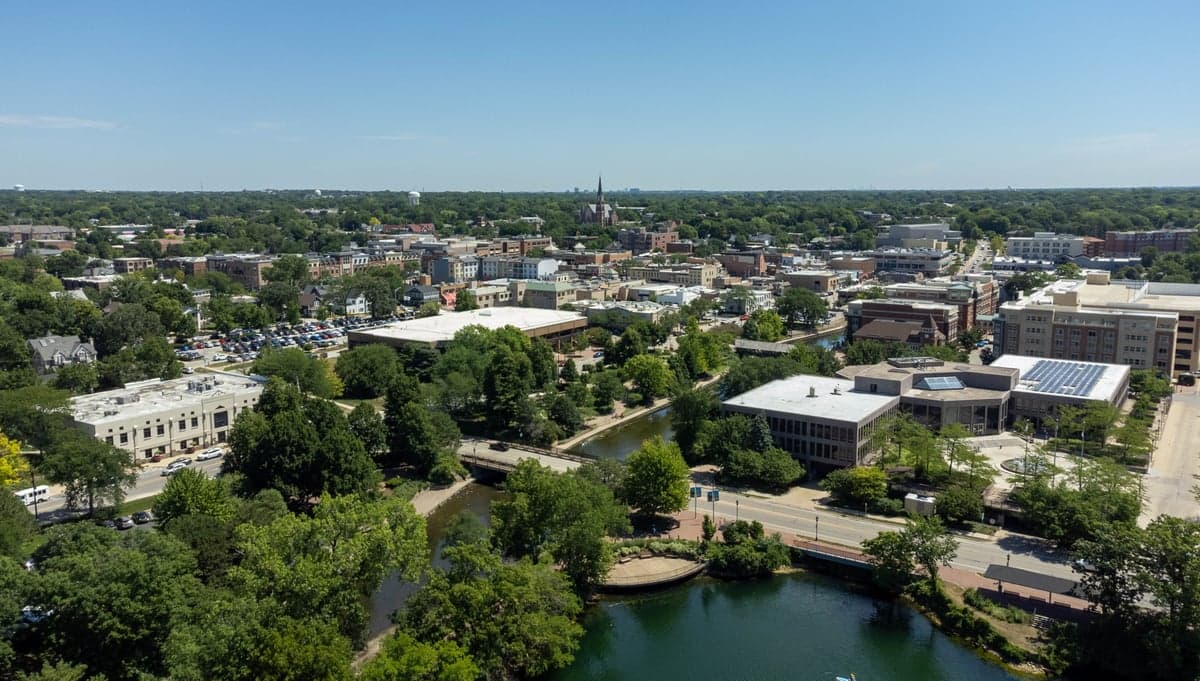
Photo: Wikipedia
Strategic Assessment of Naperville, IL
Multiple tactical vulnerabilities. Population density, target proximity, or disaster risk are likely compounding. A retreat property and exit planning is required.
What does the Strategic Assessment tell us?
Our Strategic Assessment grades tactical survivability of an area. Major population centers, military targets, fallout zones, natural disasters, and border exposure all drive risk — lower exposure means a more defensible position in a crisis.
This is heavily inspired by Joel Skousen's Strategic Relocation book. Highly recommended you checkout the book ($)What does this tell us?
Our Strategic Assessment grades tactical survivability of an area. Major population centers, military targets, fallout zones, natural disasters, and border exposure all drive risk — lower exposure means a more defensible position in a crisis.
This is heavily inspired by Joel Skousen's Strategic Relocation book. Highly recommended you checkout the book ($)Strategic Pillars

Key Distances
Regional Safe Places
Below is our recommended "safe zones" in Illinois and the surrounding area based on our strategic heuristics. For most people, it's unrealistic to live in a “safe zone” full-time due to work, family or other personal reasons. They tend to be more rural. However, many of these areas are perfect for second homes and retreat properties that double as a vacation home or even a short-term rental.
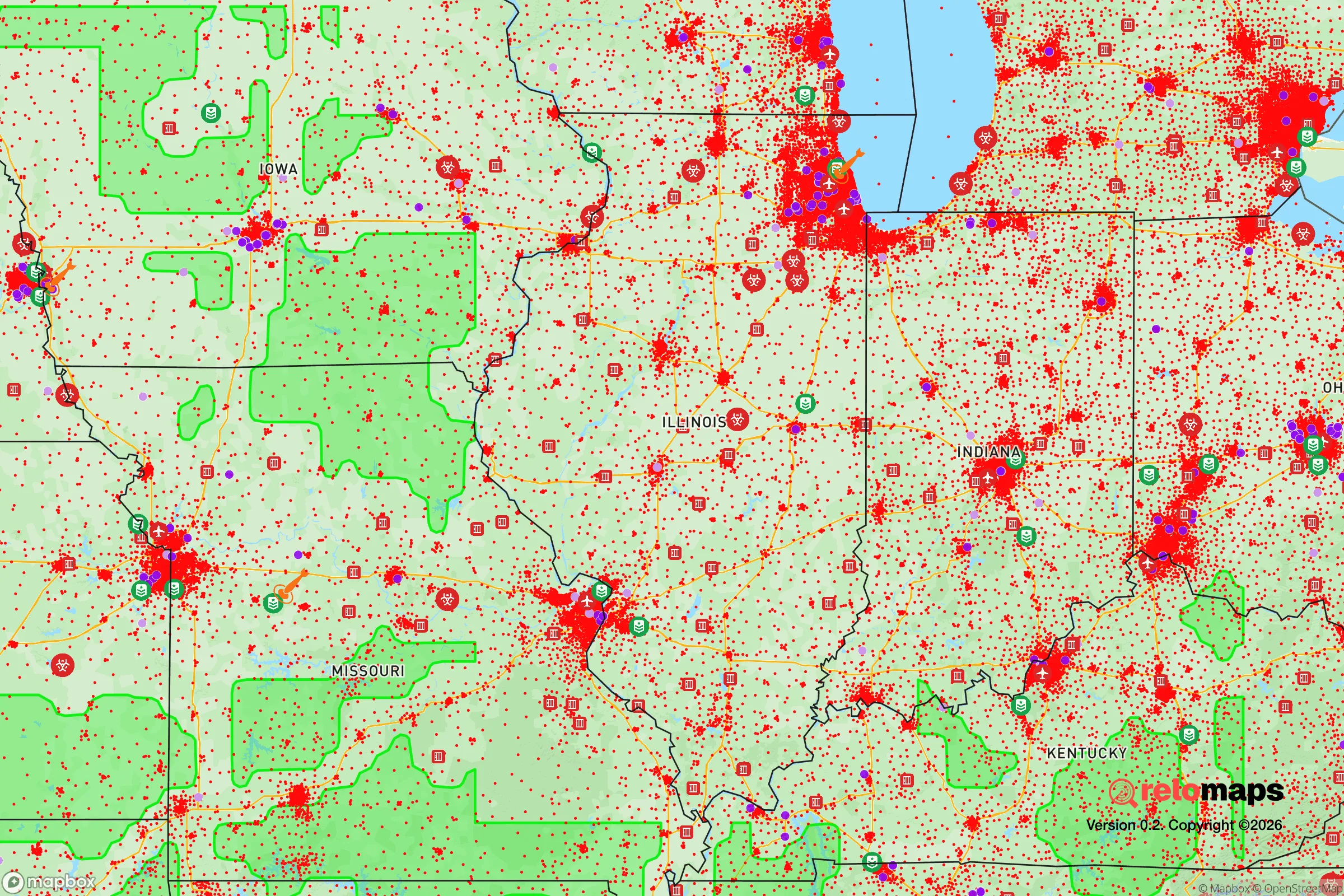
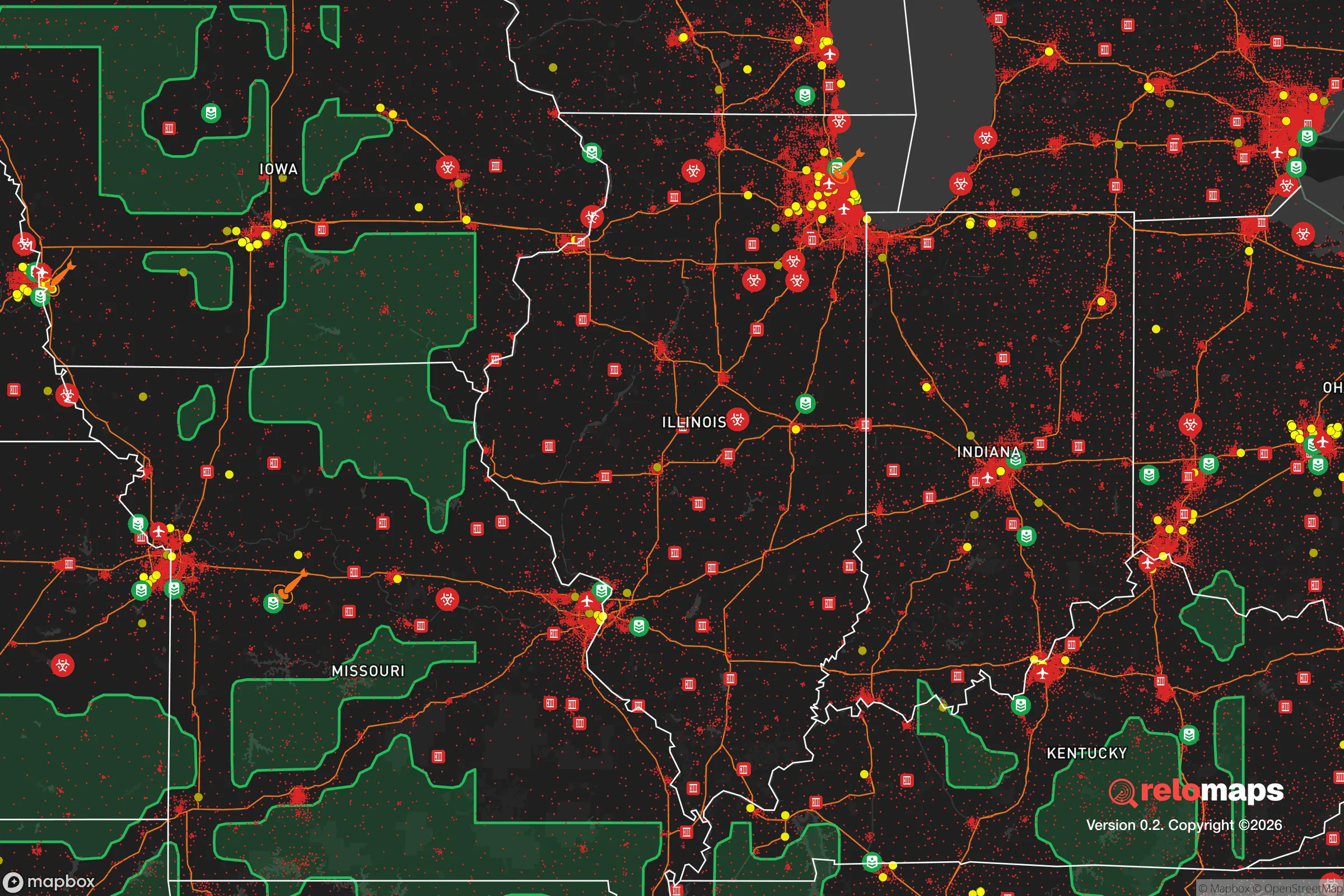


Important Note: For informational purposes only. This does not mean nothing bad ever happens in the green zones. Please use common sense. This is based on public data and modeled with AI. We tried to take a conservative approach but mistakes happen. We update this regularly as new information becomes available.
Solar Generator Recommendations
Backup power matters more here than in safer locations. We've picked three solar generators across budgets and capacity tiers — start with the budget unit if you only need a few essentials, or step up if you want to run a fridge and HVAC for days at a time.

Jackery Portable Power Station Explorer 300
Budget OptionPower on the Go: Weighing only 11 lbs, it's convenient to set up and store with book-sized foldable solar panels

BLUETTI Portable Power Station AC180
Designed for both indoor and outdoor scenarios, AC180 is highly capable as it has a robost capacity and continuous output power.

EF ECOFLOW DELTA Pro Ultra Power Station
Upgraded PickEcoFlow DELTA Pro Ultra is a whole-home energy system designed to grow with your family. Integrated with the Smart Home Panel 2, it scales to meet your evolving energy needs — keeping your home powered, intelligent, and secure through every stage of life.
We earn a commission, at no additional cost to you.
Strategic Assessment Analysis
Naperville, Illinois, presents a complex strategic picture for the conservative prepper or survivalist. Its core strength is its position as a highly resilient, resource-rich suburb that sits just far enough from Chicago’s immediate fallout zone to offer a buffer, yet close enough to be affected by the city’s collapse. The town’s robust infrastructure, affluent tax base, and strong community networks provide a foundation for weathering many crises, but its location within the greater Chicago metropolitan area introduces significant vulnerabilities that cannot be ignored. For the relocator prioritizing long-term security, Naperville is a high-potential location that demands a clear-eyed assessment of its risks and a deliberate plan for mitigation.
Geographic position and natural advantages for long-term survival
Naperville’s geography is a double-edged sword, but the edge that cuts in your favor is its access to the DuPage River and a network of forest preserves. The DuPage River, while not a pristine mountain stream, provides a surface water source that can be filtered and treated for emergency use, a critical asset when municipal water systems fail. The surrounding forest preserves—like the 2,000-acre Springbrook Prairie and the 850-acre McDowell Grove—offer cover, game, and foraging potential, though they are not wilderness. The terrain is flat to gently rolling, which is poor for defensive positions but excellent for agriculture and mobility. The area’s natural advantages are primarily logistical: it sits at the intersection of I-88, I-355, and I-55, giving you multiple egress routes out of the metro area toward the rural west (DeKalb, Dixon) or southwest (Joliet, Morris). The soil is rich, and the growing season is long enough for serious gardening. However, the lack of significant elevation or natural barriers means you cannot rely on terrain to slow down a threat—you must rely on community and preparation.
Risks, exposures, and proximity to fallout-relevant landmarks
The primary risk for Naperville is its proximity to Chicago, a city of 2.7 million that would become a humanitarian and security nightmare in any major crisis. Naperville is roughly 30 miles west of the Loop, placing it within the likely fallout zone of a nuclear detonation at the city center, depending on wind direction. Even without a nuclear event, Chicago’s collapse would send waves of refugees, looters, and organized criminal elements westward along the interstates. Naperville is also within 15 miles of the Fermi 2 nuclear power plant in nearby Byron, and while that plant has a solid safety record, any major incident would put the entire region at risk. The town is crisscrossed by high-voltage power lines and natural gas pipelines, which are both a vulnerability (targets for sabotage) and a resource (potential for tapping if you have the skills). The presence of multiple major hospitals, including Edward Hospital, is a double-edged sword: it’s a resource for you, but it will also be a magnet for desperate people. The nearby DuPage Airport is a potential evacuation point but also a target. In short, Naperville is not a remote redoubt; it is a high-value suburb that would be contested ground in any prolonged crisis.
Practical resilience for a relocator: food, water, energy, and defensibility
For the relocator, Naperville offers a strong baseline for practical resilience, but you must build on it. The town’s water supply comes from Lake Michigan via the DuPage Water Commission, which is a centralized system vulnerable to disruption. You need a backup: rainwater catchment, well access (some older homes have wells, but most are on municipal), or a reliable supply of purification tablets and filters. The electrical grid is robust but not hardened; a major EMP or cyberattack would take it down for weeks. Solar panels with battery storage are a wise investment, and many homes have natural gas hookups that can run generators indefinitely if the gas lines stay intact. Food security is excellent in the short term—Naperville has dozens of grocery stores, Costco, and a thriving farmers market—but in a long-term crisis, those shelves will empty in days. The town’s zoning allows for backyard chickens and small-scale gardening, but not livestock. Defensibility is the weak point: Naperville is a sprawling, car-dependent suburb with few natural chokepoints. Your best bet is a home on a cul-de-sac with a fenced yard, preferably near a forest preserve for a secondary escape route. The local police force is well-funded and professional, but in a major event, they will be overwhelmed. Your security plan must rely on a tight-knit group of neighbors you trust, not on the authorities.
The overall strategic picture for Naperville is one of calculated risk. It is not a survivalist’s paradise—it lacks the isolation, defensible terrain, and self-sufficiency of a rural compound. But for the relocator who wants to maintain a professional career while building a resilient lifestyle, it is one of the best options in the Midwest. The key is to treat Naperville as a base camp, not a fortress. Invest in a secondary property in a rural area like LaSalle County or the Driftless Region of Wisconsin, stock that location with supplies, and have a bug-out plan that gets you there within a few hours. In Naperville itself, focus on community-building, water storage, and off-grid energy. The town’s affluence means you can find skilled tradespeople, medical professionals, and like-minded preppers if you network smartly. The risks from Chicago and the nuclear plant are real, but they are manageable with proper planning. Naperville is a solid B+ for strategic relocation—not perfect, but far better than most suburbs, and a place where a prepared individual can thrive while the unprepared struggle.

* Values derived from national, state, county, city and local statistics and may differ in a specific area. Last updated: 2026-04-24T14:16:35.000Z
Narrative content on this page is AI-generated and may contain mistakes. Verify any details that matter before acting on them.
ReloMaps may earn a commission from affiliate links at no extra cost to you.

