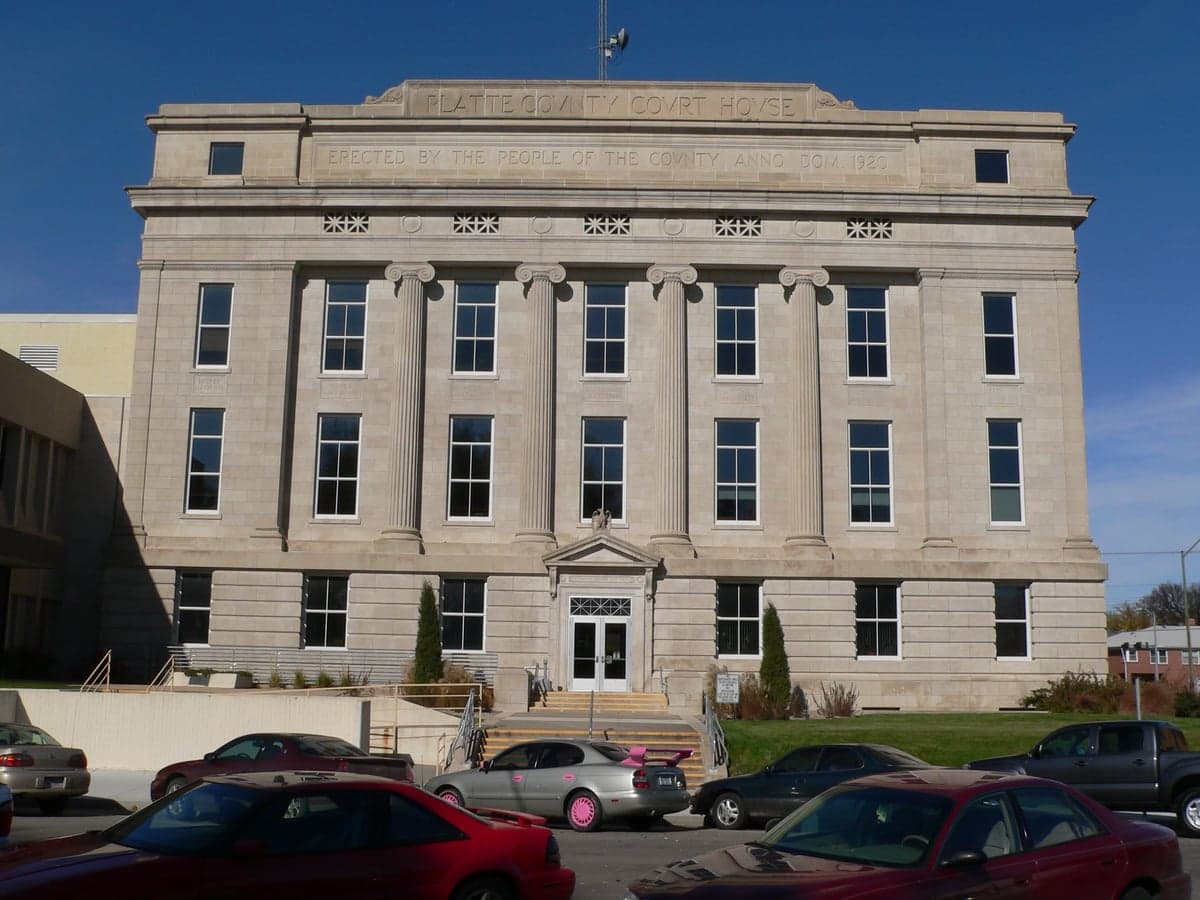
Photo: Wikipedia
Political ClimatePolitical Climate in Platte County
Showing district-level results — no local-only data available.
Local Political AnalysisPolitical Analysis of Platte County
Platte County leans reliably Republican, but it’s not as deep red as the rest of Nebraska. With a Cook PVI of R+6, compared to the state’s R+10, this county has a more moderate streak — especially around Columbus, the county seat. Over the past decade, the shift has been slow but steady toward the right, though you’ll still find pockets where Democrats can compete. That’s a far cry from the surrounding rural towns, where a Republican primary is the only real election.
How it compares
Nebraska as a whole is a solidly conservative state, but Platte County’s R+6 rating tells you it’s a few points less partisan than the statewide average. The difference shows up in local precincts. Columbus has a handful of wards — especially near the downtown core and the union-heavy manufacturing plants — that have historically leaned blue or been swingy. Meanwhile, Humphrey and Platte Center are about as red as it gets; you won’t find a Democratic candidate knocking on doors there. Duncan and Creston are more mixed, often swinging with the national mood. So while the county overall votes Republican, it’s not a monolith — and that’s something to keep an eye on if you value limited government and local control.
What this means for residents
For someone who worries about government overreach, Platte County’s moderate lean can be a double-edged sword. On one hand, the county commission and school boards here have generally resisted the kind of top-down mandates you see in more progressive areas. Property rights are respected, and there’s a strong tradition of letting communities handle their own business. On the other hand, the moderate streak means you’ll occasionally see local officials willing to compromise on issues like zoning or school curriculum — moves that can open the door to progressive influence. The recent push for diversity initiatives in Columbus schools, for example, raised eyebrows among folks who’d rather see that kind of thing left to families, not administrators. If you’re moving here, you’ll want to pay attention to local elections; they matter more than the presidential race for keeping government in check.
Culturally, Platte County stands apart from the rest of Nebraska because of its strong Catholic and agricultural roots — Columbus even hosts the annual Polish Festival. That heritage fosters a sense of community self-reliance that aligns with conservative values. Policy-wise, the county has been slower than the state to adopt things like mask mandates or vaccine requirements, which is a relief for those who see those as overreach. But the trajectory is worth watching: as Omaha and Lincoln push leftward, Platte County’s relative moderation could either hold the line or slowly bend. For now, it’s a place where you can still live free from a lot of the nonsense, but you’ve got to stay engaged to keep it that way.

State Political ClimatePolitical Climate in Nebraska
State Political AnalysisPolitical Environment in the State
Nebraska is a solidly Republican state with a Cook PVI of R+10, but don't let that single number fool you — the political landscape here is more fractured than it was twenty years ago. The dominant coalition is still rural, conservative, and rooted in agriculture, but the Omaha metro area (Douglas County) has been drifting leftward, while Lincoln (Lancaster County) is a blue island in a red sea. Over the last decade, the rural-urban divide has widened dramatically: the rest of the state votes like Texas Panhandle country, but the I-80 corridor from Omaha to Lincoln is increasingly competitive. If you're a conservative looking to relocate, the key question isn't whether Nebraska is red — it's which Nebraska you're moving to.
Urban vs. rural divide
The political map of Nebraska is a tale of two worlds. Omaha and Lincoln are the blue anchors: Omaha's 2nd Congressional District has split its electoral vote in recent presidential cycles (Obama won it in 2008, Biden in 2020), and Lincoln's Lancaster County has voted Democratic in the last two gubernatorial races. Meanwhile, cities like Grand Island, Kearney, Norfolk, and Scottsbluff are deeply conservative — Hall County (Grand Island) went +30 for Trump in 2020, Buffalo County (Kearney) +35, and Scotts Bluff County +45. The rural Sandhills and Panhandle are among the reddest areas in the nation. Even the Omaha suburbs — Papillion, La Vista, Bellevue in Sarpy County — remain reliably Republican, though they're seeing an influx of younger families from out of state. The divide isn't just cultural; it's demographic. Omaha's Douglas County has grown by nearly 10% since 2010, driven by immigration and young professionals, while many rural counties have lost population. That shift is slowly changing the state's political center of gravity.
Policy environment
Nebraska's policy landscape is a mixed bag for conservatives. On the plus side, the state is a right-to-work state with no state income tax on Social Security benefits and a relatively low corporate income tax rate (recently cut from 7.25% to 5.58% by 2025). The legislature passed LB 77 in 2023, allowing permitless concealed carry of firearms — a major win for gun rights. LB 574 banned abortion after 12 weeks, with exceptions for rape, incest, and medical emergencies. LB 514 (2023) enacted voter ID requirements, strengthening election integrity. On the other hand, the state expanded Medicaid via ballot initiative in 2018, a government program that many conservatives view as an overreach. Property taxes are a perennial pain point — Nebraska has some of the highest effective property tax rates in the Midwest, and efforts to cap them have stalled. Education policy saw a rollercoaster: the legislature passed a school choice program (LB 753) in 2023, but voters repealed it in a 2024 referendum, a setback for parental freedom. The unicameral, nonpartisan legislature often produces unpredictable coalitions, so policy wins are hard-won and can be reversed by ballot measures.
Trajectory & freedom
Is Nebraska becoming more or less free? The answer depends on where you stand. Recent legislation has expanded personal liberty in several key areas: constitutional carry (LB 77), voter ID (LB 514), and a transgender sports ban (LB 575, 2023) that protects girls' athletics. The state also passed a law prohibiting local governments from becoming sanctuary cities (LB 29, 2021). However, the trajectory is concerning in the Omaha metro. The city of Omaha has enacted a non-discrimination ordinance that some argue infringes on religious liberty and property rights. COVID-era mandates were lighter than in coastal states, but Omaha's mayor imposed mask mandates and business restrictions that rural Nebraskans resented. The biggest red flag for freedom-minded newcomers is the growing influence of out-of-state transplants in Omaha and Lincoln — many from California, Colorado, and Illinois — who bring progressive voting habits. If current migration patterns hold, the 2nd Congressional District could become reliably blue within a decade, giving Democrats a foothold to push statewide ballot initiatives on issues like abortion and minimum wage.
Civil unrest & political movements
Nebraska is not a hotbed of civil unrest, but it has seen its share of flashpoints. In 2020, Omaha experienced several nights of protests and some property damage following George Floyd's death, with the city's police response criticized by both sides. More recently, the debate over transgender athletes has mobilized conservative parents and activists, especially in Fremont and Norfolk, where school board meetings have turned contentious. Immigration politics are quieter — Nebraska is not a sanctuary state, and Fremont famously passed an ordinance in 2010 (upheld by courts) banning the harboring of illegal immigrants. Election integrity was a major topic after 2020, but the state's Republican Secretary of State, Bob Evnen, has maintained confidence in the system while pushing for voter ID. There is no serious secession or nullification movement here, but rural counties have occasionally floated the idea of splitting from the more liberal eastern counties — a sign of the growing cultural rift. Overall, political activism is more organized on the right, with groups like the Nebraska Republican Party and local 2A organizations holding regular events, while left-leaning groups are concentrated in Omaha and Lincoln.
Projection
Looking five to ten years out, Nebraska's political future hinges on the Omaha metro. Douglas County is growing faster than the rest of the state, and its demographic profile is becoming younger, more diverse, and more liberal. The 2nd Congressional District will likely remain a swing seat, but if current trends continue, it could flip permanently blue by the early 2030s. That would give Democrats a platform to push statewide ballot initiatives on issues like abortion rights and marijuana legalization — both of which have already seen strong support in polls. Rural areas will continue to lose population and political clout, but they will fight hard to maintain conservative control of the
* Values derived from national, state, county, city and local statistics and may differ in a specific area. Last updated: 2026-05-15T01:04:20.000Z
Narrative content on this page is AI-generated and may contain mistakes. Verify any details that matter before acting on them.
ReloMaps may earn a commission from affiliate links at no extra cost to you.

