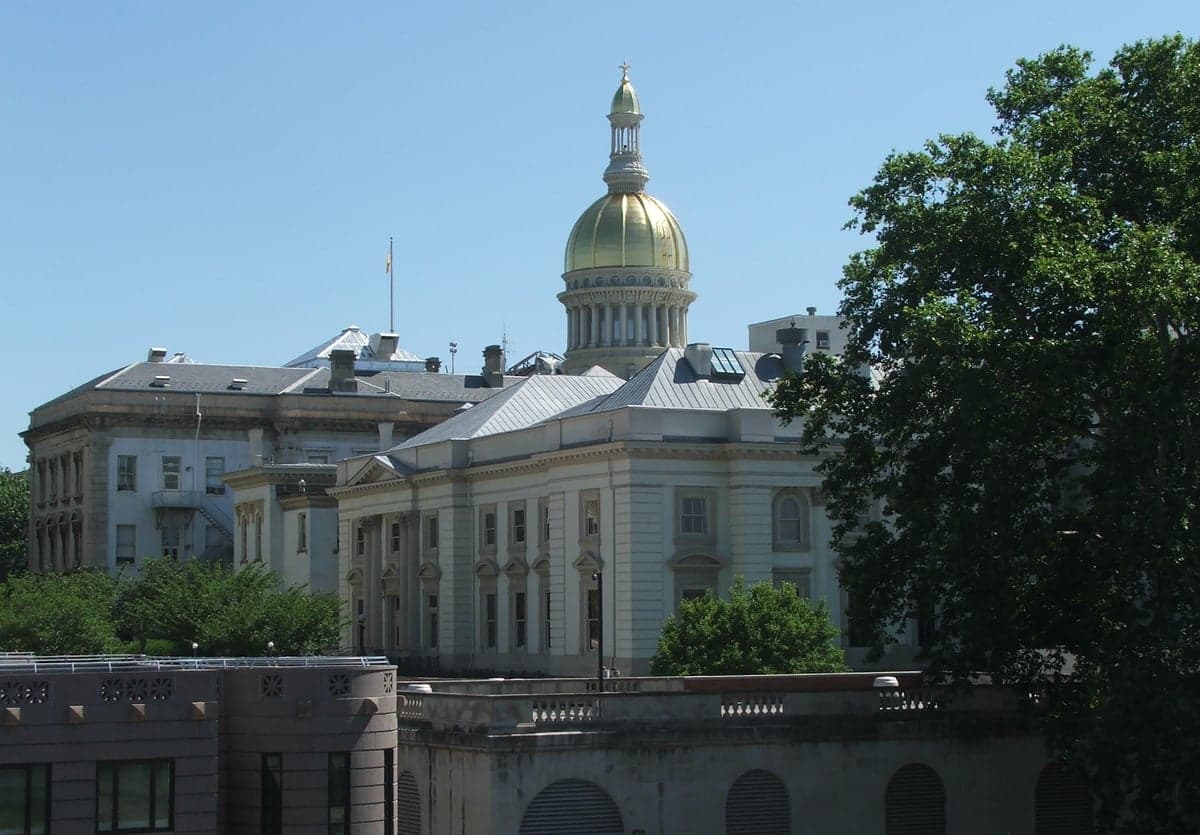
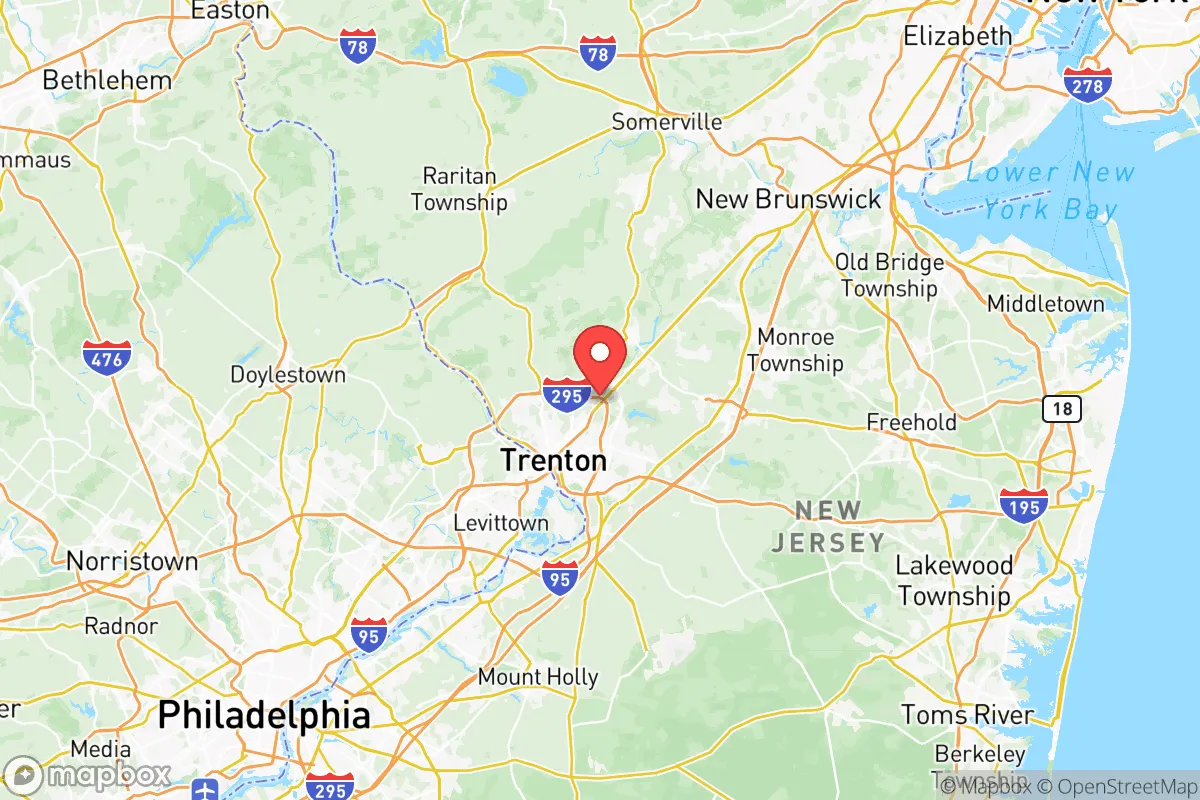
Photo: Wikipedia
Demographics of Mercer County
Affluence Level in Mercer County
A middle-class area roughly in line with national averages across income, home values, education, and employment.
People of Mercer County
Mercer County, New Jersey, is a densely populated, politically moderate-to-liberal county of 383,286 residents, characterized by its historic role as a state capital anchor (Trenton) and its modern identity as a corridor of professional, academic, and immigrant life between New York and Philadelphia. The population is notably diverse: 44.2% White, 22.2% Hispanic, 18.3% Black, 7.4% Indian (subcontinent), and 4.5% East/Southeast Asian, with 44.9% holding a college degree. Its distinctive identity is shaped by the stark contrast between Trenton’s historic working-class and minority-majority population and the affluent, highly educated suburbs like Princeton and West Windsor, creating a county of sharp economic and cultural divides.
Settlement & growth (pre-1960)
The original inhabitants of the area were the Lenape people, specifically the Unami and Munsee bands, who lived along the Delaware River and its tributaries. European settlement began in the late 17th century, with English Quakers and Dutch traders establishing farms and ferries. The founding of Trenton in 1719 by William Trent, a Philadelphia merchant, marked the first permanent European settlement. The area’s strategic location on the Delaware River and the later construction of the Delaware and Raritan Canal (1830s) and the Camden and Amboy Railroad (1830s) made it a transportation and industrial hub.
The 19th century saw waves of immigration that shaped the county’s character. Irish immigrants arrived in large numbers during the 1840s and 1850s, fleeing the Great Famine, and settled primarily in Trenton’s working-class neighborhoods, laboring on the canals, railroads, and in the city’s burgeoning pottery and ironworks industries. German immigrants followed in the 1850s and 1860s, establishing farms and businesses in the rural townships of Ewing and Lawrence, and contributing to Trenton’s industrial base. Italian immigrants arrived in force between 1880 and 1920, settling in Trenton’s Chambersburg neighborhood, which became a vibrant Italian enclave, and working in the city’s rubber, steel, and pottery factories. Eastern European Jews, primarily from Russia and Poland, also arrived during this period, settling in Trenton and later in Princeton, where they established a small but influential community.
The Great Migration of African Americans from the South to the North began in earnest during World War I and continued through the 1950s. Black families moved to Trenton for jobs in manufacturing and war industries, settling in the city’s West Ward and creating a distinct cultural and civic life. By 1960, Trenton was a majority-white city with a significant Black minority, but suburbanization was already underway. The post-World War II boom saw white families move to new developments in Hamilton Township, Lawrenceville, and Princeton, drawn by the GI Bill, highway construction (Route 1 and the New Jersey Turnpike), and the expansion of educational institutions like Princeton University and the Educational Testing Service (ETS).
Modern era (post-1965)
The 1965 Hart-Cellar Act fundamentally reshaped Mercer County’s demographics. The most dramatic change has been the growth of the Hispanic population, which now stands at 22.2%. This wave began in the 1970s and 1980s, driven by Puerto Rican migration (U.S. citizens) and later by immigrants from the Dominican Republic, Mexico, and Central America. The Hispanic community is concentrated in Trenton, particularly in the Chambersburg and North Trenton neighborhoods, where Spanish-language businesses, churches, and community organizations are prominent. A smaller but growing Hispanic presence exists in Hamilton Township and Ewing.
The Indian (subcontinent) population, now 7.4% of the county, is a post-1965 phenomenon. Highly educated professionals, many in technology, pharmaceuticals, and academia, began arriving in the 1980s and 1990s. They have concentrated heavily in West Windsor and Plainsboro, townships that now have some of the highest concentrations of Indian Americans in New Jersey. These communities are characterized by high median incomes, strong educational attainment, and a robust network of Hindu temples, Indian grocery stores, and cultural organizations. A smaller Indian community also exists in Princeton, tied to the university and research sectors.
East and Southeast Asian communities (4.5% of the population) — primarily Chinese, Korean, and Filipino — also grew after 1965, though more modestly. Chinese families, many affiliated with Princeton University and local research labs, settled in Princeton and West Windsor. Korean immigrants, often small business owners, established a presence in Hamilton Township and Lawrenceville. The Black population (18.3%) has shifted geographically: while Trenton remains a majority-Black city (about 50% of the city’s population), middle-class Black families have moved to suburbs like Hamilton Township, Ewing, and Lawrenceville, creating a more dispersed pattern. The White population (44.2%) has declined in Trenton but remains dominant in the northern suburbs, particularly Princeton, Hopewell Township, and Pennington, where it is often over 70%.
The future
Mercer County is likely to continue its trajectory of increasing diversity, but with a growing tribalization by geography. The Indian community in West Windsor and Plainsboro is expanding rapidly, with new housing developments and commercial corridors catering to this demographic. This area is becoming a distinct, highly educated, and affluent enclave that is culturally distinct from the older, more established White suburbs of Princeton and Hopewell. The Hispanic population in Trenton is also growing, driven by both immigration and higher birth rates, but the city’s economic struggles — high poverty, crime, and a shrinking tax base — may limit its ability to attract new residents. The Black population is plateauing, with out-migration from Trenton to the suburbs slowing as suburban housing costs rise.
The county is not homogenizing; instead, it is becoming more segmented. The northern suburbs (Princeton, Hopewell, Pennington) remain predominantly White and wealthy, with a growing but still small Asian presence. The central suburbs (West Windsor, Plainsboro) are becoming majority-Asian and Indian, with a distinct cultural identity. The southern and eastern suburbs (Hamilton, Ewing, Lawrence) are more mixed, with significant White, Black, and Hispanic populations. Trenton itself is becoming increasingly Hispanic and Black, with a shrinking White and Asian presence. The cultural identity of the county is thus a patchwork, with little cross-pollination between these enclaves.
For a new resident, Mercer County offers a choice of distinct communities. A family seeking a highly educated, diverse, and academically rigorous environment would find West Windsor or Princeton ideal. A single professional looking for urban energy and lower housing costs might consider Hamilton or Ewing, which offer more affordable options and proximity to both Trenton and Princeton. Those seeking a traditional, predominantly White, small-town feel would gravitate to Hopewell or Pennington. The county’s future is one of continued demographic sorting, where the decision of where to live is increasingly a decision about which cultural and economic world to inhabit.

* Values derived from national, state, county, city and local statistics and may differ in a specific area. Last updated: 2026-06-03T06:46:55.000Z
Narrative content on this page is AI-generated and may contain mistakes. Verify any details that matter before acting on them.
ReloMaps may earn a commission from affiliate links at no extra cost to you.

