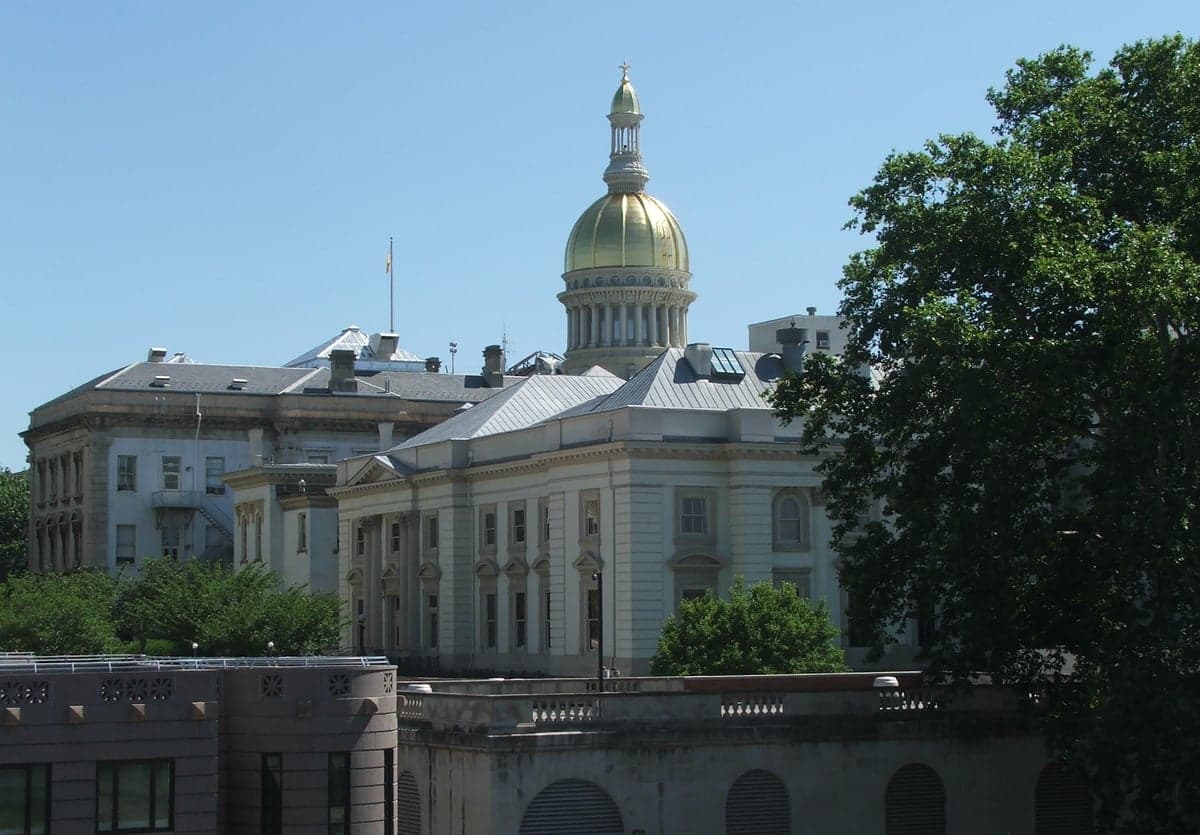
Photo: Wikipedia
Personal Sovereignty in Mercer County
Viable for self-reliance. Generally workable, though some barriers may limit total independence.
What does Personal Sovereignty tell us?
Personal Sovereignty measures your capacity for self-reliance and independence with minimal government friction. Higher scores mean fewer barriers between you and the way you want to live... but it assumes you have the space you need and good neighbors.
What does this tell us?
Personal Sovereignty measures your capacity for self-reliance and independence with minimal government friction. Higher scores mean fewer barriers between you and the way you want to live... but it assumes you have the space you need and good neighbors.
State Policy
Energy independence: Importer (8% of energy produced in-state)
Personal Liberty
Homesteading

Personal Liberty Analysis
Mercer County, New Jersey presents a challenging environment for those seeking personal sovereignty, as the state's dense regulatory framework and high tax burden significantly constrain individual autonomy. While towns like Hopewell Township and rural pockets of Robbinsville offer more breathing room with larger lots and agricultural zoning, the overall landscape is dominated by Trenton's government footprint and Princeton's progressive policy influence. For single individuals and parents prioritizing self-reliance, the county sits in a state that ranks among the worst nationally for fiscal freedom, gun rights, and property control.
Tax burden and regulatory posture in Mercer County's local jurisdictions
New Jersey's tax burden is the highest in the nation, and Mercer County is no exception. The effective property tax rate hovers around 2.3% of assessed home value — meaning a $400,000 property carries roughly $9,200 in annual taxes. Combined with a state income tax that caps at 10.75%, households in towns like Princeton and Lawrenceville face confiscatory rates that limit wealth accumulation. Regulatory posture varies locally: Hopewell Township and West Windsor maintain stricter land-use ordinances that delay building permits, while Robbinsville and Hamilton are slightly more development-friendly but still operate under Trenton's heavy state oversight. The State of New Jersey mandates costly environmental reviews, septic system rules, and building codes that make off-grid construction expensive. For a prepper-minded relocator, even securing a simple backyard shed or rainwater collection system requires navigating layers of municipal and state bureaucracy.
Self-defense and gun law specifics across Mercer County towns
New Jersey's gun laws are among the most restrictive in the country, and Mercer County enforcement reflects that reality. The state requires a Firearms Purchaser Identification Card for handgun and rifle purchases, a separate permit for each handgun transaction, and a background check that typically takes 30–90 days. "Justifiable need" for carry was eliminated in 2022, but the state still requires a permit-to-carry with a training course and psychological evaluation — and Trenton's police department has a reputation for slow processing. Towns such as Trenton and Ewing have higher crime rates, yet legal firearm ownership is heavily discouraged. Hopewell Township and rural areas of Pennington see more compliant gun culture, but even there, magazine capacity is limited to 10 rounds, and "assault weapons" bans cover many common rifles. No Mercer County town offers the sanctuary protections seen in parts of Pennsylvania or the South. Preppers should consider that self-defense options are legally constrained, and storing firearms across state lines in Pennsylvania (a 30-minute drive from Hopewell) may be a practical workaround for those living near the border.
Self-reliance and homesteading viability: lot sizes, zoning, off-grid feasibility
Homesteading potential in Mercer County is highly location-dependent. Hopewell Township offers the best prospects, with minimum lot sizes of 2–5 acres in agricultural zones and a few working farms that provide a model for self-sufficient living. Robbinsville's rural northern edge allows 1–3 acre lots, but zoning restricts accessory dwellings and animal husbandry. In contrast, the city of Trenton and dense suburbs like Hamilton and Lawrenceville impose minimum lot sizes of 0.25–0.5 acres, with strict prohibitions on chickens, goats, or bees. Off-grid feasibility is nearly impossible: New Jersey requires grid connection for any habitable structure, and net metering solar is the only renewable energy option allowed by most building codes. Rainwater collection is legal only for non-potable uses, and composting toilets face health department hurdles. For serious homesteaders, the best play is to buy land in Hopewell Township with an existing well and septic, but expect annual property taxes of $8,000–$12,000 even on raw land. A simpler alternative is to relocate 30 minutes west to rural Pennsylvania, where zoning is looser and taxes are a fraction of Mercer County's.
Personal liberties: parental rights, medical autonomy, speech, property rights
Parental rights in Mercer County are constrained by New Jersey's progressive education policies. The state mandates LGBTQ-inclusive curriculum materials without an opt-out, and some districts — particularly Princeton Public Schools and Lawrence Township — have adopted "equity" policies that prioritize DEI initiatives over parental notification. School boards in Robbinsville and Hopewell Valley are more conservative, but still bound by state mandates on vaccine requirements and student records. Medical autonomy is limited: New Jersey has strict vaccine laws for school attendance, and during the pandemic, Governor Murphy's executive orders gave local health departments broad authority to mandate masks and restrict gatherings. Property rights are undercut by rent control ordinances in Trenton and Princeton, and by a statewide "just cause" eviction law that makes it difficult to remove problem tenants. Free speech faces less restriction, though Princeton University's campus and some municipal spaces have hosted controversial speakers — local response is generally tolerant, but the cultural climate leans left, making open expression of survivalist or constitutionalist views uncomfortable in social settings. Overall, Mercer County offers little refuge for those seeking maximal personal liberty.
Compared to other areas of the Northeast, Mercer County sits near the bottom for personal sovereignty. Its advantages — proximity to Philadelphia and New York, diverse job markets, and a handful of rural townships — are outweighed by high taxes, heavy regulation, and a state government that actively curtails self-reliance. For the prepper-minded individual or family, the best sovereign move is to look across the Delaware River to Pennsylvania's Bucks or Hunterdon Counties, where lower taxes, looser gun laws, and friendlier zoning make self-reliance more attainable. Within Mercer County, only Hopewell Township and the rural edges of Robbinsville offer a glimmer of independence, and even there, the state's long arm reaches deep.

* Values derived from national, state, county, city and local statistics and may differ in a specific area. Last updated: 2026-06-03T06:46:55.000Z
Narrative content on this page is AI-generated and may contain mistakes. Verify any details that matter before acting on them.
ReloMaps may earn a commission from affiliate links at no extra cost to you.

