Demographics of Mckinley County
Affluence Level in Mckinley County
A low-income area with significant economic hardship. Household wealth and educational attainment are well below national averages.
People of Mckinley County
McKinley County, New Mexico, is home to 71,172 residents, making it one of the most predominantly Native American counties in the United States, with a population that is overwhelmingly Navajo and Zuni. The county’s character is defined by its deep Indigenous roots, a sparse rural settlement pattern, and a cultural identity centered on the Navajo Nation and the Zuni Pueblo, with only 8.0% of residents identifying as White and 12.2% as Hispanic. This is not a place of recent immigrant diversity—just 1.4% of the population is foreign-born—but rather a region where centuries-old Native communities remain the demographic and cultural majority, creating a distinct identity unlike any other in the Southwest.
Settlement & growth (pre-1960)
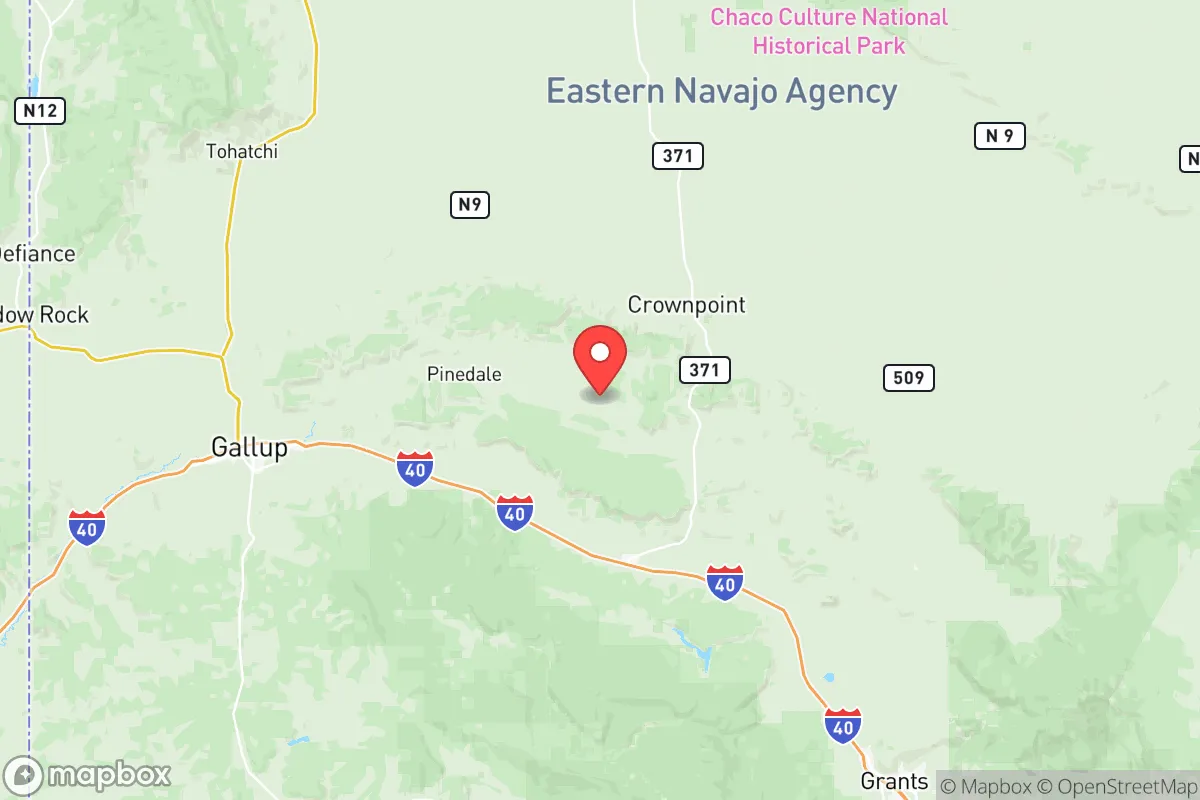
McKinley County’s human history begins long before European contact, with the Zuni people inhabiting the Zuni Pueblo for over a thousand years. The Zuni, one of the oldest continuously occupied settlements in North America, established villages like Zuni Pueblo and Hawikku, which were encountered by Spanish explorers in the 16th century. Spanish colonization, beginning with Francisco Vázquez de Coronado’s expedition in 1540, brought brief contact and conflict, but the Zuni and later the Navajo (Diné) maintained their lands and cultures through the Spanish and Mexican periods. The Navajo, who migrated into the region around the 15th century, established a vast territory across what is now McKinley County, with settlements at places like Crownpoint, Tohatchi, and Ramah.
The United States took control of the area after the Mexican-American War in 1848, and the 1860s brought the most traumatic event in the county’s history: the Long Walk of the Navajo. In 1864, U.S. forces under Kit Carson forced thousands of Navajo to march to Bosque Redondo in eastern New Mexico, devastating the population. After their return in 1868, the Navajo Reservation was established, encompassing much of modern McKinley County. The county itself was created in 1901, named after President William McKinley, and its early growth was tied to the railroad. The Atchison, Topeka and Santa Fe Railway reached Gallup in the 1880s, turning the town into a coal mining and rail hub. Gallup became the county seat and the primary population center, attracting Anglo and Hispanic workers to its mines and rail yards. Small farming and ranching communities like Thoreau, Vanderwagen, and Prewitt also grew, but the county remained overwhelmingly rural and Native, with the Navajo and Zuni populations forming the vast majority.
By 1960, McKinley County’s population was around 37,000, with Gallup as the only town of significant size. The coal industry and the railroad drove the economy, but the county’s demographic core was already set: a Native American majority, a small White and Hispanic minority, and virtually no foreign-born population. The post-World War II era saw some out-migration of Navajo to urban areas for work, but the reservation remained the cultural and physical home for most.
Modern era (post-1965)
The 1965 Hart-Cellar Act, which reshaped U.S. immigration, had almost no impact on McKinley County. The foreign-born population today is just 1.4%, and the county has not experienced the waves of Asian, Indian, or Latin American immigration seen in other parts of New Mexico. Instead, the modern era has been defined by the persistence and growth of the Native American population, which has increased through natural increase and a return of some Navajo from urban areas. The county’s White population has declined from around 15% in 1990 to just 8.0% today, as mining and railroad jobs have diminished and younger Anglos have left for larger cities. The Hispanic population, at 12.2%, is largely composed of long-established New Mexican families, not recent immigrants, and is concentrated in Gallup and along the I-40 corridor.
The most significant demographic shift since 1965 has been the strengthening of tribal governance and cultural identity. The Navajo Nation, which spans parts of Arizona, Utah, and New Mexico, has its capital in Window Rock, Arizona, just west of McKinley County, but the county contains key Navajo communities like Crownpoint, Tohatchi, and Ramah. The Zuni Pueblo, entirely within the county, has maintained its language and traditions while engaging in modern economic development, including tourism and arts. Gallup, the county’s only urban center, has become a hub for Native American art, jewelry, and the annual Inter-Tribal Indian Ceremonial, which draws visitors from across the region. The city’s population is roughly 40% Native, 30% Hispanic, and 25% White, reflecting the county’s broader demographics.
Suburbanization has been minimal in McKinley County. There are no sprawling subdivisions or exurbs; instead, the population remains dispersed across the reservation in small communities like Church Rock, Smith Lake, and Brimhall Nizhoni. The county’s college-educated share is just 12.5%, reflecting limited access to higher education and a rural economy that does not demand advanced degrees. The coal industry, once a major employer, has declined due to environmental regulations and the shift to natural gas, leading to economic stagnation and population loss in some areas.
The future
McKinley County’s population is projected to remain stable or decline slightly over the next 10-20 years, as the Native American birth rate remains above replacement but out-migration of young people to Albuquerque, Phoenix, and Denver continues. The county is not homogenizing or tribalizing into distinct enclaves—it is already overwhelmingly Native, and that identity is likely to persist. The Hispanic population may grow modestly through natural increase, but immigration from Mexico is negligible. The White population will likely continue to shrink as older residents age out and younger ones leave.
The cultural identity of McKinley County will remain deeply Navajo and Zuni, with English and Navajo as the dominant languages. Economic development efforts are focused on tourism (especially around Chaco Culture National Historical Park and the Zuni Pueblo), renewable energy (solar and wind projects on tribal lands), and small-scale entrepreneurship. The county will not attract significant in-migration from outside the region, and its character will remain distinct from the rest of New Mexico—less Hispanic, less Anglo, and more rooted in Indigenous traditions than anywhere else in the state.
For someone moving in now, McKinley County offers a unique experience: a place where Native American culture is not a minority interest but the mainstream. The pace of life is slow, the landscape is dramatic, and the community is tight-knit. However, economic opportunities are limited, and the county’s isolation and low educational attainment can be challenging for newcomers. This is a region that will remain what it has always been—a stronghold of Navajo and Zuni identity, shaped by history, geography, and a population that has endured and adapted for centuries.

* Values derived from national, state, county, city and local statistics and may differ in a specific area. Last updated: 2026-06-01T12:55:37.000Z
Narrative content on this page is AI-generated and may contain mistakes. Verify any details that matter before acting on them.
ReloMaps may earn a commission from affiliate links at no extra cost to you.

