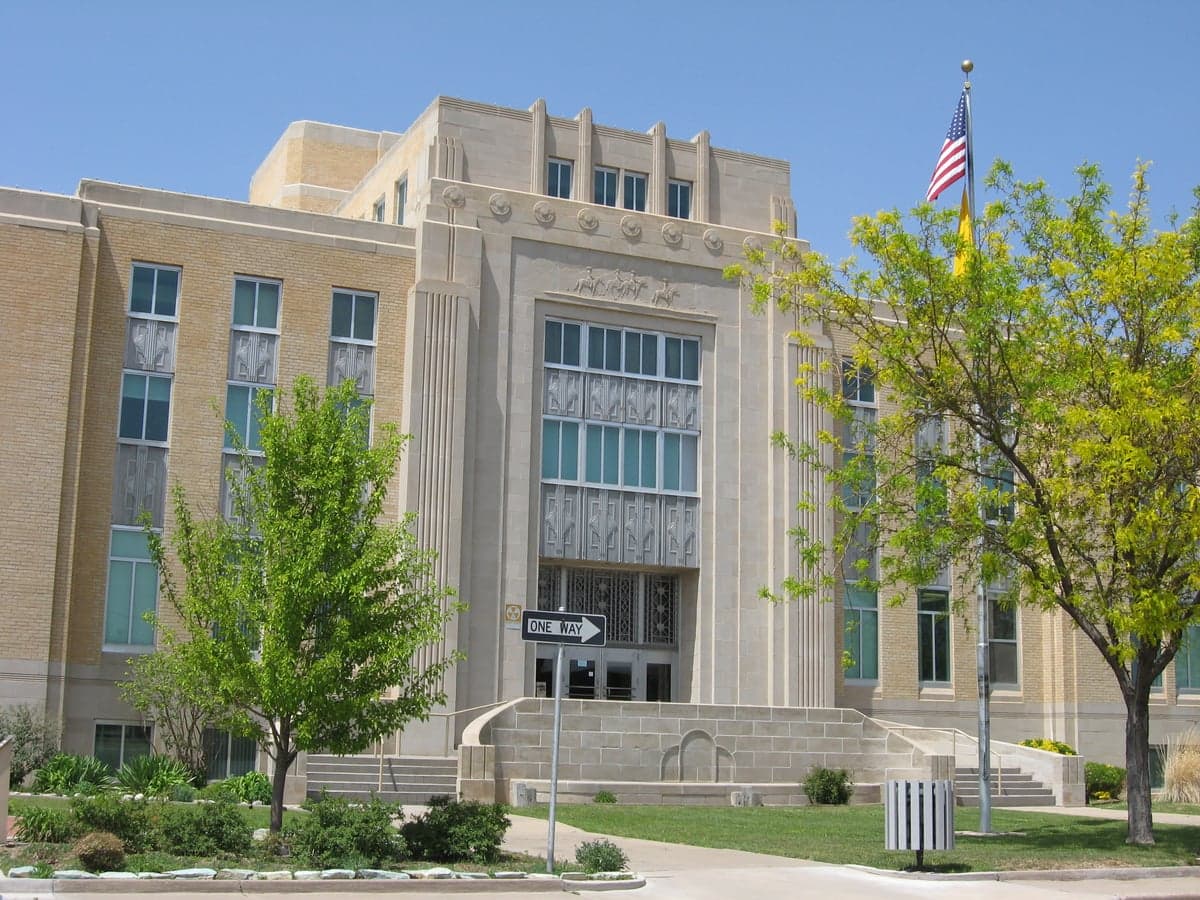
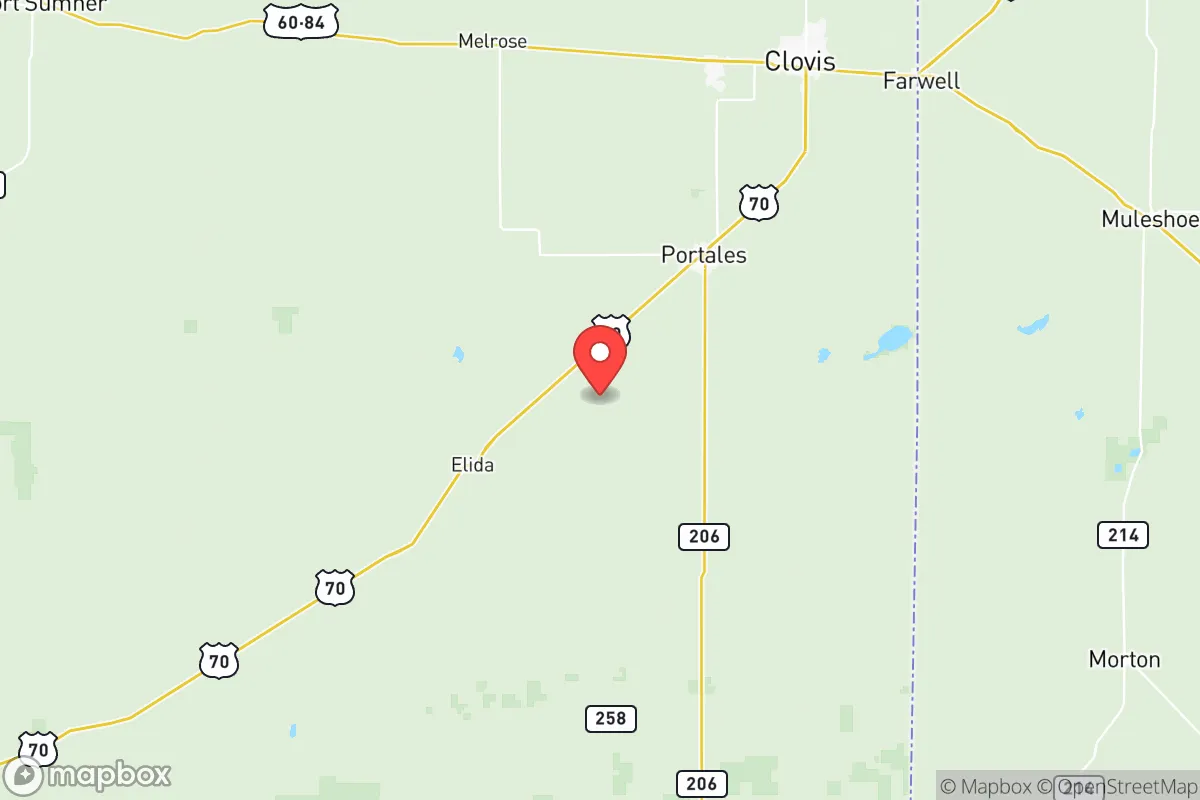
Photo: Wikipedia
Political ClimatePolitical Climate in Roosevelt County
Showing district-level results — no local-only data available.
Local Political AnalysisPolitical Analysis of Roosevelt County
Roosevelt County, New Mexico, has a Cook PVI of D+3, matching the state's overall partisan lean, but don't let that number fool you—this place feels a lot more conservative than the statewide average would suggest. The county's political heart beats in Portales, the largest town and home to Eastern New Mexico University, which creates a noticeable blue island in an otherwise red rural landscape. Outside of Portales, places like Elida, Floyd, and Dora vote overwhelmingly Republican, and the unincorporated areas are about as red as they come. The D+3 rating is really a reflection of Portales' student and faculty vote dragging the county left; if you strip out the university precincts, Roosevelt County would likely lean R+10 or more.
How it compares
On paper, Roosevelt County and New Mexico share the same D+3 PVI, but the reality on the ground is night and day. Statewide, the Democratic edge is driven by Albuquerque, Santa Fe, and Las Cruces—places where progressive policies on energy, land use, and education are the norm. In Roosevelt County, those same policies are met with deep skepticism. You'll hear folks in Portales grumble about state mandates on oil and gas regulations (even though the county isn't a major producer) and the steady creep of government overreach into local schools and property rights. The county commission is reliably conservative, and local elections often turn on issues like water rights, tax burdens, and opposition to state-level gun control measures. While New Mexico as a whole has trended left over the past decade, Roosevelt County has held the line, with voter turnout in rural precincts consistently favoring Republican candidates by 20-30 points.
What this means for residents
For someone living here, the political climate means you're constantly fighting against a state government that doesn't seem to understand rural life. The push for renewable energy mandates, for instance, feels like a direct attack on the agricultural economy that's kept this county alive for generations. You see it in the way state officials talk about water usage—trying to impose restrictions that would cripple farms in Floyd and Dora while leaving urban lawns untouched. The real concern is that as Santa Fe gets more progressive, the gap between state policy and local values widens. School curriculum battles are heating up, and there's a growing sense that personal freedoms—like how you use your land or what you teach your kids—are being chipped away. It's not alarmist to say that if this trend continues, Roosevelt County could become a flashpoint for resistance against state overreach.
Culturally, Roosevelt County is a place where people still wave at each other on the highway and the county fair is the biggest event of the year. That's a stark contrast to the urban centers driving New Mexico's politics. The policy distinction that hits home most is land use: here, property rights are sacred, and any talk of state-level zoning or environmental restrictions is met with a wall of opposition. If you're looking for a place where local control still means something and government stays out of your business, this is it—but you'll have to keep fighting to keep it that way.

State Political ClimatePolitical Climate in New Mexico
State Political AnalysisPolitical Environment in the State
New Mexico has been a reliably blue state for decades, with a Cook PVI of D+3, but don’t let that single number fool you—it’s a far more complicated picture than a simple partisan label. The state’s political engine is driven by a coalition of urban progressives in Albuquerque and Santa Fe, combined with a large Hispanic electorate that has historically leaned Democratic but is increasingly up for grabs. Over the last 10-20 years, the state has shifted leftward on social and cultural issues, but a strong, independent-minded rural and small-town conservative base remains, particularly in the eastern plains and the southwestern bootheel. If you’re a conservative looking at New Mexico, you need to understand that the state’s politics are a tug-of-war between a powerful, centralized Democratic machine and a resilient, if outnumbered, conservative resistance.
Urban vs. rural divide
The political map of New Mexico is a textbook case of urban-rural polarization. The entire state’s blue lean is generated by two metro areas: Albuquerque (Bernalillo County) and Santa Fe (Santa Fe County). Together, they cast roughly half the state’s votes and deliver margins of 15-25 points for Democrats. Santa Fe is the epicenter of progressive activism—think government unions, environmental groups, and a heavy arts-and-nonprofit sector. Albuquerque is more mixed, with a growing tech and film industry, but its core is solidly Democratic. The rest of the state is a different world. Las Cruces (Doña Ana County) is a swing area, often voting blue but with a strong conservative Hispanic and military presence from nearby White Sands. The eastern plains—Clovis, Portales, Hobbs, and Roswell—are deep red, driven by oil and gas, ranching, and agriculture. Farmington in the northwest is also reliably conservative, anchored by the Four Corners energy industry. The rural counties regularly vote 70-80% Republican, but their populations are too small to overcome the urban centers. A new resident moving to Hobbs or Clovis will find a very different political culture than someone settling in Santa Fe.
Policy environment
New Mexico’s policy environment is a mixed bag that leans progressive, but with some surprising brakes. On taxes, the state has a graduated income tax (top rate 5.9%) and a gross receipts tax that functions like a sales tax but applies to many services—it’s high, often over 8% in cities. Property taxes are relatively low, which is a plus for homeowners. The regulatory posture is generally business-friendly in the oil and gas sector (the state’s economic lifeblood), but burdensome in other areas. Education policy is a flashpoint: the state has a powerful teachers’ union, and recent years have seen a push for “culturally responsive” curricula and critical race theory-inspired frameworks in public schools. School choice is limited, with no robust voucher or charter school expansion. Healthcare is dominated by the state’s Medicaid expansion, and the government runs a large public health apparatus. Election laws are concerning for conservatives: New Mexico has no voter ID requirement, same-day registration, and automatic voter registration—a system that critics argue is vulnerable to fraud. The state also has a “sanctuary” law (the 2019 New Mexico Law Enforcement Protection Act) that limits local police cooperation with federal immigration authorities.
Trajectory & freedom
Over the last five years, New Mexico has become less free in several key areas, and the trend is accelerating. On gun rights, the state was once a relative haven, but the 2023 legislative session saw the passage of a “red flag” law (HB 129), allowing courts to temporarily confiscate firearms from individuals deemed a risk. A 2025 law also banned firearms from polling places and government buildings. On parental rights, the state has moved aggressively: in 2024, it passed a law (SB 253) that allows minors to receive reproductive and gender-related healthcare without parental consent, effectively overriding parental authority. Medical autonomy took a hit with the 2021 repeal of the state’s right-to-conscience law for healthcare providers, forcing some doctors to participate in procedures they object to. Property rights are under pressure from a 2023 law (HB 366) that expanded the state’s ability to seize land for “affordable housing” projects. Taxation is creeping upward: a 2024 tax package raised the top marginal rate and expanded the gross receipts tax base. The only bright spot for freedom advocates is the state’s continued resistance to federal land grabs—New Mexico has a strong “county supremacy” movement in rural areas, with several counties declaring themselves “Second Amendment sanctuaries” and “sanctuary counties” for property rights.
Civil unrest & political movements
New Mexico has a history of political flashpoints, though large-scale civil unrest is rare. The most visible recent movement is the “New Mexico Stands Up” coalition, a left-wing activist group that has organized protests for police reform, immigrant rights, and environmental justice, particularly in Albuquerque and Santa Fe. On the right, the “New Mexico Patriots” and local county-level “constitutional sheriff” movements have been active, especially in Otero and Eddy counties, pushing back against state mandates and federal overreach. Immigration politics are a constant undercurrent: the 2019 sanctuary law sparked a backlash, with several rural counties (including Lea and Roosevelt) passing resolutions declaring themselves “non-sanctuary” and vowing to cooperate with ICE. Election integrity is a hot-button issue: the 2020 and 2022 elections saw allegations of irregularities in Albuquerque’s absentee ballot processing, though no major fraud was proven. A new resident in Alamogordo or Carlsbad will hear constant talk about the state’s “blue wall” in Santa Fe, while someone in Santa Fe will likely encounter activist groups pushing for more progressive policies. The cultural divide is real and visible.
Projection
Looking ahead 5-10 years, New Mexico is likely to become more progressive, not less. The demographic trends favor the urban centers: Albuquerque and Santa Fe are growing slowly but steadily, while rural counties are losing population. In-migration is coming from out-of-state retirees and remote workers, many of whom lean left. The oil and gas industry, which has propped up the rural economy and funded the state budget, faces an uncertain future as the Biden administration and state regulators push for a green transition. If energy production declines, the rural conservative base will shrink further. The Democratic supermajority in the legislature is likely to hold or expand, meaning more red flag laws, more restrictions on parental rights, and higher taxes. However, there is a wildcard: the Hispanic electorate, which makes up nearly half the state, is not monolithic. Younger Hispanic voters in places like Las Cruces and Los Lunas are showing signs of shifting right on economic and cultural issues, particularly on energy and education. If the state GOP can rebuild a credible, locally-focused party, there is a path to competitiveness in a decade—but it’s a long shot.
For a conservative moving to New Mexico, the bottom line is this: you can find a community that matches your values, but you’ll be swimming against the political tide. If you settle in Hobbs, Clovis, or Farmington, you’ll live in a red enclave with like-minded neighbors and low property taxes. If you move to Albuquerque or Santa Fe, you’ll be in a blue city with progressive policies on guns, education, and parental rights. The state government in Santa Fe will continue to push policies that many conservatives see as overreach—red flag laws, parental consent overrides, and sanctuary policies. Your best bet is to choose your county carefully, get involved in local politics, and be prepared for a fight over the state’s direction. New Mexico is beautiful, but politically, it’s a battleground that’s slowly shifting away from the values that built it.
* Values derived from national, state, county, city and local statistics and may differ in a specific area. Last updated: 2026-05-28T02:24:19.000Z
Narrative content on this page is AI-generated and may contain mistakes. Verify any details that matter before acting on them.
ReloMaps may earn a commission from affiliate links at no extra cost to you.

