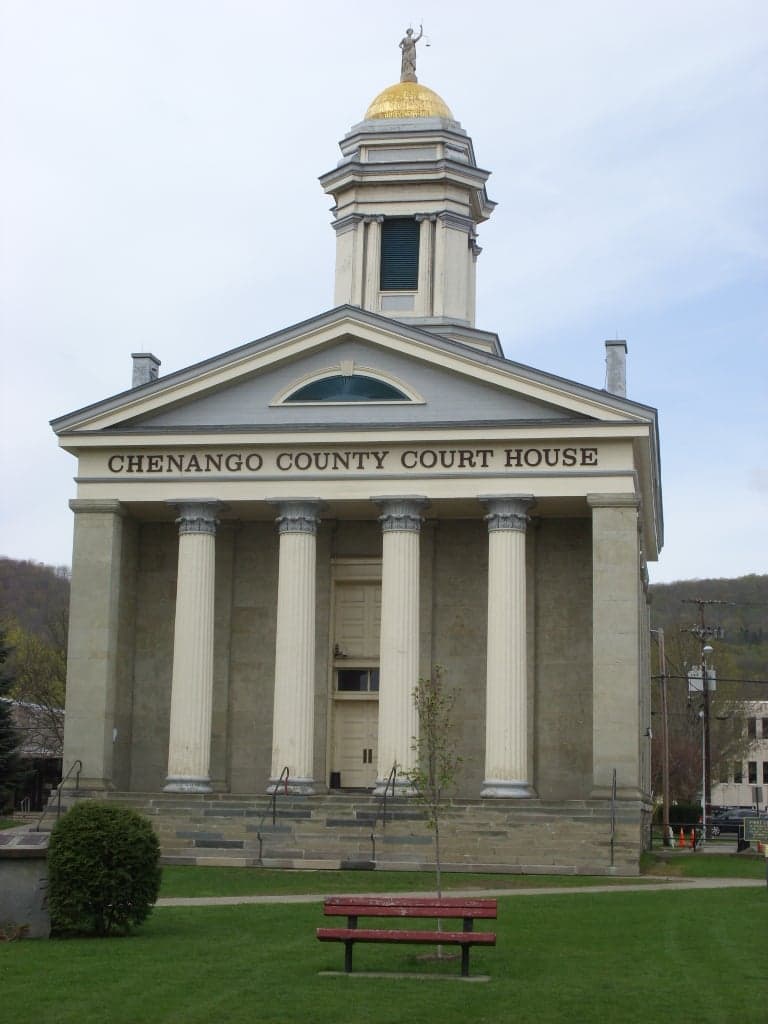
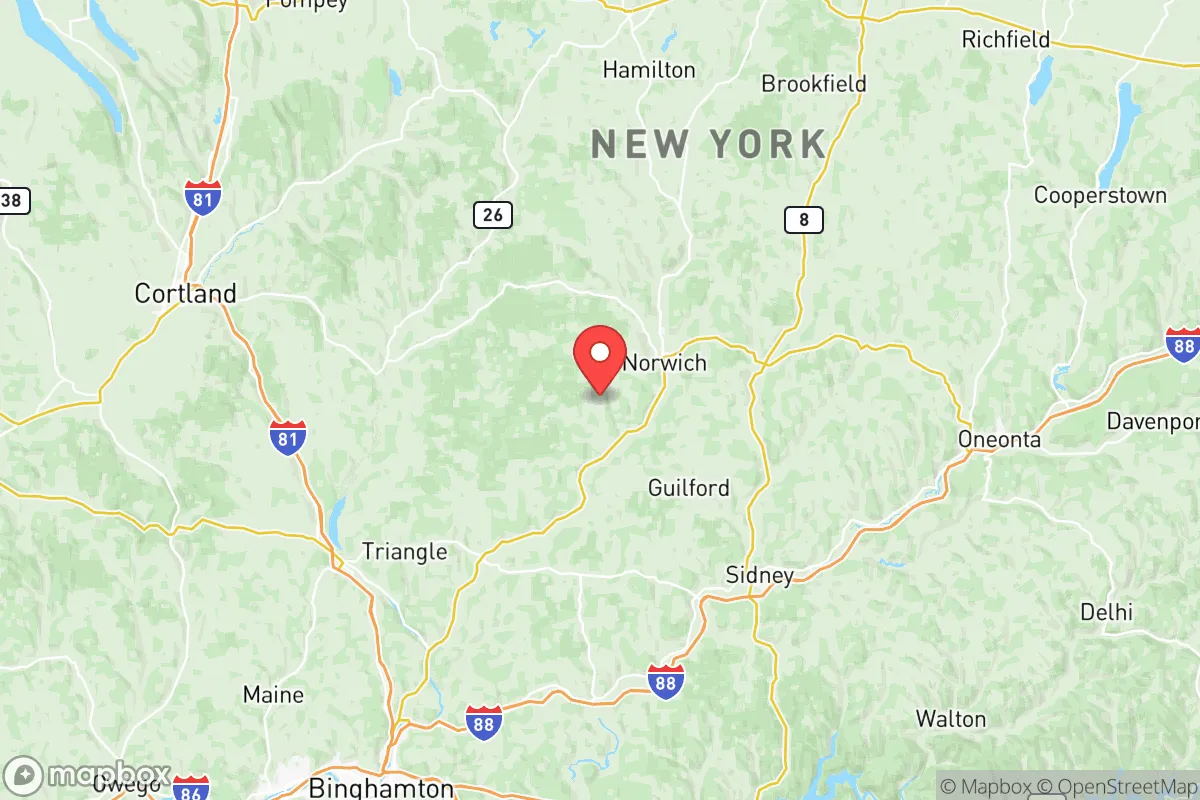
Photo: Wikipedia
Personal Sovereignty in Chenango County
Moderate friction. Expect trade-offs in some aspect of personal liberty and independence.
What does Personal Sovereignty tell us?
Personal Sovereignty measures your capacity for self-reliance and independence with minimal government friction. Higher scores mean fewer barriers between you and the way you want to live... but it assumes you have the space you need and good neighbors.
What does this tell us?
Personal Sovereignty measures your capacity for self-reliance and independence with minimal government friction. Higher scores mean fewer barriers between you and the way you want to live... but it assumes you have the space you need and good neighbors.
State Policy
Energy independence: Importer (12% of energy produced in-state)
Personal Liberty
Homesteading

Personal Liberty Analysis
Chenango County, New York, offers a notably high degree of personal sovereignty relative to much of the state, particularly the downstate metropolitan region. The county’s rural character, low population density, and limited local government footprint create an environment where residents enjoy significant autonomy in daily life, from property use to self-defense. While New York State imposes a substantial regulatory and tax framework, Chenango County’s local implementation is comparatively light-touch, making it a viable option for those prioritizing personal freedom within a blue-state context.
Tax burden and regulatory posture in Chenango County
New York State’s overall tax burden is among the highest in the nation, but Chenango County sits on the lower end of the state’s spectrum. The county’s property tax rate, while still above the national average, is roughly 20-30% lower than in neighboring Broome or Oneida counties, and significantly less than the Hudson Valley or Long Island. The median effective property tax rate hovers around 2.1% of home value, compared to the state average of 1.7% — but this is offset by much lower home prices. A $150,000 home in the county pays roughly $3,150 annually in property taxes, versus $8,000+ for a similarly valued home in Westchester. Sales tax in Chenango County is 8% (4% state, 4% county), which is standard for upstate. The regulatory posture is permissive by New York standards: there is no county-level zoning overlay in unincorporated areas, and towns like Norwich (the county seat) and Sherburne have minimal commercial zoning restrictions. Towns such as Oxford and Greene have adopted basic land-use ordinances but do not aggressively enforce them for small-scale activities like home businesses, livestock keeping, or accessory structures. The county’s building code enforcement is limited, with most permits required only for new construction or major renovations, not for routine repairs or outbuildings under 200 square feet. This creates a regulatory environment where residents can modify their property with relatively little bureaucratic friction.
Self-defense and gun law specifics in Chenango County
New York’s gun laws are among the strictest nationally, including a 2022 concealed carry reform requiring a “proper cause” showing for permits. However, Chenango County is a shall-issue jurisdiction in practice, with the county sheriff’s office processing permits efficiently. The county’s permit approval rate for pistol licenses exceeds 95%, with typical processing times of 3-6 months — faster than downstate counties where waits can exceed a year. The county does not impose additional local restrictions beyond state law, and open carry of long guns is common and uncontroversial in rural areas. Towns like Bainbridge and New Berlin have a strong hunting culture, and gun ownership is near-universal among rural households. The state’s 2013 SAFE Act, which bans certain semi-automatic rifles and limits magazine capacity to 10 rounds, is enforced but not aggressively policed in Chenango County; local law enforcement focuses on violent crime rather than technical compliance. For self-defense, the county’s low violent crime rate (roughly 1.2 incidents per 1,000 residents, versus the state average of 3.8) means that defensive firearm use is rare, but the legal framework for justified use of deadly force follows New York’s “duty to retreat” standard outside the home. Inside the home, the Castle Doctrine applies, and there is no legal requirement to retreat before using deadly force against an intruder. The county has no local gun-free zones beyond those mandated by state law (schools, government buildings), and private property owners may allow or prohibit firearms at their discretion.
Self-reliance and homesteading viability in Chenango County
Chenango County is one of the most homestead-friendly areas in New York State, with abundant land, permissive zoning, and a culture of self-reliance. Minimum lot sizes in unincorporated areas are typically 1-2 acres, but many parcels are available in 5- to 50-acre tracts, particularly in the towns of Plymouth and Pharsalia. There is no county-wide zoning for agricultural use, meaning residents can keep chickens, goats, pigs, or cattle on any parcel without a special permit, provided they meet basic setback requirements. Off-grid living is feasible but requires navigating state building codes for primary residences: composting toilets and solar power are allowed, but a septic system must meet county health department standards. Many residents in South New Berlin and Earlville use wood stoves as primary heat sources, and rainwater collection is legal for non-potable uses. The county’s soil quality is generally good for small-scale farming, with the Chenango River valley offering fertile loam. The growing season is short (roughly 140 frost-free days), but cold-hardy crops like potatoes, kale, and apples thrive. For those seeking maximum autonomy, the town of Sherburne has a strong tradition of Amish and Mennonite settlement, providing a community that values self-sufficiency and minimal government interference. The county’s low population density (roughly 50,000 residents across 899 square miles) means that neighbors are typically far apart, reducing conflicts over noise, odors, or land use. Internet access is limited in many rural areas, with satellite or fixed wireless being the primary options, which can be a barrier for remote work but also reinforces a lifestyle disconnected from urban infrastructure.
Personal liberties in Chenango County: parental rights, medical autonomy, and property
Parental rights in Chenango County are broadly respected, with local school districts like Norwich City School District and Sherburne-Earlville Central School District generally deferring to parents on educational and medical decisions. Homeschooling is common, with an estimated 5-7% of school-age children being homeschooled — well above the state average of 2%. The county’s school boards have not adopted controversial curriculum mandates, and parental opt-out rights for sex education and library materials are routinely honored. Medical autonomy is constrained by New York State’s vaccine mandates for school attendance and healthcare workers, but Chenango County has a higher rate of religious and philosophical exemptions than downstate counties. The county’s healthcare infrastructure is limited, with UHS Chenango Memorial Hospital in Norwich as the primary facility, meaning residents often travel to Binghamton or Syracuse for specialized care. This reinforces a culture of self-care and alternative medicine, with several naturopathic and chiropractic practices operating in the area. Property rights are strong: there is no county-wide rent control, no short-term rental bans (though some towns like Greene have considered them), and no local ordinances restricting the display of political signs or flags. The county’s sheriff is elected and generally takes a hands-off approach to private disputes, encouraging mediation over enforcement. Free speech is protected under the First Amendment, and there are no local hate speech or public assembly restrictions beyond state law. The county’s political culture is predominantly conservative, with a 60-40 Republican lean in local elections, which shapes a permissive environment for personal expression and lifestyle choices that align with traditional values.
Overall, Chenango County offers a level of personal sovereignty that is rare in New York State, comparable to rural counties in the Midwest or Mountain West in terms of regulatory freedom and self-reliance culture. While residents cannot escape state-level mandates on taxes, gun laws, or healthcare, the county’s local governance is minimal and deferential to individual choice. For those willing to accept a slower pace, limited services, and a cold climate, Chenango County provides a genuine alternative to the high-regulation, high-cost environments of downstate New York, making it a strong candidate for relocation by families and individuals who prioritize autonomy over convenience.

* Values derived from national, state, county, city and local statistics and may differ in a specific area. Last updated: 2026-10-05T03:00:48.000Z
Narrative content on this page is AI-generated and may contain mistakes. Verify any details that matter before acting on them.
ReloMaps may earn a commission from affiliate links at no extra cost to you.

